3.3 is one of the many malls of Sanlitun, the formerly gritty and atmospheric, now increasingly malled-in section of Beijing. Despite the typically offensive structure in which it is housed, this mall offers a unique charm, since it is devoid of chain stores. The first floor features old-school Chinese gaudiness with the usual lace and glitter, but on the third floor is one of China’s few designer resale shops, specializing in apparel and accessories formerly used by celebrities. In the basement are some very cute craftsy places.
The forth floor is a twisted paradise of designer and trendy rags for men and the leading emporium of Chinese Paul Smith. Several stores specialize in shirts, bags, and ties in patterns and fabrics inspired by and using the label of the quirky British knight. The Paul Smith “replicas” are an excellent example of how Chinese counterfeiters go well beyond mere copying to actually imbibe the style of the original brand in their own new creations. Some of the Paul Smith “replicas” are of tolerable quality, though clearly not up to the original. As many Beijing fashionistas must be aware, “100% cotton” here tends to exhibit many of the, sweat-inducing, qualities of poly-blend fabrics after a few wearings, even if it does seem like cotton while on the rack. The fabric used for the Paul Smith dress shirts is, however, superior to that of the custom-made “100% cotton” shirts in Ya Xiu and Xiu Shui. Stay away from the fake Paul Smith shoes though, as the soles could bring orthopedic problems. More on fake Paul Smith later.
One of the more interesting shops catering to the designer clothing-addict without a trust fund is right and up from the escalator and offers Dior Homme, Yohji Yamamoto, Raf Simons, and other more cult (read: adored in Shibuya and appropriate for the Japanese physique) designer labels. Photographed here are the two shopkeepers. These replicas are produced in a Guangdong factory run by a Japanese man. Intended for export to Japan, some key samples nonetheless have surfaced in 3.3.
He goes by the name “Kele” – Chinese for coke (the drink) and hails from the great Northeast. Of course for Dsquared, you don’t need to go to 3.3, as it is more plentiful in Beijing than the Gap in suburbia.
He was in a hurry and didn’t have much time to chat. This was right by the Xiehe Hospital on Dongdan. I think this fellow looks great though – picky but relaxed – studied disheveledness but not in a preppy way. Tie with sneakers rarely works. (0) Comments | Post Comment
Stylites in Beijing will soon be moving to a permanent address: stylites.net. Before this move occurs, updates may be less frequent, so I ask you to bear with me. We have to try to make our new home stylish before moving in. It might be a sort of bohemian shack at first though.
Anyway, I will send notification when the next site is up and running.
Riding my bike out of the Candy Floss Cafe – one of Beijing’s best spots for sunny Sunday afternoon, I encountered this apparition. Judging by her gear, she is a much more serious photographer than I pretend to be. I adore women with colorful scarves. She was on her way to some kind of performance, apparently in the company of her mother.
A fellow who lives on the tenth floor of my building. We met him in the elevator. I don’t know how he managed to evade me for the last thirteen months. Perhaps the only interesting looking individual in the entire several-thousand-man-strong residential complex.
If you don’t live in China, you might not find this fellow exceptional.
But most of his contemporaries are extreme of dowdiness. They are pudgy little goons wearing brown polyester polo shirts with the playboy logo and sporting a comb-over and a pleather manbag. Styles like this just aren’t common in his generation.
Here we have John Travolta’s Grease hair-do with a late ’80s “our country just opened to the West” Chinese swoosh. He bought this pair of flared jeans sixteen years ago and has been wearing them since. I told him I thought he must be an artistic type, and he responded that he was just a normal working man. (0) Comments | Post Comment
Rating Yang Fan as an artist is beyond my ability, but her paintings admirably depict the young Chinese girl dominated by materialism and faintly understood Westernized values.
These are beautiful girls whose ideals for fashion, physique, and sexual expression changed drastically in the space of a few years.
Life was service to family. It suddenly became the pursuit of pleasure.
These girls are much more stylish and attractive than the typical specimen you see just off the train at Beijing’s Central Station (right next to my work).
A young shop assistant at the Muxiyuan Fabric market.
A young hipster on Chaonei Avenue. He described himself as a freelancer, but his two, less stylish, friends said that he doesn’t have a job. His main inspiration is Japanese youth fashion and he buys rags at Xidan.
I may not go. How could it possibly be as charming as the old Vic’s?
Really. Ignore the packaging for a moment. A place isn’t made so much by the decor and music as by the wit and beauty of its clientale. It was a place with men of style and women of substance.
It’s amusing to recall the image in my mind when I first heard of Vic’s.
My New York friend, who had never actually been himself, suggested I go since he had heard it was THE place for expats in Beijing.
I imagined a Bogartesque owner, named Vic, nursing a scotch or maybe even a mint julep while his gaze lingered on a lovely Danish photographer just back from the Onon river in Mongolia. There would be a North Korean propoganda movie director, really a spy, aiming to befriend gullible but lovable Midwesterners in derby hats. A Japanese diplomat, somehow blending stiffness with affability, would be stroking his Siamese cat as he spoke perfect French with an aspiring actress just off the plane from Paris, trying to hide that she was from a village outside Toulouse and not the capital. The wife of an unnamed but utterly powerful CCP official would be present, but no one would be sure which of the elegant ladies was her.
The movie is not incredible, but the bar Ralph Fiennes opens in the White Countess would be nice in reality. I thought Vics would be a bit like that bar, with all of its intrigues and glamour.
Instead I got six high school students doing shots, two Chinese girls snorting coke for the first time in the bathroom, and some skinny Long Islanders hanging out upstairs, humping all the new arrivals.
Comments
Funny~ I think I have been to Vics twice. I gotta say I prefer the place across the street. Posted by Pescatore on 05/18/2007 02:06:28 AM
Pesci, you came to Beijing without contacting me? Posted by stylites on 05/18/2007 02:51:50 AM
This man could be anywhere in China. They are the dark dandies of urban streets. The hair cutters. The men who dare prance. Long, slim, shoes are essential.
This is at Chaonei South Street. To see really over-the-top hair cutters, you should head to Hangzhou.
Despite the thousands of people switching trains at Fuxingmen, I still spotted this guy, beyond the wall.
He’s a petite bourgeois who owns a clothing store.
Quite an appropriate image for Tom Meaney’s birthday – no? They would totally be friends.
We can do blazers in this cut, too, but the quality of the fabric and buttons would be far superior. I’ll even perform a complimentary lip piercing for you.
All of a sudden, as I was walking out of the Willy Ronis photography exhibit at Beijing Capital Museum, everyone seemed to wearing suspenders. The thin suspenders with a tee shirt and skinny pants look was revived on the Dior Homme runway for the spring 2006 collection, but it has long been an emblem of various British rocker subcultures. The “skinheads” of Beijing adore prancing about in this style.
This fellow leads a band that frequently performs at the Nameless Highland. His shirt actually says “skinhead”, as do the tee-shirts of most Beijing skinheads.
This is the first woman I have seen in China wearing suspenders – and they are these very slim plaid ones. I noted that the dude that walked out of the exhibit right before her was also wearing suspenders, and she made clear that she had absolutely no connection with him and was following her own style muse. It was just a coincidence that there were two suspendered people walking out of the Willy Ronis exhibit at the same time. She is studying journalism and shops at Xidan mainly. She wanted my number.
Here shoes were in some ways more notable than her suspenders.
Below Hedi Slimane shows us that the thin suspenders look is best executed with a sleeveless shirt.
And white socks on display.
The two-tone shoes are also essential.
And a subtle cat reference in your trousers is never a minus. I tried to find a photo with a man wearing suspenders, but couldn’t, so here is the classic if you don’t recall Willy Ronis:
China’s retail sales hit 320 billion yuan (42 billion U.S. dollars) during the May Day holidays, up 15.5 percent from the same period last year, according to the Ministry of Commerce.
The ministry said liquid crystal TV sets, jewelry, digital cameras, and fashion clothes were among the bestsellers.
The whole problem is that they don’t consume enough and the economy depends on exports, meaning US consumption. Put simply, China runs into trouble when the US economy dips, as it could be doing now. In the United States, the contribution of domestic consumption to growth is over three times the contribution of exports. International trade matters more to China than it does to the US.
When the contribution of domestic consumption to GDP in China is doubled or tripled that of exports, many key parts of China will be under water. When all Chinese consume at an American level, there will be much less oxygen and dry land on the planet. But humans always evolve. To leapfrog ahead in their conceptual thinking, young Chinese fashion designers need to showcase mandarin collar tees with slits in the side for gills. What will be the fashion in our “submerged future with Chinese characteristics”?
Comments
grammar mistakes notwithstanding, the last paragraph is the best thing I have read all day Posted by pescatore on 05/09/2007 06:38:32 AM
Uh…those are all for effect. Thanks. Posted by stylites on 05/09/2007 07:58:49 AM
The future is Waterworld with Chinese characteristics? A cheesey place, no doubt. Posted by stylites on 05/09/2007 08:00:29 AM
Excellent blog article. Is the man or woman on the street concerned about becoming a throwaway society? Or is China still far from discarding last year’s fashions? Are they thinking of building and renting “storage units” so people can box and store years of unused but accumulated shoes, clothes and cheap furniture? Or can they still ship such unwanted items to the Chinese countryside or sell and give away to Africa? The problem of overconsumption has incrimental ramifications. Not all are in the government domain. Posted by khavurta on 05/11/2007 03:30:05 AM
Obviously the wealthy and those aspiring to seem wealthy have a great antipathy toward used items. I would assume that there is a reluctant market for them in the countryside and among the urban poor. Solutions to the problems caused by overconsumption can always be transferred into the government domain in the form of taxes. However, society seems to reject environmental/consumption taxes and government doesn’t want them because they curb growth (leading to unempolyment and instability). Our vicious cyclic addiction to growth cannot stop, meanwhile the cost of environmental degradation is never allowed to figure in. It’s more than just the environment – the cost of all things long term are irrelevant in the growth equation. But there is no point in being an irrational activist. There are reasons growth can’t stop. Well, in this way Europe seems to have a more durable model. It’s too bad demographics will forestall the development of a European century. Posted by stylites on 05/11/2007 08:53:31 AM
These leggings are a hot thing. Widening horizontal stripes are good for slim Chinese people and they are everywhere now. If you want a sailor or prison style shirt, come to China. They were out shopping with their two boyfriends, both owners of clothing shops nearby.
The Air Jordan 1 XQ China Edition will be available exclusively on the Chinese main June 1. Styling highlights include dragon inspired patterns, laser designs, and use of silk material.
A large demographic will rush to welcome this riveting new style with collectors hoarding the limited supplies of the original. To beat the lines, try fine boutiques in Xidan or 3.3 offering “replicas” in advance of the June 1 release date.
This fellow was looking tough in Nanzhugan Hutong: He buys his rags at Xidan. His shoes are also from Xidan, and are made, he reports, by the brand Adidas.
It’s always reassuring to slip into a pair of size 32s when your waist measures 36. However, the Chinese government will not allow the common practice of brands understating the measurements of the waists on trousers:
They have no outlets in the US, perhaps because their style of clothing is not quite as “Euro-chic” as Zara, etc. They would run into direct competition with GAP. GAP is the world’s forth major fashion retail chain, and they still do not have plans to enter the China market. Maybe their clothes are too baggy for Chinese people, and it’s not worth producing a whole new line for this market.
In fact, it is interesting that all sources note that GAP has no presence in China, because up until two years ago there was a GAP as well as a Banana Republic (subsidiary of GAP) at the former Xidan Times Square, now called Maison Mode (and home to Gucci and other royalty). These two shops must have been operated through an agency. Maybe they were unsuccessful and that is why GAP is hesitant to enter this market.
To be frank, the style of C&A is a bit lame. That is not to say that it won’t catch on here, but I get the feeling that Chinese people really study the runway and hope to emulate its looks, hence the success of Zara. C&A may be competing with the likes of Baleno, JeansWest, Giordano and Metersbonwe – all distinguished local chains with a startlingly dull take on casual fashion.
Comments
“distinguished local chains with a startlingly dull take on casual fashion” Most if not all are HK chains IIRC? Posted by Pescatore on 04/25/2007 02:34:04 AM
“distinguished local chains with a startlingly dull take on casual fashion” Most if not all are HK chains IIRC? Posted by Pescatore on 04/25/2007 02:35:40 AM
Yeah, you’re actually right. But they still seem “local” in their sensibilities – maybe “local” meaning global boring-casual. Posted by stylites on 04/26/2007 06:54:07 AM
This guy is working with limited resources, on several fronts (money, exposure to global fashion trends, transport beyond feet and tricycle, etc.).
However, there is something about the eagerness to pose, and the swagger of this young fellow that made him Irresistible. I wish every stylish person was walking in front of this blue barrier, since it is a nice backdrop. This is just the type of person I would like to find more often. If you live here in China, his spirit and style might be old news, but I believe that this sort of attempt should be documented.
He was in front of a construction site in the hutongs south of Pingan Dajie. I would recommend a walk through that area as soon as possible.
I wonder if he would be interested in making a suit.
Guess is opening its first store on the mainland tonight:
“Tonight, a grand inauguration party will be held at the Infiniti Mall on Huaihai Road M., where Guess opens its Shanghai flagship store, celebrating the American denim pioneer’s official landing on the vast Chinese market – that’s why Marciano is on his second trip to the city.
The company plans to open about 30 stores in China by the end of this year, 13 in Shanghai, 11 in Beijing, three in Hong Kong and a few more in Macau. The number is expected to expand to 55 by the end of 2008.”
The new Guess girl (Anna Nicole Smith launched her career by being a Guess girl) is going to be Chinese.
The article doesn’t mention that fake Guess products are already widely available on the mainland, but they are right to be sanguine about success here. The Guess look seems well-adapted to local style sensibilities. Guess’ cheaply baroque sexiness will have many takers. It will also help if they made sure to pick a Guess girl with big double-fold eyes.
“Guess” gets 16810 hits on taobao. I’m not certain that all of these are attempting to be the Guess that we know and love from the States, but the samples I have looked at seem to be.
Alright then, maybe 1 store in Plaza 66, one store in Huaihai, 1 store in Xintiandi, 1 store in Xujiahui… ok that i could see… but 13-stores-is-a-fricken-lot when you are dealing with a market that is full of fakes and has minimal consumer differentiation is it not? Maybe I missed something? Why do I think this decision was made with the help of large amounts of yay and bubbly? Posted by namrehsif on 04/20/2007 04:15:52 AM
Yeah, I hadn’t really reflected on that. And this is supposed to be by the end of this year. Hahaha. So guess would be the major foreign apparel chain in China after that. Hmmmm. Of all of the major US chains, it actually seems closest in style to the glitzy dross that most Chinese women already wear, so why would they pay extra for a somewhat mediocre brandname? Posted by stylites on 04/20/2007 04:28:42 AM
April 19 2007 (07:30:00) US/Pacific ( 3 views )
Last week, François Pinault, one of France’s richest men and the head of PPR, the world’s second largest luxury conglomerate after LVMH, denounced what he called France’s “Social Marxist culture.”
It’s not suprising that he or other CEOs would say this, as they relocate their production lines to China. I believe the French are the only electorate that understands what globalization means for citizens of the developed world.
Comments
It’s dated 1 January ’04? I am surprised those boots didnt make a bigger splash in the Paris of the East, which has a fairly solid track record of being obsessed with all things LV…maybe the colour being different threw things out of whack… Posted by namrehsif on 04/19/2007 10:49:48 AM
That is just one piece in the enigmatic puzzle that is the taste of Chinese consumers.
Comments
Interesting article. My first thought is that, in most cases, ‘China inspired fashion’ doesn’t sell in China. In the PRC, one tends to occasionally see ‘old chinese style’ ma gua and qipao stuff, and then there is also the communist-era clothing. The first style tends to make everyone look as though they are either someone going to a wedding, an idiot foreigner going out for a friday night on a dive bar street, or possibly, in the case of a qipao, a restaurant hostess, and I think that right now (speaking with regard to Shanghai), no self respecting person would wear such things on the high street in the light of day. The second type of ‘Chinese’ clothing one also tends to see are the post-revolution big bulky jackets, workmen’s hats and cloth shoes. Once again, no young trendy person (in Shanghai) would wear such things, as they are generally the garb of those 60 and older and physical laborers. Something along the same vein that I have seen as being popular with a certain type of college student is the ‘Wei Renmin Fuwu’ messenger bag/’Comrade Lei Feng’ T-shirt, but again most self respecting people will not wear such things. In closing I would say that Shanghai Tang is probably taking the right tack by using subtle rather than over the top Chinese inspiration for their clothes…good luck to them in making it work in the mainland. Posted by namrehsif on 04/19/2007 02:53:48 AM
one addendum to the above: PLA green overcoats are awesome Posted by namrehsif on 04/19/2007 02:57:01 AM
I would love to open a larger discussion of how Chinese fashion influences (and enters) mainstream global fashion. There are so many ways. What the commenter above says about the need to be subtle is on target. I would add to that by saying that the concept is important rather than the details. Collections that capture the essence of “Chineseness” are more successful than those that blatantly pick up Chinese elements like the collar or the tired old pop references to communism. Those collections that use poems, philosophical tracts, and paintings as inspiration for the ethos they are creating tend to be more aesthetically pleasing. Posted by stylites on 04/19/2007 05:33:47 AM
No angst, no evil, no frustration – these are not rebellious youths trying to shed darkness on their society. These were typical upbeat Qinghua girls eager to show off their English skills and their unique take on fashion.
Here it is sitting by a haw, fruit-roll-up. You probably know about Vin de Pays. This particular bottle cost 79 Euro cents. According to Yuanyuan it tasted like its price, but I thought it was fine. Her senses of sight, taste, and smell are all more refined than mine though.
My sense of inebriation was alright. Which is classier the wine or my way of drinking it?
The obligatory crash into college girls out for a Sunday boat ride followed…But it wasn’t captured on film.
The walk around Beihai was nice.
This was a random girl walking through Beihai. She apparently comes through the park every Sunday to burn incense by an unmarked patch of grass where her great-great-grandmother is said to be buried. This woman was the court quicksand maker during the reign of Emperor Xianfeng.
And I left Beihai, not having offended the spirits of the court eunuchs in any truly unforgivable ways.
China’s global luxury brand workshop By Olivia Chung
HONG KONG – Don’t be surprised if you find the Prada, Armani or Burberry products you are wearing are made in China. Goods “Made in China” are no longer limited to cheap, low-end products. More and more brand-name luxury consumer goods are made in this “world’s workshop”, largely because of growing domestic demand as more and more Chinese can afford them.
According to a report by the World Luxury Association, more and more brand-name luxury goods are shifting their production to China. It expects that 60% of the world’s luxury brands will have
their products made in the country by 2009.
“This will be largely driven by the booming demand for luxury products by consumers in the Asia-Pacific region, particularly in China,” Ouyang Kun, representative of the association in China, was quoted as saying in China Daily.
He said the demand for such products in China was increasing by 15% annually. At present, the demand for luxury goods in China has already surpassed the manufacturing capacity of European makers by about 60%; therefore, they have had to shift their production to China, where labor and other costs are relatively low. In addition, this saves them the cost of shipping.
Sales in China’s luxury market hit US$2 billion in 2004, making it the world’s third-largest consumer of luxury goods, after Japan and the United States, according to a report by Ernst & Young. The report predicts that the market will grow by 20% each year until 2008 and then 10% annually to 2015, when sales are expected to exceed $11.5 billion.
Au Kin-fan, associate director of the Hong Kong Polytechnic University’s Institute of Textiles and Clothing, said seeing their competitors, one after another, shifting production to China’s low-cost environment to maximize profit forced other luxurious-goods makers to follow suit.
“However, foreign manufacturers usually shift part of their production line to China to cater for the growing demand there and keep their production bases in their home countries or other places to meet the global demand,” he said.
Foreign luxury-goods manufacturers started to shift part of their production line to China in 2004, and products made in China with foreign labels have flooded the Chinese market since 2005, said Ouyang: “Some luxury brands claim all of their products are made at home, but 60% of them are actually made in China.”
So far a number of fashion brands have gone public about shifting their production to China or have announced plans to do so. They include Pierre Cardin, Burberry, Armani, Prada and Furla.
The Chinese media have reported that French fashion brand Louis Vuitton plans to set up a production base in Zhejiang province this year. However, Janie Zhuang, public relations executive at Louis Vuitton China, said the firm does not produce any products in China at this time, nor does it have any plan to do so in the near future.
Au said one of the reasons for the international fashion brands keeping a low profile when shifting their production to China is the negative image of goods “Made in China”, which are often regarded as low-cost, low-quality products.
To avoid the possible negative impact on the brand value of their products, foreign manufacturers proceed with caution even if they shift only part of their production to China. For instance, their Chinese partners are assigned to produce mid-end products, or products made in China are sold under other brand names.
However, as globalization progresses, it’s not surprising to see a growing number of goods being made in more than one country before being put on the market. The nationality of a brand no longer has much to do with where the product is made.
Patrizio Bertelli, chief executive of Prada, has said that if his firm’s products were made in 10 countries, they should be labeled “Made by Prada” to give the brand the freedom to produce wherever it was thought appropriate.
This is because the most important aspects are design, quality and marketing – the production can take place anywhere, Au explained.
Au said more and more brands will relocate part of their production to China as other markets become saturated. Famous brands are struggling with a dilemma: the temptation to cut costs by shifting production to China and the sense of exclusivity that customers demand.
“Due to historical factors, it will take a long time for consumers to change their perception of the ‘Made in China’ label to a positive concept of being highly desirable from the existing perception of substandard quality,” Au said.
Before China began its market-economy reforms, factory workers were paid equally and there were no bonuses or rewards for superior performance, so whether the products were good or not did not matter to them, which led to serious quality problems. This attitude toward quality still persists to some degree.
According to China’s General Administration of Quality Supervision, Inspection and Quarantine, of about 9,000 goods that its quality inspectors sampled in the first six months of last year, 78% were found to comply with the relevant safety rules.
“To enable luxury brands with the ‘Made in China’ label to be well received, China needs stricter quality-control procedures, not to mention better technical and management skills,” Au said. “Quality control is key in every market.”
To illustrate how important quality control is, Au cited as examples some products of well-known fashion houses Armani, MaxMara, Burberry and Ermenegildo Zegna that failed to pass a quality inspection in China last year.
“This not only tells us that high price may not necessarily link to high quality, but also that international fashion makers are adopting a double standard when marketing their products in different countries,” he said.
“As China and other new and emerging countries for the fashion brands are only the mid-end markets, in order to capture a bigger market share, they mass produce and sell the products at not-so-high prices, so the brand products are of not-so-good quality,” he said.
However, Au stressed that where human health is concerned, the international brands should not employ a “double standard”.
In an examination carried out by the Shanghai Administration of Industry and Commerce last year, brands’ dresses, suits, coats and pants were found to be substandard. Problems included high levels of formaldehyde, a chemical that can cause cancer, unacceptable acid levels and poor dyes.
In addition to quality-control measures initiated by manufacturers themselves, China’s authorities should also improve health and safety regulations for all kinds of consumer products, which could help improve the average quality of the country’s exports and transform the “Made in China” image into something desirable, Au said.
As the major brands outsource production to almost every corner of the world, quality control could be a problem, so there is a need to increase consumer awareness of the need to make the right choices when shopping.
As for the “Made in China” label, Au said many makers of international brand-name products flocking to China in recent years have been quite satisfied with Chinese firms’ quality of production, reliability and management. It is, he said, time for the world’s consumers to take a new look at the “Made in China” label.
“With more overseas tourists coming to China, they will learn more about the great progress the country has been making and [have more] confidence in products made in China,” he said.
Olivia Chung is a senior Asia Times Online reporter.
Comments
Ha, Ha, I told you less than 6 mos ago that China would be producing high end goods because now they have the skills and the market is there too. You are right to want to be paid in yuan. Posted by khavurta on 04/17/2007 01:20:51 AM
Bold young designer Alison Mary Ching Yeung launched pricey “made-in-China” shoes named called “Imperial Funk,” all with purple leather soles. Snakeskin high heels are trimmed with mink – Yeung calls them “lush, powerful, yet fragile,” writes Michelle Zhang
Purple is Alison Mary Ching Yeung’s favorite color. The half-English, half-Chinese young lady wears no makeup, but has streaked her fringes purple.
According to Yeung, purple was the imperial color of the Chinese emperor, and represents opulence and decadence. The mysterious color, a combination of blue and red, is prevalent in the shoe designer’s first collection for autumn and winter: All the leather soles are purple. And she has named it “Imperial Punk.”
A capsule collection of 16 styles of sexy, glamorous shoes captures the eye immediately, possibly the soul, and perhaps eventually the wallet, when people step into the young designer’s spacious studio on Wulumuqi Road S.
“I started the collection drawing on scrolls and rice paper using ink,” she says. “I have been collecting imagery of Chinese emperors, lotus shoes, ceramics and furniture while absorbing the architecture and daily life in Shanghai. Then I contrasted the research with a fascination with punk fashion and pop art.”
Bearing the label “Mary Ching,” they come from a dark, plain palette of black, slate gray, chocolate brown and China red with exquisite and playful details.
For example, inspired by the penny loafer, the “Mao Loafer” is studded with Chinese one-jiao coins. A pair of simple flats is decorated with letters but when the right and left are placed side by side, they read “Shanghai.”
Yeung’s personal favorite is the “Empress Pearl,” a pair of fancy high-heels of snakeskin trimmed with mink. “Lush, powerful yet fragile,” she calls them.
Prices, however, range from US$260 to US$750, quite expensive for a starter in the industry. The 28-year-old is confident and ambitious: “I want to create the first international luxury shoe brand that is ‘made in China.”
She also wants to correct people’s association of the “made-in-China” label with shoddy, inferior products.
In fact, the “Mary Ching” brand philosophy is based on the belief that there will be a shift in perspective over the next 10 to 15 years towards a positive concept of “made in China” being highly desirable.
“People always presume that things ‘made in China’ are of poor quality, which is not true,” she says. “All my shoes are hand-made in China. When people see my collection, they are amazed by the quality.
“More and more luxury productions are reallocating to China and the customer is becoming more aware of this trend,” she adds.
The idea is to create shoes that combine the Asian aesthetic and European styles, using the finest materials from Italy and the local market, and are made with the top craftsmanship in China.
Yeung moved to Shanghai a year and a half ago as she saw vast possibilities in the market.
“Since I was a little girl, I have always dreamed of having my own fashion label one day,” she recalls. “So here I am now, working on fashion and following my dream.
“I think Shanghai is such an exciting city that the future of fashion is here,” she continues. “It is unlike any other major cities such as Paris, London and New York, where the fashion scene has already been established.”
And with white- and gold-collar income booming, she says, people are more likely to spend on brands and quality.
A graduate of the University of London’s King’s College in Business Management and Central Saint Martin’s in Fashion Design, Yeung understands both fashion and business. Not only has she worked with leading designers such as Julian Mcdonald, Hussein Chalayan and Ozwald Boateng, but she also worked as an investment associate at a London-based private equity firm, where she focused on the fashion industry.
The hard-working entrepreneur is meeting with interested buyers these days and has already framed a solid business development plan.
According to the plan, the “Mary Ching” label will be officially launched in September in the city. She plans to distribute it nationwide and expand gradually to other parts of Asia. The long-term plan is to bring the label back to her roots in UK and maybe one day to present it in United States. “I would like to create a ‘Chingdom’ one day,” she says, giggling.
Comments
Sounds tacky, but I guess you would have to see the goods to make a real decision. Will it sell? I don’t think I could see a person who can afford to pay $250 and up for a pair of shoes purchasing a pair of shoes covered with 1-jiao coins. Posted by namrehsif on 04/12/2007 08:13:22 AM
You can get a quick glimpse of the “Imperial Punk” collection on Mary Ching’s website: http://www.marychingshanghai.com Personally, I can only say that I envy this designer’s obvious confidence and optimism. Some people are born with both qualities – a blessing in disguise sometimes. Posted by Y Y on 04/13/2007 08:04:05 AM
YY seems to always leave subtly clever comments. Posted by stylites on 04/13/2007 08:07:38 AM
and thanks for the link. This designer’s attitude has the key elements of success for young sino-foreign entrepreneurs making it in the new China. Posted by stylites on 04/13/2007 08:11:18 AM
Guess I will be going to Shanghai to get my colorful socks…
H&M hits Shanghai
(Shanghaidaily.com)
Updated: 2007-04-10 11:33
While Asians crave designer labels – often the name over the product – Swedish giant H&M successfully offers low-cost fashion for everyone. And it has just moved to China to prove that consumers are the same everywhere. Are they?
This undated photo shows two pedestrians pass by a big poster of Swedish giant H&M in Shanghai.[Photo:shanghaidaily.com]Asia is about to change,” declares Swedish fashion giant H&M as it finally expands to Asia – Shanghai next week – bringing its style of cheap and chic that has come to be accepted and admired by millions in Europe and America.
The Stockholm-based cut-price retailer opened its first store on the world’s most densely populated continent a month ago in Hong Kong. It opens two stores in Shanghai this month.
One store opens next Thursday in the former Benetton building on Huaihai Road M. and the other at the Superbrand Mall in Pudong on April 26.
But the big launch party for Asia and China will be in Shanghai next Wednesday night – not in Hong Kong.
Asia is known for its taste for luxury and designer brands among young professionals, but H&M hopes to change that, or at least hopes that the wardrobes for Asian men, women, teens and children will include a wide selection of its stylish apparel.
The H&M message is that trendy, stylish and tasteful doesn’t have to cost a lot of money.
“We believe that design is not a matter of price,” says Rolf Eriksen, CEO of H&M. “Our fashion is created for everyone.”
However, the launch party is clearly not for everyone. Coveted tickets to the event at Pudong’s Science and Technology Museum are sought by every fashion enthusiast in town.
Unlike Zara, which celebrated its flagship store opening in a rather low-key way, H&M plans to throw a huge, one-of-a-kind party. Australian pop diva Kylie Minogue has been invited to make her debut on the Chinese mainland, promoting “H&M loves Kylie,” a limited beachwear line.
According to Eriksen, H&M spends about three percent of its annual turnover on advertisements in one market.
From the amount of money the company is going to spend on the party – and what it has spent on the gigantic billboards suddenly flooding the city – its expectation for the Chinese market is obvious.
“China is a strategic and exciting market with great fashion awareness and spending power,” he says.
“We therefore see a vast potential for expansion.”
As one of the world’s leading apparel retailers, H&M has chosen China to lead its development in Asia.
Apart from its first store in Hong Kong and two in Shanghai, another three will open in Hong Kong by the end of the year. The first store in Japan will open in Tokyo in 2008.
“Looking into the future, we think it’s necessary to enter new markets,” says CEO Erikson. “We chose Hong Kong and Shanghai because we are familiar with the two cities, where we have our production offices present for 30 years and 25 years respectively.
“It’s a big step for us to enter the Far East,” he continues. “The Asian market is huge. It could be one of the key markets for H&M in the future. However, we prefer to start slowly and plan carefully for further expansions.”
He says the company has learned a lot in the US market, where it opened its first emporium on Fifth Avenue in New York City seven years ago. The Manhattan store was such a success that the company thought it could open much bigger stores in the US than in Europe.
“We did make some mistakes with the US market at the very beginning,” he says.
“The stores we opened at that time were too big, which brought about problems. We changed our strategies and have also gradually learned how to operate long distance business from the US market.”
The ideal development mode in China would be operating a couple of stores to collect necessary market information first.
Shanghai, or “China’s Paris” as Eriksen puts it, will be the center. The company will consider moving to other cities after the Shanghai market is established.
“We are not in a rush,” the CEO emphasizes. “The most important thing is to make sure that Chinese customers like H&M. We believe that fashion behavior is the same all over the world, be it Paris or New York, Hong Kong or Shanghai.”
H&M, the second-largest clothing retailer in Europe, will compete in the surging local retail market with Spain’s Zara and Mango, Germany’s C&A as well as a raft of local brands such as the Hong Kong-based Esprit.
“Just like fashion, competition is worldwide,” Eriksen says. “Every time we enter a new country, there will be local competitors and worldwide competitors.
“Our business idea is to offer the customers fashion and quality at the best price. We understand the customers would like to see our competitors around us. It’s up to them to judge which they prefer.”
Last Monday, Benny from Beijing Radio’s English language service interviewed me about this blog. The interview will be on air between 8pm and 8:30pm on Monday (4/9) and Tuesday (4/16).
The frequency is am774.
You can also listen to it on the website: www.bjradio.com.cn. Click on 外è¯å¹¿æ’ on the blue board that is toward the right side of the page.
I had the honor of being the first interviewee in this series on foreigners based in Beijing who blog.
On US ebay, there are 534 entries for “Paul Smith” in Men’s Clothing, accessories, and shoes. I believe that many of the items selling here are fakes or over-production made in China.
On Taobao.com, China’s premier online retail site, there are 15,729 entries for “Paul Smith” in the same categories. Almost all of these entries are for multiple items – that is you can pick the size, style, etc.
Needless to say there are far more retail points at which Paul Smith products can be purchased in the US than in China.
In a city with such fine wines, I still chose what I know and hate. I need more of a kick to take me through a day of sightseeing.
I think this came out alright.
Yuanyuan made a lovely dinner in our cute little flat in Les Halles. Sancerre is a very common but good white wine in France. It is impossible to find it here so I brought several bottles back in my luggage.
I’m sure you all noticed but Beijing’s lone tolerable stretch of turf made it into the NYT. I’ve met the guy who wrote this. This and 798 are the two spots in Beijing.
Back-Street Beijing By MIKE MEYER
As the city prepares for the 2008 Summer Olympics, Beijing‘s historic lanes, or hutongs, are disappearing in a dust cloud of new construction. But South Gong and Drum Lane (Nan Luoguxiang) is an exception. Near the central lakes, the 700-year-old hutong is a bit of authentic bohemia in an otherwise Starbucks-saturated central city.
One of the lane’s pioneers, Pass By Bar (No. 108; 011-86-10-8403-8004), was opened in 1999 by Xiao Biar, whose shaved head and Coke-bottle specs make him instantly recognizable on his bar-stool perch. The original local clientele has given way to affluent Chinese and foreign hipsters drawn to the open courtyard seating and the soundtrack of Tibetan drums. Pass By’s success has spawned a sequel, the posh Pass By Restaurant (1) (No. 114; 011-86-10-6400-6868; entrees $10 to $15), which serves salads, fresh fish and perhaps the capital’s only veal piccata.
As a planned showcase for the Games, the lane was repaved last year with gray bricks, and storefronts were ordered repainted — with one xception, the hulking concrete Central Academy of Drama (2) (No. 39; 011-86-10-6403-5626), which stages nighttime performances. (Check the signs, posted in English.) Take in the youthful scene at the nameless (and phoneless) restaurant (3) opposite the school’s gate, where students congregate over bowls of hand-pulled noodles. Though there are dozens of newer restaurants and bars, two stalwarts continue to impress. Drum and Gong (4) (No. 102; 011-86-10-8402-4729; entrees $3 to $10) serves spicy Sichuan-style dishes, and across the lane, Here Cafe (5) (No. 97; 011-86-10-8401-4246) has plush sofas, freshly ground coffee and free Wi-Fi.
Architecture buffs should head 100 yards east on Juer Hutong (Chrysanthemum Lane) to see its World Habitat Award-winning housing project, which used modern materials to reproduce traditional courtyard living. Though Beijing’s lanes are being replaced by car-friendly streets and high-rises, the design was praised locally, staking a claim for responsible development in a 21st-century city.
Thanks to John Kramer for sending me this piece. Trend spotting would be a great job. I wonder if high waisted jeans will be in for men.
Spotting the Next Hoodie
Fashion Increasingly Relies
On Trends From the Streets;
Spying Raccoon Hats in SoHo
By VANESSA O’CONNELL March 29, 2007; Page D1
Standing near a cluster of bars at the corner of Red River and East 6th streets in Austin, Texas, earlier this month, Helen Job grew anxious about denim. She had spent four days in the hip college town, trying to determine whether a new look was catching on.
After seeing mostly skinny jeans, which she believes are on their way out, Ms. Job finally spotted a young woman in a T-shirt and high-waisted, straight-legged jeans. The sighting was further confirmation of a trend her colleagues at Worth Global Style Network had already documented on the streets of Scandinavia, Europe and Japan and in stores in Paris and London. “Give it about six weeks,” she said, “and all the New York stores will have them in the windows.”
Ms. Job is one of the fashion industry’s secret weapons. As U.S. editor of WGSN, a fashion-consulting service, she is one of a growing number of third-party researchers who go out into the streets to get an early look at emerging styles and to find out where young people are shopping. A competing service, Doneger Group, has increased the number of employees dedicated to so-called trend spotting by 50% to 120 people in the past five years. The 30-year-old Ms. Job even teaches a class on trend spotting to fashion-merchandising students at Parsons The New School for Design.
The role of trend spotters — sometimes also called cool hunters — has grown in importance as the fashion cycle has speeded up. Desperate for an edge in a lackluster market, apparel makers and retailers increasingly are seeking help in quickly sorting through competing trends. Trend spotters can help mass merchandisers figure out which nascent trends from chic boutiques or even thrift stores might be hot sellers on a wider scale.
Street style has become an important source of inspiration for retailers eager to lure shoppers with a taste for “fast fashion” at chains like H&M and Zara. Many chains have their own in-house trend spotters. Store inventory is also turning over more quickly, as retailers strive to refresh the merchandise on their racks. At Nordstrom Inc., for instance, inventory turned over 5.06 times last year, compared with 3.7 times in 2001.
These consultants work in different ways, but many produce slick, periodic reports — often focused on key looks, such as accessories — which they sell to mass retailers, apparel manufacturers and designers. Ms. Job says her photos are used by clients such as Levi Strauss, Liz Claiborne, Giorgio Armani, Calvin Klein and Polo Ralph Lauren.
Many trend spotters focus almost entirely on young people on the theory that they have an impact on the broader fashion scene. “A lot of the people we buy from are the people who are interpreting the street trends, they are just doing it at a higher-level quality,” says Julie Gilhart, fashion director at Barneys New York.
“There is the longstanding debate of what influences what. Does the street influence high fashion or does fashion influence the street?” says Michael Macko, vice president for men’s fashion at Saks Fifth Avenue. He for one, is “always fascinated” by street fashion.
The recent rise of the men’s all-over-print hoodie, or hooded jacket, shows how street trends spread. The Japanese urban streetwear chain A Bathing Ape helped push the look into the U.S. from Tokyo acouple of seasons ago, prompting small retailers like
Union in New York’s SoHo neighborhood, Barneys Co-op and Internet stores such as Hypebeast and Karmaloop to start selling their own versions. Soon, print hoodies were showing up in hip magazines such as Complex and Nylon and hip-hop videos. Over the past six months, more mainstream designers and apparel makers picked up the style, which is now widely available.
Equally important to identifying trends, is figuring out when they are over. Tim Bess, the 41-year-old menswear street-style guru for fashion consultancy Doneger Group, studies men ages 18 to 26. Sometimes he brings along the young woman who works as his assistant to help break the ice.
On Saturday, he roamed the streets of SoHo and Harlem in New York. He chatted briefly with several sharply dressed kids, two of whom wore printed hoodies, and checked the window displays of influential boutiques. His conclusion: The printed hoodie trend still has legs, but won’t last much longer. Some guys on the street had already moved on to a more “cleaned up” look of solid shirts and jeans with little or no detailing.
Another sign: Mr. Bess spotted a printed hoodie on a scruffy middle-aged man walking by. “You can tell when a trend sort of moves on,” he said. “When you start seeing people who shouldn’t be wearing a certain brand or look, that’s when it’s over.”
In SoHo, Mr. Bess stopped to chat with a group of about 10 young men in vintage 1980s garb, including big gold chains. Mr. Bess has worked with these men before, bringing them into his office to pose for one of his street reports. Calling themselves the “Retro Kids,” they say they try to promote 1980s style. “It’s easy to start something new,” said one man in the group, Ladaz Marshall, age 20. “Anybody can do it.”
Up in Harlem, Mr. Bess admired the outfit of one young shopper, Xavier “Ozve” Peña, age 19. Mr. Peña was wearing slim-cut jeans and a Kidrobot all-over-print hoodie. “What are your favorite Web sites?” asked Mr. Bess. “Do you go to Karmaloop?” The young man said he got his jeans at a New York outpost of the Japanese chain Uniqlo.
For next year, Mr. Bess predicts a shift to a ’90s grunge style. Some boutiques, he noted, have begun carrying plaid and flannel shirts.
It’s getting tougher to figure out where to find fashionable folks. In the 1970s and 1980s, trend spotters trawled the boutiques of St. Tropez, France, after the Paris fashion shows, in search of emerging labels. Some still swear by the French resort when it comes to resort or cruise wear.
But trendy neighborhoods are constantly shifting today. Trend spotters now attend rock music festivals in Denmark and Scotland, and trek off to Colombia, Brazil and Istanbul. Barbara Fields, who runs her own trend-spotting firm, travels monthly to the streets of London, Barcelona, Tokyo or Seoul, and says lately one of her best tactics has been taking photos of young people on the streets of the Harajuku district in Tokyo. Based on what she’s seen there, she believes fur-trimmed hooded athletic jackets will be an emerging trend for fall, along with wide-leg pants with a diameter of 24 inches to 33 inches, among other styles.
Janine Blain, head of Doneger Group’s Los Angeles office, meanwhile, recently began dividing up her presentations according to where the photos were shot: Third Street in Los Angeles or Malibu/Santa Monica, for example. She sees a movement away from “girly” styles to an “alpha male” look of structured women’s jackets and pants in menswear fabrics.
This week, WGSN’s Ms. Job sorted through more than 400 pictures she took in Austin, putting together groupings of three to six shots that illustrate a trend for her “trend flashes” — short reports that she will produce once a week for the next three weeks. In addition to high-waisted jeans, which she has noticed since at an H&M store in New York, she plans to focus on Ray-Ban Wayfarer-style sunglasses and the trapper-style raccoon hat that several young women were wearing.
Comments
>Based on what she’s seen there, she believes fur->trimmed hooded athletic jackets will be an emerging >trend for fall, That is last year’s style in Japan IIRC I wonder where the originality is coming from as it seems that often this idea of finding new trends is rather circular, with US designers copying Japanese designs that were themselves inspired by UK/US/French fashion… Posted by Pescatore on 04/02/2007 04:10:29 AM
I think there is a certain dearth of originality in the world of fashion. Do you think it is a field that requires originality? Or perhaps any originality in it must emerge from the street. Posted by stylites on 04/02/2007 05:38:13 AM
We are pleased to announce a special offer for this Saturday (March 17) to celebrate St. Patrick’s Day and welcome (or beckon) the arrival of spring. We are also extending the offer to Sunday (March 18). With the coming of warmer weather, it will be time to shed that cashmere cardigan. The article of clothing most on display in spring and summer will be your shirt.
Consequently, on these two days we will present a complimentary custom dress shirt with any order of a suit made from our selection of British fabrics. This is a wonderful opportunity to experience the superior fit and quality of a Senli and Frye shirt. We are delighted to make it in the style that you like, whether it be Dior Homme, Saville Row, or the Great Gatsby. If you or any of your friends have been waiting to order the perfect suit – the best Beijing has to offer – this would be the time to come to our shop. British fabric is our speciality and we have one of the most extensive selections of it in Beijing. Prices for suits made from our British fabrics range from RMB 2,500 to 7,800 for men and 2,000 to 6,000 for women. Materials are 100% wools (s100-s150), cashmere/wool blends, cashmere/wool/mink blends, and Scottish tweeds (in wool or wool/cashmere blends). At each pricepoint, there is a wide range of choices in terms of weights, patterns, weaves, and colors. Please contact me at 13910092410 if you would like to schedule an appointment. (0) Comments | Post Comment
This is good timing. Hopefully it will help them revive their image after that poopoostorm following the complaints on the Forbidden City location.
As an American, I am very proud that we export premium coffee culture to the world through this chain with its high standards of service, quality, and cleanliness. It gives the global urban middle class a quiet and comfy place to chat about the latest art films, sketch interior design ideas, or even conclude a major acquisition.
My two favorite songs for the last few weeks have been Eartha Kitt’s “This is my life” and Shirley Bassey’s “This is my life”. These are two very different songs depicting life, presumably in the Seventies.
They have five shops here Beijing, which I might investigate at some point.
Comments
Hi, i like how ur blog documents fashion in China. Is it possible that u start doing something like the SATORIALIST? Like when u see something interesting(even in a nasty way), u put it on ur blog? Because every major city got its own fashion blog except china. it would be interesting for China to have a voice in the net. have a nice day. Posted by Ah Sir on 02/20/2007 07:45:01 PM
I can understand buying a fake when there is no other choice: that is often the case here in China. However, I’ve never understood buying things where you can tell the brand immediately, whether it is fake or real. Any product which inspires the question “is it real or a fake?” is off limits to people hoping to be stylish.
February 12 2007 (03:58:00) US/Pacific ( 2 views )
Tiantong Xiyuan Third District South, Changping District, Beijing – Sze Tsung Leong
Another new interest I have is in architecture and city planning. This famous quote explains why the way Chinese cities now develop is not revolutionary at all:
“One of the most important historical characteristics of cities in China is continuity with the past—an aspect reflected in the urban patterns and layouts that have remained, in their many incarnations over the centuries, relatively unchanging. Despite the common view that present-day Chinese cities constitute a break with the past, they are still consistent with three historical patterns that have defined urban change in China: large-scale destruction and replacement of urban fabrics to inaugurate changes of emperors or dynasties; massive relocations of populations; and highly planned urban configurations enabled by centralized and unchallenged forms of authority. These traditions underly the shape and nature of the contemporary Chinese city.”
“The persistence of these traditions is possible only in a nation and society that has historically been steered by absolute forms of power. Only by acting as vehicles of these forms of power can urban and architectural development undergo processes that are by now commonplace – demolishing, relocating, wiping clean, and starting anew – all on a magnitude that affects not just individuals, but populations. Concentrated authority gave shape to cities such as traditional Beijing. It also wiped them clean, accommodating a new society in the form of luxury apartment complexes, office towers, and shopping centers. Power today may not exist in the singular form of an Emperor or a Chairman, but it is managed and exercised with enough strength to channel the possibilities for urban experience, and to choose which urban traditions to preserve.”
-Sze Tsung Leong, a Photographer of Historical Images, Urban Scenes, etc.
One always thinks they are just ripping things up and replacing the old with the garish new beyond any rhyme or reason, but here we see that it actually is the traditional thing to do.
Comments
very interesting indeed. Posted by Pescatore on 02/13/2007 03:29:30 AM
I appreciate that, Pescatore Posted by stylites on 02/13/2007 10:24:27 AM
February 07 2007 (03:13:00) US/Pacific ( 2 views )
In January, the Shanghai Administration for Industry and Commerce said that global fashion brands such as Armani, Dior and Zara may be forced to halt sales of some garments in China due to quality and health issues.
Foreign companies are always under closer scrutiny. At worst, the government might be acting in this way to protect market share of domestic competitors. At best, one of the few areas the media is allowed complete freedom is in exposing the wrongs of foreign companies.
Comments
Of course the People’s Republic of Ingroup/Outgroup encourages criticism of all those big bad MNCs who are forcing their inefficient underpaying uncreative local businesses to actually have to compete. How appalling. Ha ha only serious Posted by Pescatore on 02/08/2007 03:55:51 AM
Hehe…apparently Mango was lying about fabric content – picking up some local techniques it would seem. But to be fair they have done tests in the west that found many fabric content labels do overstate cashmere content or threat count. Posted by stylites on 02/08/2007 04:01:27 AM
Which luxury Chinese brands are the authorities trying to protect from foreign competition?? I don’t think protectionism is at the heart of the issue here…xenophobic bureaucrats just like to flex their muscles when they can because they can… Posted by Lincoln Annecam on 02/08/2007 04:08:00 AM
While your statement about xenophic bureaucrats is on target and that is probably the reason here, there are several small Chinese luxury brands and chainstores that they are trying to nurture. Off the top of my head, there is Jefen and if you can scroll down to see the report on Cabbeen, which has 300 boutiques throughout the country. In any case, there have numerous articles saying that China wants to move from just producing to designing apparel with its own brands. Posted by stylites on 02/08/2007 05:50:30 AM
Chinese luxury brands, with an emphasis on ‘Chinese’, which means they don’t compete with established international juggernauts like Armani and co, and probably won’t for decades if they ever do. And of course China wants to move up the value chain (since when has wealth creation/accumulation ceased being a national aspiration?) but if xenophobic bureaucrats, in their warped minds, think that giving foreign brands a hard time is a means to that end, I think you’d agree that they’ve sadly deluded themselves. Posted by Lincoln Annecam on 02/09/2007 07:42:14 AM
February 07 2007 (02:39:00) US/Pacific ( 2 views )
The new “business bib” is for conference calls from home where your boss can only see the upper half of your body. Our bespoke version is priced at 65% of the cost of our standard suits. I wouldn’t call this suit “versatile”. For more information: http://www.luxist.com/2006/09/17/the-business-bib/
February 07 2007 (02:34:00) US/Pacific ( 4 views )
I’ve been delaying this for some time due to a heavy workload. Below are some interesting looks from the Fall ’07 collections that we would like to recreate for you:
Lacoste
I like the jacket and Frenchness of the outfit.
John Varvatos
I enoy the full trousers and the slim scarf. This would be perfect in the heavy English wools that are our specialty. By the way, you should see the scarf Yuanyuan is knitting me from Italian yarn. Just a reminder: Beijing’s best custom hand-knit scarves.
Gucci
The model looks a bit questionable, but I love the skinny checked suit, even though it is double-breasted and you should never walk around with a double-breasted suit unbuttoned. It’s interesting to note that not a single client has ordered a double-breasted suit. Medium and light grays have been “in” for a couple winters. They are so much soothing and fresh-feeling than black. Or I should say: black is appropriate at evening while light gray is a truly versatile color. I have noticed that many young men in China view this shade of gray as suitable only for older people, but I think black is already played out for the young. Light gray seems to make an older man’s face fade a bit, especially if his hair is also gray.
These updated Tyrolean jackets are nice, especially in the colors chosen by Frida Giannini, now designing menswear at Gucci.. With the oversexed days of Tom Ford in the past, we can see this label emerging as a constant reinventor of Mediterranean style. This winter took us on vacation in the Alps – a skiing trip for a Roman dandy.
It’s sad that this label is so over-hyped and mainstream because the style options it is starting to present are fresh alternatives for the sartorially inclined gentleman. These are stylish revisions of classics that could actually be worn every day (thank goodness she didn’t seek to revisit lederhosen).
Ignore the bag. I must find a medium weight tweed in this color.
Valentino
This seems like nothing special: a slim, peaked-lapel, one-button suit. We have created suits in this style to great effect. Everyone probably knows that this is the cutting-edge shape for a suit currently. And yet…and yet…something about the color and the texture of the fabric makes this very desirable. Valentino’s color palette made heavy use of this shade of gray.
Light to medium grays could be both good and bad for Beijing. Good because they show dirt and dust less than either white and khaki or black and navy. Bad because you might blend in too much with the air – not enough contrast. Hmmm, dressing to match the pollution – would this signal a final resignation to live contentedly in this moonscape?
Rag and Bone
I would like to draw your attention to some coats showed by this US label:
These casual wool jackets would be perfect in the Chinese and English tweeds that we offer.
February 06 2007 (06:49:00) US/Pacific ( 3 views )
Let me do a swift analysis:
Overall, the big surprise is the extent to which products and prices are the same here as they are in the West. Yes, foreigners, Beijing finally has a chain store where you get stylish clothing without nonsense words scrawled across or beads and lace – and it will actually fit.
1. Price: Basically the same as New York, though there could be slight differences that I cannot discern because of a different mix of products (Zara is always changing that).
2. Selection: Again, a pleasant surprise for the most part. There is quite a range for both men’s and women’s clothing. I was expecting the selection to be poor, as it often is in the mainland branches of luxury chains, but that is not the case at Zara. It does too different from New York.
3. Best Value for a Foreigner: Shoes, shoes, shoes. They have big sizes! 44 AND 45 for men. 39 and 40 for women are no problem in most styles. You can pick up a pair of stylish men’s trainers for 400 or so. There’s good value in a city of such poor selection when it comes to quality and style. For less than 700 RMB you could have a pair of suede peep toe wedge pumps or the cutest patent ballet flats – very “of-the-momentâ€. Other styles of ballet flats are under 400.
4. Quality: My initial reaction is that the quality is similar to the West. Some of the cotton fabrics are a bit unpleasant and there are far too many 100% synthetic pants, which for 500+ RMB seem a bit much overpriced. However, there aren’t many sources for modern slim-fit trousers in town (unless if you want some tailor-made in quality English wool cashmere blends – Contact me!).
5. Style:
Men: Beijing’s first one-stop source for fashionable clothing for work and going out. DiorHomme style blazer/safari jackets were in abundance in at least five different colors. Zara is the best place for pointy captoes with, regrettably, PVC soles. These are made in Spain and priced at from 850-1000 RMB. Do not go for a suit here. Zara may offer the only slim-fitting suit in Beijing off the rack at an acceptable price, but we can give you a much better one in English fabric in the same style for this price range.
Women: Somewhat bland, but that is just what we need in sequined, rhinestoned, lace-infected Beijing. This is a great source of party outfits and work clothes for young ladies working in foreign multinationals. The Beijing office girl finally has the chance to vie with the style of her female boss without a monumental financial sacrifice.
With your youth and good looks, you’ll look way better than her when she strides across the office in her newly purchased Christian Louboutin.
The young female expat can finally abandon Yaxiu and the outlets opposite the zoo. The price is a bit more, but the style and absence of logos and sequins are worth it!
Foreign Girls: your womanly form can finally be properly fitted. Sizes 6 and above are available.
Mr. Pablo Isla, CEO of Inditex Group, parent of Zara.
Comments
Fun and fashion in Beijing. You are a bright spot. Wish you wrote more! Posted by Kim on 02/06/2007 09:06:35 AM
Dear Kim, I really appreciate your kind words. Please keep reading my blog and encourage your friends to do so as well. Any suggestions for content or contributions would also be much appreciated. Best, Nels Posted by stylites on 02/06/2007 10:09:16 AM
Amancio Ortega is the owner of Inditex Posted by pelocha on 03/05/2007 11:51:03 PM
February 05 2007 (03:43:00) US/Pacific ( 4 views )
Chinese label on show in New York
(Article is from The Guardian, photos are from google.cn)
Jess Cartner-Morley in New York Monday February 5, 2007The image of Chinese fashion, still in the west associated with cheongsam dresses and Mao jackets, has been brought up to date by a catwalk show in New York. The show by Cabbeen [NF:å¡å®¾], a hugely successful menswear label in China, which now plans to go global, marked the first time a designer from mainland China had taken part in New York fashion week.
The image of Chinese fashion, still in the west associated with cheongsam dresses and Mao jackets, has been brought up to date by a catwalk show in New York. The show by Cabbeen a hugely successful menswear label in China, which now plans to go global, marked the first time a designer from mainland China had taken part in New York fashion week.The collection, by the 35-year-old designer Cabbeen, featured faded jeans, “vintage” look T-shirts, customised blazers and designer trainers – all key elements of popular contemporary men’s casual wear in New York, Milan and London as well as in Cabbeen’s native Guangzhou.
China is already a powerhouse of production in the fashion industry, the base for more than half the world’s textiles manufacturing. Increasingly it makes clothes for European and American labels, and has a fast-growing interest in fashion.
When Chinese Vogue launched 18 months ago the first issue demanded a second print run within a fortnight, and all copies still sold out. The appetite of the growing Chinese middle class for luxury goods already has western labels such as Giorgio Armani and Louis Vuitton competing for Shanghai’s prime retail locations. China is increasingly restless with its role as the manufacturing arm of other countries’ fashion brands.
Cabbeen, launched in 1989, now has 300 stores on the mainland, and is favoured by fashion-conscious young Chinese celebrities. The style is international and expensively casual.
At his show the designer himself appeared in black jeans and with artfully dishevelled hair and diamond earring studs. On the catwalk faded jeans were worn with rock’n’roll T-shirts and pinstriped blazers, a look already much favoured by boy band members and successful off-duty young .
Cabbeen maintains a distinct identity using Chinese elements; there is a mandarin-collar velvet blazer but worn with white jeans and trainers; traditional pink cherry-blossom embroidery, but juxtaposed onto a suit jacket.
“The Chinese are often viewed as somewhat stiff and conservative,” says Cabbeen, “and so I am always trying to relax that.”
Here is the designer himself. And his slow, but interesting, website:
Zara is for the person who wants exclusivity, but can’t afford it. In some respects you do really get it. Of the major chains, it is the only one that recycles its fashions so often and has a design to shelf timespan of two weeks, supposedly. If you find something you like, snap it up, because it will be replaced with something different.
It’s interesting that, despite having production here in China, you do not see very many zara overproduced items or fakes. Zara stands out in this regard since Ralph Lauren, Banana Republic, Gap, and Abercrombie are everywhere. The highest fashion items at Zara are made in Europe, often Spain, Portugal, or Romania.
If you want suits at this price that are more “exclusive” (tailored for you) and have the same fashion-forward look but made of far better, English fabric and with top-notch construction, contact me.
The party was a bit of a bore. It seems alcoholic of me to say this, but a good party does need more than enough alcohol. Here there was a tiny trickle of wine that was almost as good as Great Wall, though it came in a foreign-label bottle.
They made up for everything with the gift: a cute slim red tie with white polka-dots that claims to be 100% silk and made in Italy. I am wearing mine now and the one that Yuanyuan received (they said she would get a scarf) could be yours.
Thanks go to Oglivy for arranging for a party which had pluses and minuses. Perhaps if they had supplied more alcohol, people would have bought more at the store, which opened right after the party.
The store opened afterwards.
I met Mr. Dong Lu in the store. He has started a stylish custom tailoring business here in Beijing. I really liked his outfit – most of it custom made. The cashmere coat is based on a Gucci one from Fall ’03, but the lining makes it better than anything from Gucci.
More on Dong Lu in the future. These pictures don’t really capture how exceptional he seems.
His business, started late last year, centers on shirts at the moment. He’s taken up the noble causing of convincing Chinese men to wear custom-made rather than big brand name. His approach: tailoring with style makes so much more sense for men than buying designer stuff off the rack.
February 02 2007 (07:08:00) US/Pacific ( 3 views )
To give you a taste of our jet-set lifestyle, here is a pic of Yuanyuan from last weekend while she was staying at the Tabarcka Inn in Marakesh. She was there for the North African High Fashion Crocheting Forum’s Annual Seminar on Hot Pink Cashmere Thread.
February 01 2007 (06:42:00) US/Pacific ( 2 views )
Here Yuanyuan is wearing her newly completed midnight blue velvet jacket.
With stylish one button closure, notch lapels, and a cut that tapers at the waist and hits at the hips, this versatile piece can be worn with jeans to the club or in an ensemble like this for an office party.
Ladies: Don’t worry about shoulder pads, boxiness or any other unstylish nuissances that might have harmed your past efforts at having clothing custom made.
If you like a good Bloody Mary, check out the 5:19 bar at Women’s Street. They have the best one in Beijing. In fact, it was the best I’ve had in the world. And it was 25 RMB, which is quite reasonable considering the imported ingredients.
I went there this past Saturday night for a discussion on Lolita that didn’t really materialize.
As an added plus this bar has a contingent of builders and carpenters from the Southern regions of the United States. They are a very lively and congenial bunch. This is a very authentic collection of dudes from Louisiana, Mississippiand other Faulknerian sorts of places transplanted directly into Beijing. You should go to this bar just to meet them. They are building our government’s new outpost in this heathen land. They recognized me as a Yankee at once but were very friendly anyway. The owner is an Canadian named Dave who has opened several similar bars in Beijing.
The amount of faux fur in Beijing is irritating, though apparently not to the skin of most Chinese men. That’s Beijing even did a guide to buying fake (or real) fur. Almost every down coat (羽绒æœ) in the city has fur around the collar. Does it really offer that much extra warmth? Do you really need that warmth in a city where the temperature rises by five degrees with each new winter? No matter how much fake fur people wear, they are loath to don a hat even on the few days that are genuinely cold. Yes, I am bitching about Beijing not being cold enough.
Often the coldest days are the windiest ones and on these days the air pollution is swept away. The sky becomes blue and the air crisp.
Stripes were the new stripes at Colin’s birthday party held last week at a fabulous, but secluded, Hunan restaurant north of Oriental Plaza. We rented out a whole section of this trendy but authentic establishment. I forgot to bring my original gift for Colin, so I picked up the newest and most popular Paul Smith accessory to overwhelm local markets.
Let me not take credit for work that is not my own. Please go to Colin’s flickr empire at:
N+1, NYC’s chicest new literary journal, is now on sale at the Bookworm, Beijing’s premier literary cafe, lending library and foreign language bookstore. The Bookworm is Beijing’s literary hotspot for the foreign community – a hive of aspiring intellectuals. Every writer or reader passing through Beijing stops at the Bookworm. Check out their website for more information: http://www.beijingbookworm.com/.
As VP Asia-Pacific and China Marketing Director for N+1, I am proud of our prominent spot in this esteemed literary institution.
Several copies have already sold. The price is RMB 100, which is now about 13 dollars.
N+1 is next to the The Jews in China, which is a photographic journey through a century of Jewish life throughout the mainland. It contains many fascinating photos of mixed Jewish-Chinese families, highlighting the way Jewish Europeans found a welcoming haven in Shanghai and other Chinese cities before and during WWII. One can see from these photos that the Jews integrated locally to a much greater extent than many other European settlers. I searched for pictures of relatives of my dear friend, David Adler, whose family lived like royalty in Shanghai during the thirties and forties.
The Jews have been a tiny but notable part of the tapestry of minorities since the Northern Song Dynasty, when they established a community in Kaifeng.
I visited the What? Bar, after nearly a year of frequenting posher establishments.
This band was pretty good I was told. Of course, I don’t actually enjoy raucous music, whether it be dance, hip-hop or rock. I do support the subversive spirit – especially here in China.
The What? Bar is one of the most famous live music venues in Beijing. Located just north of the West gate of the Forbidden City, the What? Bar is on Xichang Road, the narrow strip that runs between the new and the old centers of power. Thirty meters east of the What?Bar is the Forbidden City, from which the emperors of Ming and Qing issued their dreaded commands. Fifty meters west is Zhongnanhai, the “Southern Central Sea”, center of power for the modern rulers of China. There is a notable dearth of other commerce around the What?Bar, certainly no other bars or businesses catering to foreigners or the Chinese bourgeoisie.
This sign is from the doorway of a Mexican restaurant in Shanghai:
This photo is from a discussion that I started on the forum of thatsbj.com
Comments
we disapprove this resteraunt Notice. it’s posted by that pervert wacko Laozhong aka Macro polo aka Laowild aka street laowai. i thought prostitution is always some hidden factor to promote the economics developing, no matter in what countries. a fairly subtle contribution to national GDP. Posted by Mottosinner on 01/28/2007 09:39:19 AM
Nobody is saying prostitution is bad or that it is unique to China. I’m sure it plays a part in the economic miracle (may that miracle be praised and worshipped eternally). On a side note, would anyone shed tears if they never heard the acronym “GDP” again? One of the reasons why so many development experts are trying to create alternative macro-economic indicators must be that they are simply sick of this yardstick’s divine status. Posted by stylites on 01/29/2007 08:32:51 AM
Ugo Umeh came in for his first fitting yesterday. He is using an s120 navy matte from England. This is the best value option we offer, and perhaps the best value for a custom-made suit anywhere in the world: 2500 RMB (320 dollars) for a slim fashionable suit in durable, all-season, English suiting wool.
This is going to be one of the best looking suits, which is partially owing to the model-like physique of Ugo.
Ugo lives in New York City and he was born in Nigeria. He is at the start of a career in investment banking. He will be based out of Hong Kong.
This young lady entered the shop and unobstrusively watched the entire fitting process. Her job is to welcome people into the building where the tailorshop is located. There are three or four other people who have this same job. They all stand in the lobby visible behind her. She wants to find a foreign boyfriend to learn English.
This regrettable situation with the web has continued. I have no way of accessing this blog and updating, which has caused no small amount of anguish. There are so many uberchic happenings in the chilly courtyards of Beijing these days. I need for you to know.
The earthquake in Taiwan made the internet really hard to access from the land of Yellow. Please keep checking back since the Central Committee will rectify the situation imminently. I have some fantastic material waiting. (0) Comments | Post Comment
The question of what constitutes style in China is a perrenial one. Does style have to be deliberate? Does the wearer have to be at all aware of fashions? Does style need to be unique? Is the wearer more important or what is being worn? I suppose the answer to the final question is both and how the wearer wears things. There is also a question as to how the great income disparity figure into these questions.
Below is a typical middle aged migrant labourer wearing a typically oversized hat. These hats are probably the most stylish item that peasants and soldiers wear. I applaud them for being among the few people who wear hats through the cold winters in Beijing.
Peasants, beggars, and laborers can be the most stylish people, since often fashionistas and hipsters look too brand-laden and contrived. Of course, the real point here may be the expression that has been captured.
I would like to thank my friend and close associate Colin MacLennan for taking the great shot. I’m for more contributions from Colin as Stylites develops and expands. I look forward to his becoming a key articulator of the Stylites voice and lifestyle.
The common folk deserve their place at Stylites, if only because I love them for what they are not. They are not members of the Chuppy bourgeoisie, the global corporate meritocracy or the plutocracy of pigheads and vulgarians running the world’s two most powerful countries.
Comments
‘They are not members of the Chuppy bourgeoisie, the global corporate meritocracy or the plutocracy of pigheads and vulgarians running the world’s two most powerful countries.’ – well said. There was an interesting article in the WSJ Asia the other day about construction workers, how they make 3 dollars a day and are working all-out to finish all the construction in Beijing before sometime in ’07 so that the dust can clear for the olympics and then they are just expected to go somewhere else and not get in the way. Posted by Pescatore on 12/29/2006 01:47:11 AM
Over the Christmas weekend I met two young designers working in Beijing, whose photos and profiles I will be posting over the next week or so. I’m very excited about this. I think you will find that one of the designers in particular, surnamed Huang, has really figured out how to blend Chinese and Western styles to great effect. You will love his designs for both men and women!
So keep checking back and don’t drink too little over the holiday season!
Also, not to be overly narcissistic (I’ve never been that way), but below are some photos from over the holidays.
We both wore similar-colored herringbone tweed coats. On mine, the herringbone pattern is bigger, appropropriate for my status as a male. This overcoat is also a custom-made piece. We were posing by the restroom in Bed Bar. This is a perfect opportunity to introduce my closest associate, eternal partner in good works, and charming muse, Yuanyuan. We do everything together and she always makes me happy.
I have been getting a lot of use out of my blue cord jacket recently. I will do a little post on it to show all of the special features. Here I am with my good friend Colin’s girlfriend, Marie, a Japanese baroness from Michigan.
Born at his family’s summer villa in a hilltop village near Lake Van, Barak Bessarian is a Sephardic Armenian who grew up in Beirut, and spent his adolescence in Haifa, Novosibirsk and Yokohama. His father was an amber and fur merchant, and work took him frequently to Yakutia. Barak has many fond memories of summers on the family yacht cruising through Lake Baikal, right after the fall of the Soviet Union. The yacht was later confiscated by a local magnate/governor, but the Bessarians purchased a new one, which they sailed mainly in the South China Sea. This yacht was sold to a Singapore developer when amber prices plunged around the turn of the century.
At fifteen, Barak was sent to New York to live with an uncle and reap the benefits of an American education. His nickname growing up was “silver bolt†– referring to lightning rather than the metal object.
That gives you a bit of an introduction to Barak. I would love to continue telling his story, but I have to write some steps companies can take to protect IPR.
Let’s come up to the present.
Barak is an antler merchant currently, though he also smuggles champagne. Demand for the latter product is skyrocketing in China. Antlers have been hot since the Zhou Dynasty.
Barak is also an accomplished scholar of Naiman (a tribe in northern Mongolia) burial rites. There is even a Naiman mating dance named after him.
Barak is THE man about town in many towns throughout Asia.
Barak recently bought a Blackberry to replace the little Inuit man that did his scheduling.
Here he is checking on a delivery of ground reindeer collarbones coming in from Omsk.
He smokes the cigarettes officially designated for use in bribery, Zhonghua.
It is a Chinese style tux, smoking jacket or emblem of elegance, but Barak calls this product of his imagination “seduction with a passion liningâ€. Imagine him saying this in a smoky Southern Caucasus accent while gently moving his many-ringed hand.
The poppable collar is like the spoiler on an Aston Martin Lagonda that rises to stabilize the vehicle at high velocity. Barak raises the collar not to show-off his chicness, but because he must…it’s just safer for everybody. He is not only successful and a true sybarite, he also has a sense of civic responsibility.
Perhaps I should mention that this jacket is made of the finest silk, both the shell and the lining. It is thicker silk, perfect for use in odd jackets like this. Adaptations of traditional Chinese fabrics in modern dress rarely conform to current taste. Forget Tom Ford. This is a rare example of total success that works off the runway, too. The perfect fit and quality of the craftsmanship are what do it. Do you dare to don the Barak Bessarian Seduction with a Passion Lining?
Here is a typical late twentyish Chinese society girl. She was crossing Stadium Rd. on her way to go play at a bar or nightclub. She seemed proud of her plans for the evening. She was more than willing to pose for me after I told her she had wonderful taste and looked very nice. I expanded her ego.
She could be your life, but you will have to take her shopping for more prints that belong on a Masai chieftain’s wife.
Her manner was forward – confident, which is not so common here. She smiled and gazed enrapturingly.
Note the bus in back. I quickly boarded a similar one after this shot, afraid to walk in the same direction as her. (0) Comments | Post Comment
China’s largest leather shoemaker has put the shoes on its own feet, deciding to sell footwear under its own brand after being a supplier to famous brands such as Prada and Timberland for more than a decade.
Hong Kong-based Stella International Ltd, which exported 5 billion yuan (US$621 million) worth of shoes last year, plans to open 100 stores across China under the Stella Luna brand in three years.
“We plan to invest 1 billion yuan to open the stores in China’s major cities like Shanghai, Beijing, Chengdu and Chongqing,” said Jimmy Chen, the firm’s chairman, who opened its first store on Shanghai’s Huaihai Road.
He added that the firm plans to have 30 stores this year alone.
The company, which is the original design manufacturer for LVMH Group, PaulSmith and other top luxury brands, said it also signed an agency deal with American fashion brand Guess pending its entry to the US market.
“The partner will help us open stores in New York and San Francisco in two years,” said Chen. “We will later expand our brand to Europe and other Asian markets including Japan.”
Apparently, Stella International Ltd (hereafter: Stella) even designs the shoes for Paul Smith. The fakes or factory “overstock” selling everywhere must be the work of Stella. I wonder if any other brands besides Stella design and produce Paul Smith. Stella probably designed my pair of “Paul Smith” trainers.
Stella’s other major newsworthy item is considered a landmark legal in the history of the modern labour movement in China. Several workers were jailed after protesting sub-human working conditions at one of Stella’s sweatshops and then released following a concerted effort by concerned Mainland lawyers and international labor rights groups.
It’s hard to find anything else about Stella on google.
Once Stella becomes a well-known shoe brand, all of its production facilities will come under increasing scrutiny. The more people that know about Stella’s past misdeeds, the better. Stella will no longer be able to force workers to slave over the leather 15 hours a day while failing to provide proper ventilation, a sanitary work environment, and food fit for human consumption. Stella, I’ll be watching you!
Comments
i have seen their shoes and they are beautiful. i contemplated buying a pair at RMB1,300. interestingly, at both outlets i visited in Shanghai, the staff told me the brand’s from Italy… Posted by LHS on 02/05/2007 02:55:13 PM
Chinese economist, Yang Fan, has estimated there are 20 million sex workers in the country, accounting for fully 6 percent of the country’s gross domestic product.
There is no mention of ducks here, but the Guardian did a piece on them earlier this year:
Google “Nels Frye”! My blog now comes up. At last.
Try to ignore the hookah article.
Yahooing me works as well. In fact, the yahoo image search turns up this image:
This is from an Assyrian demonstration outside the UN.
The Google image search yields this image:
Naturally.
Comments
Where would you find the wettest place on earth? What is the world’s largest desert? If you walked the whole Appalachian Trail, from start to finish, what states would you start and end in? These are just a few examples of the questions Geograbee winner Andi Zhou ’09 (day student representative) and other cluster finalists faced at Andover’s ninth annual geography contest. In a quiz-show format, Chair of the History Department Peter Drench read the questions, while students buzzed in to answer. Students were awarded three points for every correct answer, while they were penalized one point for each incorrect answer. Chair of the Biology Department Marc Koolen kept score. The other finalists were Peter McCarthy (WQS), David Mauskop (WQN), Oliver Bloom (PKN), Hugh Edmundson (FLG), and Ben Elder (ABB). The competition began with a few “warm-up†questions for the audience, including where was the wettest place on earth: Hawaii. After the contests completed the warm-up round, the bee started. Zhou buzzed in first to answer correctly that the world’s largest desert is the Sahara. After Edmundson answered the second question incorrectly, Elder gave the right answer: Georgia and Maine frame the Appalachian Trail. The rest of the questions from this year’s bee ranged from the most sparsely populated country, Australia, to the name of the United States’ first national monument, the Devil’s Monument in Wyoming. Zhou took a commanding lead in the beginning of the round with 13 right answers, but by the end of the competition Elder had caught up to him. Elder nearly won, but Zhou answered the final question to win the initial round: Hundreds of wooden churches with Christian and Viking ties were built in what country? Norway. Unlike previous years, this year’s Geograbee went into overtime, which consisted of a sudden death following a round of five questions. Zhou answered the first question correctly: The Queen Elizabeth Islands are part of which Canadian province? Nunavut. However, Elder won the second point, naming Cote d’Ivoire as the site of one of the largest churches in the world, The Basilica of Our Lady. By the fifth and final question of overtime, Zhou was losing, but would win if he answered the last question correctly. The final question asked what Dutch-named group in South Africa had once been described with the word “trek.†After giving an older name of the group, Zhou said the correct name, Afrikaans – giving him not only the lead but also the win. Zhou received $100 and a world map with his name engraved on it, which he plans to hang in the day student locker area. Elder, who placed a very close second, received $50. In third place was Edmundson, who received $25. When a student asked Zhou where he had learned so much world geography he replied, “My dad kind of started me when I was three and after that he me started me with maps. Then I just went along with it.†When asked how he felt about winning the bee Zhou said, “Relieved.†Every year the Community and Multicultural Development Office (CAMD) organizes the bee with Instructor of Biology Raj Mundra. Mr. Mundra said, “I thought i t went really well. There was a pretty sizable crowd. Each of the finalists was well qualified.†He continued, “It’s a fun competition because the whole school gets involved…It’s a different type of knowledge [than what’s taught here] and it’s nice for students to be able to showcase it.†Mr. Drench said, “I think that the Geograbee is one of the best events of the year at PA, combining fun and competition, and because it was started as a collaboration between students and faculty.†Mr. Drench, Cluster Dean of Pine Knoll Ms. Murata, and Mr. Mundra handpicked the questions for the bee. The Geograbee was founded in 1997 by a former Instructor of Spanish Nels Frye ’99 and former International Student Coordinator Hal McCann. Obviously the last paragraph was what caught my attention. “Andover: Training journalistic standards from a young age.” Posted by Pescatore on 12/19/2006 07:53:06 AM
Yes, they gave me some real Mianzi there. Did they mean that I was an Instructor of Spanish prior to graduating in ’99 – perhaps even before I enrolled as a student? Still, I get the credit I deserve for founding “one of the best events of the year” at such an elite high school. Posted by stylites on 12/19/2006 08:49:43 AM
Yes, they gave me some real Mianzi there. Did they mean that I was an Instructor of Spanish prior to graduating in ’99 – perhaps even before I enrolled as a student? Still, I get the credit I deserve for founding “one of the best events of the year” at such an elite high school. Posted by stylites on 12/19/2006 08:49:43 AM
Yes, they gave me some real Mianzi there. Did they mean that I was an Instructor of Spanish prior to graduating in ’99 – perhaps even before I enrolled as a student? Still, I get the credit I deserve for founding “one of the best events of the year” at such an elite high school. Posted by stylites on 12/19/2006 08:49:45 AM
Yes, they gave me some real Mianzi there. Did they mean that I was an Instructor of Spanish prior to graduating in ’99 – perhaps even before I enrolled as a student? Still, I get the credit I deserve for founding “one of the best events of the year” at such an elite high school. Posted by stylites on 12/19/2006 08:49:45 AM
At Xidan, there are cartloads of fake streetwear. They fake limited-edition sweatshirts designed and made in Tokyo and worn only by obscure rappers living in the Bronx. It is difficult to take photos.
This shop stocks this Japanese streetwear brand called “A Bathing Ape”, also refered to as “Bape”. Apparently these hoodies sell for USD 300+ at one store on the Lower East Side – maybe more than just there, but that is the most visible example. Here they are for under RMB 300, probably in more styles than the original.
If you want the product of local talent, Xidan has much to offer:
Enticing…But even at this shop selling its own branded dross – not fakes – they won’t let you take pictures.
It would be too embarassing if people outside the caverns of Xidan got an idea of what passes for fashion inside.
Comments
Mwahah, Ape must never fight Ape. Posted by Pescatore on 12/18/2006 09:14:32 AM
I was trying to take photos of that too. But just got some hands back~lol… It is true,that many fakes in Xidan. But it’s always fashion and cheap,so many young people buy them. It’s just common in China,don’t be surprised anymore. Posted by Lori on 12/19/2006 09:22:15 AM
Hehehe, how practical! Must one drain the freshness out of everything? I adore being surprised whenever possible. Granted, I must pretend some of the time, but it’s worth it! Posted by stylites on 12/19/2006 10:17:17 AM
It was Riel’s last weekend in Beijing before heading back to Toronto for Christmas. He wore the jacket from the stunning velvet suit just completed by Senli and Frye. The color is a smoky java with a tint of aubergine.
Riel is kind and gentle but has a titilating sense of humor. He is a good listener, but also clever. A free spirit, he is also very committed to his friends and family. I like him a lot, so he must be a swell sort of fellow. He also boasts an excellent background and education. This month he will turn 24.
He enjoys the company of charming, stylish, and witty but calm females. If you would like to arrange a meeting, please send me and email. The fee for an introduction is 100 euros, which can be sent to my paypal account.
Rogan may not be the most obscure brand in the world, but as I understand, it does take pride in being “made in the USA”. They should also be proud of being “Made in China”:
To be fair, perhaps BJ is still behind the fashion curve. For this one, there is very little and the prices are in that high bracket where one starts to wonder if the product is real. I have to examine more closely.
Shockingly, there are only 1945 entries for Evisu. Hmmm, 1945 for Evisu.
We are now up to 104 entries for Dior Homme jeans. We should keep in mind that most of these entries has several pairs available in different sizes.
What about Rock and Republic – a totally mainstream brand? I’ve actually never seen the originals, since it’s a relatively new brand, but I have seen some in Xidan.
Taobao has 41 entries, starting at around 15 dollars in price.
Rock and Republic is all being made in Guangzhou. Cantonese people are fashion forward.
Let me note in passing that two US designer brands, John Varvatos and Theory, are entirely absent from the Chinese market. It’s strange because most Theory is produced in China. Come to think of it, I have seen Theory here, in shops. (0) Comments | Post Comment
Spend winter in the capital of the next hyperpower!
Hack up phlegm before it becomes illegal!
Will you brave the firecrackers and myriad Volkswagens?
Can you stomach lardburgers and no oxygen?
Buy a plane ticket to BJ and you’ve got a place to say for the two last weeks of February!
February 18 – March 3, babysit my flat.
You must be stylish, sophisticated, silly, and a sailor.
Please send a photo, statement enumerating prejudices and vital sentiments, and a commitment to wear and take with you my Bollywood-style leather jacket.
All female applicants must agree to (1) buy plastic white boots and (2) tuck their jeans into the boots.
I shall be in the city of light…
Comments
i enjoy reading this blog a lot. and i sure would like to come. 🙂 haven´t been to china for quite a while. although i´m not so sure about the bollywood-leatherjacket. have any photos of it online? Posted by peripherique on 12/07/2006 07:32:36 PM
Well, thank you for your interest. It’s a perfect location and it is quite comfortable. As for the leather jacket, it’s also very Detroit – a cross between detroit and bollywood. Waist length, vintage 1960s, it is on my girlfriend’s list for incineration. It’s not that bad though. Posted by stylites on 12/08/2006 01:34:31 AM
Another picture of the tweed jackets. I’m wearing trousers that are also a tweed with a very subtle check and Colin is wearing jeans that he distressed himself. Colin and I were at Hatsune that night.
Some comments made by members of styleforum.net after seeing photos of our custom tweed jackets.
“I agree, I love the tweed jacket and hat combo. It works so perfectly and gives that that great “fish out of water” look while still being fashionable.â€
“Dude, I’d love to find a jacket like that. If you ever plan on having one made like that again, count me in.â€
“By the way BGS, I love the tweed blazer/jacket with the ticket pocket on your blog. Is this made by you?â€(I am BSG)
We are trying to locate more of this fabric. Despite being a very classic herringbone, it was a limited run.
These two models are on their way to the agency on floor 25 of my building.These tall women have achieved the winter style goals of many Beijing girls – the white coat, sunglasses, permed hair, and tall boots. Jeans tucked into boots is, thankfully, not quite as common this winter as last, but still captures the imagination of the most fashionable young ladies. These girls do have the proportions to wear this style.
It is very unremarkable that they are both wearing the same outfit. The scary fact is that they probably did not plan this. Note that one girl added a green scarf as a statement of individual style and perhaps, in keeping with the shades, rebellion.
In my hutong, starting the next generation early:
The trousers make it work.
So why do Chinese girls like this style so much?
Comments
Posted by Morbid-Calendar on 01/13/2007 03:58:56 AM
I’m extremely ecstatic that my blog was mentioned at the top of the Links of the Week section in the That’s Beijing “That’s Seven Days in Beijing, Weekly Newsletter”:
Stylites in Beijing, which appears to model itself on New York’s The Sartorialist, is keeping a critical eye on fashion – and pollution – in the capital.
This mention is well-deserved; I have worked hard for it. How might one even imagine what could come next?
I don’t know how much like The Sartorialist my site really is, but it is a flattering comparison. I think my blog is going in a different direction, due to the nature of the content that is available. I have certain ideas about that direction, and it will be an exciting one. We could end up with a coffee table book. Obviously, my blog functions as a promotional tool for Senli and Frye, temporarily, until we get the website up and running.
It is proving difficult for me to find interesting street style to post, I must confess. The Beijing street fashion scene is more repetitive than I had anticipated. Does one focus on ugly chuppies, punks and hipsters, wannabe hip-hopsters or the “real people” -workers, bums, and farmers? The groups are too defined. People are too obsessed with looking like the group that they aspire to enter. They rarely break free in their style, and I rarely break free of the office. Maybe I am just not noticing things. Any suggestions? (0) Comments | Post Comment
I don’t really want to support buying fakes. I don’t want to give advice about which ones are good and where to buy them.
So, as Westerners, should we be coming up with solutions for this problem? That is, should citizens of the countries in which the brands are produced not buy fakes? Is it unpatriotic? Are we supporting China’s rise and the West’s demise when we buy their fakes of our stuff?
The problem for the established brands may not be as great as they themselves make it out to be. Clearly Hedi Slimane and Paul Smith aren’t about to starve on the streets because of IP theft. The companies they design for or own also have a loyal base of consumers who derive great spiritual value from buying the real thing – even in lands where fakes are available. However, I should caution that brand loyalty is not fully developed in China, their fastest expanding market.
The new affluent classes hanker after luxury brands for the status they can provide. A percentage of these people are not price sensitive, but highly face sensitive. This group might only buy the real thing.
There is another large slice of the wealthy who are happy to have the status at a lower price tag, and who don’t really give a damn about the illustrious history of LV.If they can find a fake that looks just as good as the real thing to be their new toy, they are happy to take advantage of a discount.
Paul Smith just entered the Beijing market this year. He had a store in Shanghai for a year or more before that. There is Paul Smith EVERYWHERE now. This was not the case a year ago. Can you imagine “Paul Smith” appearing with the same frequency as GAP and Banana Republic combined in the US? It’s almost like that. The quality difference is apparent for SF types, but not for everyone. I met a very stylish Dutch fellow yesterday, wearing a real Paul Smith scarf, perusing the mall of fake Paul Smith shops. He said that he was happy to buy the fakes selling there, since they were just as good as the real thing. Perhaps this is not a problem, since Paul Smith will continue to be a successful company.
You don’t think this has a negative effect on his brand image? Maybe not, but it seems hard to believe. I want to analyze this further when I have the chance.
As for rising brands, designers and creative types, this is a terrible problem. You can say that their niche consumers will carry them through, but this is imbuing dissimilar consumer groups with attributes of ones with which we are more familiar. Chinese consumers prefer anything foreign and established, particularly when it comes to fashion. A fake Dior Homme sweater will always sell better than that of a local brand, because it still has that aura of style, of Paris, of something elite. Also, please keep in mind that you cannot even rise to any level of fame and profitability when your brand is ripped off immediately. There are exceptions, things will change, but for now the situation is getting worse.
“D&G” is sold in boutiques that seem glamorous and foreign. The sales assistants will state they are a registered seller of D&G. It is very hard to compete with stylish, decent-quality, “D&G” selling at a lower price than you could possibly hope to offer if you wanted a profit.
Keep in mind that “D&G” is not necessarily just copies of the real D&G. Anyone hoping to sell a stylish clothing item would be advised to slap on the tag D&G, Dior Homme, or True Religion, or Rogan (I see this in increasing quantities).
You can either pay to market a brand that will promptly be copied, or slap D&G onto your product. Which one is more profitable? When you make 100 dollars a month, the choice is not hard.
I can only defer to those who are really facing that problem. Local designers all list IP theft as the main problem preventing their rise.
So, will production ever go back to the first world because of this?
Or will the market that best protects IP be the one that succeeds in the long-run or atracts foreign producers?
It would seem as though the problem of IP theft is not as big for the big companies as I am making it out to be. They obviously all keep their production here in spite of being copied.
Are the “fakes” and “overstock” sometimes actually allowed by the parent companies so they can secretly make a profit off people who do not normally have the means to buy the originals? A kind of price selection.
Perhaps this is a secret stategy on the part of the big brands to curtail the development of local competitors, while making money off lower income members of the production…Probably not, but it seems to be a benefit that comes out of an othe rwise bleak situation.
Maybe IP theft offers the West the chance to retain its ascendancy, since brands and marketing are the only real advantages we still possess.
Well, I guess they still make better wool in England.
“We were not created to sit down for long hours, but somehow modern life requires the vast majority of the global population to work in a seated position. This made our search for the optimal sitting position all the more important.”
-Waseem Amir Bashir, a researcher at the University of Alberta Hospital in Canada.
I find it relevant for the general subject of counterfeiting. It also mentions the current position of South Korea as source of all things wacky and modern for East Asia.
Comments
I must beg to differ about Japan’s lack of creativity of export-quality stuff. HK and Taiwan have been borrowing Japanese trends and fashion for oh the past 30 years probably and the current popularity of Samsung phones is poor backup for the author’s argument. That being said, the comment on China’s educational system is spot-on. Our lunch conversation today centered around when if ever China will ever get around to getting a 3G mobile network. Don’t you ever get the feeling that you are wasting your time climbing the corporate ladder at low wages in a developing country for the next 5-10 years when you could be off doing more interesting things in the rest of the world? Maybe you really love Beijing and have really bought into the ‘China is the future’ story but I am quite convinced that unless there some drastic top-down change happens here, then the country isn’t going anywhere fast. Just based on your writing and clothes knowledge I am quite sure you could get a killer job working as some sort of apparel industry/China consultant to any big-name firm in Europe and making 80 g’s a year if not more, all you need is the connection with the job… My $0.02 Posted by Pescatore on 11/29/2006 09:40:14 AM
That’s very kind of you to say. Now I do just need that connection. I really appreciate your frequent comments here and I hope that we can meet up at some point in the near future. Are you still in Shanghai? Posted by stylites on 11/30/2006 11:34:54 AM
The more I think about it, the more fond I become of the sound of those 80 g’s you are waving for me out there. How is this done? Money is such a vulgar thing, but one has to be around vulgar people in life. Posted by stylites on 12/01/2006 05:54:07 AM
Also, let’s here more about the country going nowhere fast…perhaps a contribution to my blog? I see fewer jeans tucked into plastic boots this year, which I think means things must be progressing toward something better. Posted by stylites on 12/01/2006 05:57:35 AM
hear – why don’t they let you edit comments? Posted by stylites on 12/01/2006 05:58:47 AM
‘Going nowhere fast’ in my book means: it is over 25 years since gai ge kai fang and still I can’t have a more meaningful conversation with Zhang San Li Si on the street than either 1)’can you use chopsticks/can you eat chinese food etc’ 2)the ‘national representative’ conversation 3) ‘let me speak English to you because you obviously are incapable of having a proper knowledge of Our China’s incredibly difficult 5000-year-history language’ ten years ago when we were going to school I would have put the previous 3 conversations into perspective by saying ah well it is a learning experience, now they just bore me to tears so I’m leaving Shanghai probably at the beginning of ’08. If you hadn’t heard, apparently Dr. Han retired and now lives in Shanghai again, I have been meaning to look him up one of these days. Posted by Pescatore on 12/04/2006 08:31:05 AM
Chatting over pizza last night, two friends and I concluded that the only safe course of action in China is to buy the fake.
Almost no shop can convince you that you have bought the real thing. These days, good fakes sell for the same price as the original, so high price does not prove a product is genuine. The only way to feel confident is to buy the fake, for a low price. At least you know it is fake, and can feel happy that you got a bargain. If it falls apart, at least you didn’t pay full price. What if the thing you thought was real and for which you paid full price were to fall apart?
This is the environment of uncertainty and fear that fakes create. Since you never know, you can never have enough trust in sellers to buy something claiming to be real.
Moreover, sellers claiming fake items are real will charge too much for the fake. They also generally lack knowledge of the product and (faked) brand which they are selling. The best thing is to find honest sellers of fake products, or sellers who ackowledge that they do not know the precise origin or identity of the products they sell.
By the way, this isn’t my idea. I took it from someone else.
Comments
I’m tempted to try an item from hong kong. Which brand do you think is usually faked in better quality(I don’t mean overproduction)? Posted by Panna on 11/27/2006 08:57:15 AM
Well it really depends on what category of good you are seeking. I know most about fashion-forward menswear. In this category, I would recommend the fake Dior Homme, Paul Smith (the best), Kris Van Asche (sp?), and some more obscure Japanese designers that are being faked. Dsquared is also quite good, if you like their style with much weird logo-use and clever pictures. Avoid Versace, most D&G (there is some good D&G – it is clearly made by a whole range of producers with differing levels of quality), Gstar, Energie, and Gucci. I see keep away from sneakers. Although they look very much like the original, it is more difficult to assess quality. Why don’t you wait a little bit? I’m trying to find away for Americans to buy directly from China. The fake Dior stuff from HK sells at 3-4 times the domestic price. Posted by stylites on 11/27/2006 09:26:48 AM
Thanks for your answer. So I’ll try DH or Paul Smith… On ebay.com are a lot of chinese guys…. Don’t you recommend this way? I’m from germany so I would prefer to buy with paypal…but the shipping costs seems to be reasonable.. Posted by Panna on 11/27/2006 01:28:46 PM
I don’t really want to support buying fakes. It me feel bad to be giving advice about which ones are good. So should we be coming up with solutions for this problem? Should citizens of the countries in which the brands are produced not buy fakes? Is it unpatriotic? Are we supporting China’s rise and the West’s demise when we buy their fakes of our stuff? Posted by stylites on 11/29/2006 03:16:03 AM
Today I went to two potential distribution points for N+1. The Bookworm and Le Petit Gourmand. I left a copy of the magazine at the Bookworm and scheduled a meeting with their manager for Monday. Then I went to Le Petit Gourmand and talked for an hour with the manager. He was very interested and agreed to put a copy on display. He will arrange for me to discuss sales with their library manager.
N+1 is a new publication out of the Lower East Side with no equivalent in the literary world. It has been billed as an East Coast answer to the Believer, but the sensibilities of the magazines are very different. The commitment of n+1 has always been to a serious, academic engagement with a broad spectrum of cultural, political, and literary topics relevant to the here and now. Each issue of the magazine is comprised of essays on politics and the intellectual situation, fiction, translation, and reviews. The magazine aspires to an international focus and appeal and believes in the compatibility of passion, genuineness, humor, and rigorous intellectual thought. N+1 has been written up in a great number of brand name newspapers, among them the New York Times Magazine, the Boston Globe,the TLS, the Frankfurter Allegemeine Zeitung, Revue des Deux Mondes…etc. The editors publish frequently in the New Yorker and New York Review of Books. They have published works of fiction, among them
“Indecision” by Benjamin Kunkel. And essays from the magazine have been reprinted in Harpers and the Best American Essays.
There is something appropriate about going to an auto show on Thanksgiving – no? Auto culture is such an important contribution of the US to the world. But, predictably, our gaze was attracted most by the European cars.
The models match the Lamborghinis in style. I always imagine a short guy in pleated pants, a black zip-up cardigan, and a black leather blazer jumping out of one of these and saying, in a nasally voice: “My Lambo can do 0-60 in 3.1 seconds.†It just seems like a supercar for flashy dweebs, the kind of guys who froth about hot chics like these models.
Below is the chariot of modern royalty, now the car for Shanxi mining barons to own by the fleet, and pay for entirely in cash. Ah, the ghetto economy…China probably already has a GDP twice the size of the US.
This model had a severe expression, matching well with the grill and headlights of the atrocious vehicle next to which she stood. Through all manner of Simian antics, I made her crack a smile, which brought smiles to all of the onlookers. I promptly frowned, and proclaimed smiling to be vulgar and fake.
If you do decide to buy an oversized Rolls Royce like this, please keep in mind that you need a chauffer. The new models may be ugly, but this is still the automobile of princes, statesmen, and magnates. You don’t drive it around town for a thrill. This may seem obvious, but Hong Kong princelings have been known to adore scooting around town at the wheel of this big toy. In an effort to stem this tide eroding the exclusivity of his empire’s most esteemed brand, a previous governor-general passed an edict banning this abuse.
I advise young and affluent mainlanders to study the way the male lead in the Lover (L’Amant) uses his Rolls. The film is a lovely ode to romance in a colonial setting, with an interesting reversal, from the racial perspective.
I will be posting more pictures from the auto show as they come in.
John Galliano? They would really fake that weirdo’s designs? At the same time, coming from Hong Kong, this cannot be real. I see this as a trend that the big brands really have to be wary of. Soon the fakes will really be bought unawares by the same people who would shell out to buy the genuine article.
These people do not have the time, imagination, or money to do it the hard way and create their own brand. Their profits are squeezed by the real brands for which they do manufacturing. This is their only choice, it seems. They have to piggyback. It is revenge for colonialism – revenge for the imperialism of our brands. Soon they will be producing the exact same quality and style at an only slightly lower price. No more shoddy knock-offs. This will be the real Dior Homme in every way, except for the identity of the person making the profits. Maybe they will only take action when the Chinese government actually acquires LVMH.
I just don’t understand why ebay doesn’t control this sort of thing. Is there any doubt about these being fakes? Good fakes, maybe, but it is embarassing for ebay and America, in a sense, considering we have created the platform for selling fakes of luxury European goods.
This is new question in the Chinese fashion world. Fakes are no longer just boring Prada and Gucci handbags and over-sized Zegna suits. Now we see loads of Paul Smith floral shirts, Catherine Melandrino silk ball gowns, and Marc Jacobs peasent shirts – not to mention mountains of Dsquared, Roberto Cavalli, and Y3. And the quality is good – with the pieces often being seemingly one off. These are not just black leather bags and logo T-shirts. We are now talking about very detailed prints and cuts – special interest high fashion goods. Often only one or two items are available in a given shop. You wonder how many are being produced to begin with.
This is a shop in the building next to the Henderson Centre. The prices are quite high for China, with Ralph Lauren pants selling for 20 dollars, Paul Smith shoes selling for 55 dollars, Abercrombie and Fitch tee shirts selling for 15 dollars, and Burberry sweaters selling for 50 dollars.
There is a bit of the usual stuff. The shop assistants were going wild while I did this, so I only got a few pictures.
These Paul Smith shoes are everywhere, on the web and in shops. I have a pair. I am ashamed of this.
This is the first time I have seen Dior intended to be Dior Homme selling in this way. This sweater is wool, very slim-fitting, and has rhinestones woven into the front. It says “made in Italy” and that it is intended for the Japanese market. The price is about 45 dollars. The avant garde styling and slim fit indicate that this is supposed to be the Dior Homme line, designed by Hedi Slimane, rather than crappy Christian Dior diffusion lines. For those who do not follow fashion, Hedi Slimane is considered one of the most revolutionary designers of men’s clothing. The Dior Homme line revived the prestige of Christian Dior as a menswear label.
Anyway, despite the great fame of Dior Homme, it had not until recently reached the shelves of stores like this that sell high-end potential fakes.
Before I started pictures, I asked to try one on. They brought out a different size from the back.
There were also many (10-15 on display) Dior tee-shirts in black and white with random patterns and words. These were selling for about 12 dollars. These didn’t seem as much like direct copies.
What I am interested in here is the variety of fakes. Some brands are clearly made in China. When you see polo and A&F it is not so much a fake as an overproduced goods. Paul Smith, Dior, and others are a mystery since they are not produced here. They are either (1) copied from pictures, (2) not based on the real product – just using the brandname, (3) copied from real articles of clothing.
There is a lot that can be said about this and I invite the contributions of others.
Comments
I too was wondering about the fakes that are clearly not from factory over-runs. And I am also curious about the real price of these goods as they leave the factory. Posted by passerby on 11/21/2006 08:40:22 AM
if u go for the “good fakes”, then u can simply replace the word “fake” by “without horrendous marketing costs and irrational profit margins” Posted by fish on 01/09/2007 05:43:45 PM
According to weather reports, it was a sunny day today. You could even see the sun if you looked hard.
The gases seemed illuminated and glowed more than normal.
At street level, by the broken rainbow at Jianguomen. It lights up at night.
Yesterday, we met up with Mike while he was at work at Beijing’s largest annual art auction. He is a spokesman and translator for the company. In his spare time, he covers the Beijing gallery scene and up-and-coming artists for leading international art magazines. One of his next pieces is going to be on foreign artist communes in Beijing. He is also an artist himself, and I’m very eager to see some of his projects. In these pictures Mike is wearing his first suit from Senli and Frye.
Mike is very happy to have a suit that matches his position, attitude, and personal style. The sacks that other local tailors had made were not the right thing for him. Note the thin lapels with high gorge, and single-button front. Observe the slim silhouette, perfect button stance, and trouser to jacket length ratio.
Mike is standing by a Qing Dynasty gate. The starting price is around 700,000 dollars for the gate.
Just in the half-hour we spent with Mike, several people praised him for his great style. He really pulls it together, a rare thing for Beijing expats. Mike shows us how to look professional, up-to-date and distinctive. I noticed that his suit had three fewer front buttons than the average for his colleagues.
It don’tunderstand why I am thinking of ways to produce more stuff. All I should really be considering is how to consume and produce less, and ways of convincing others to do the same.
The lobby of the Henderson Centre was a veritable jungle of models. There is an agency on the twenty-fifth floor, so we often get the visually spectacular. These four hot puppies were all taller than me, not to mention slimmer.
Sell beautiful fresh-cut Oregon Christmas Trees as a fundraiser and publicity event for your organization!
The Douglas Fir is a premium 7-8 foot four-sided tree, with a symmetrical, pyramidal shape and dense but uniform branches. The bluish-green needles are soft to the touch and produce a sweet fragrance when crushed.
Delivery to Beijing is Dec. 5
35 dollars a wholesale tree – You sell for 70 dollars a tree!
You buy 50-100 trees
This means a profit of 1750-3500
Sell to friends, colleagues, parents, kids, hotels, etc.
This tweed jacket and its fabric are becoming famous. Finding this fabric here in China and turning it into a blazer was brilliant, if I may say so myself. This is the third one that has been made, and I consider it to be a magnificent success.
This one is in a slightly different style than mine, but it really suits Colin. He is using it here in a very streetwear kind of way – appropriate for his weekend skater self.
Note the ticket pocket, kissing cuff buttons, and perfect gorge height and lapel width. This style and fit are perfect for Colin. Mine has wider lapels with and a very high gorge. I will post a picture of mine and the one that my friend Mr. Model is making soon.
I ran into Colin at an American Chamber of Commerce event analyzing new M&A regulations on Monday and he was wearing this jacket with a tie, dress shirt, and slacks. He looked so smart and formal that I didn’t even realize it was the same jacket. It just highlights the versatility of this piece. Mine is more exclusively casual, with visible stictching running the length of the lapels – a half inch in (this is a casual style of stitching-not pick-stitching like you see on suits), sewn on pockets, and no button-hole on the lapel. Let me note here also that all of our button holes are hand-sewn, including the lapel one.
Here he is with Riel, whose picture can be found below. Riel’s two suits turned out excellently. I do think Riel needs a casual blazer if he is going to continue running with modish blokes like Colin.
Comments
Real Kool stuff:) Posted by girlygirl on 11/12/2006 01:11:32 PM
Modish blokes need street Tuff protection. But yeah I guess a casual blazer wouldnt hurt Posted by Roch D. on 11/16/2006 09:16:28 AM
that’s true. It is a tough street here – particularly on the southside. Still up for a trip to the fabric market on Sat? Posted by stylites on 11/16/2006 09:32:18 AM
The question is why China hasn’t developed a high street type shop like Banana Republic (GAP), Zara, H&M, Topman, etc. These chains usually control every stage of production from design, to manufacturing, to branding, to retailing. The only one that has entered China is Zara, with a highly-successful branch in Shanghai. The others must fear pirating or believe that the market is not mature enough yet for their style and price level. I met a fellow last night whose real estate company approached GAP to assess their interest in entering this market. According to him, they shudder at the great investment this would require, with minimal returns in the short-term. They should develop their brands of course, since the middle classes that eat up their goods are rising fast. Still, fashionable mid-level brands like this are too easily ripped-off – this probably explains why China hasn’t developed its own branded retailers to sell on the domestic market.
Chinese apparel chain stores do exist, but they only sell goods at a low price-level (4-15 dollars). Some of these stores include Giordano, Robin Hood, or those others. The quality and level of these brands is not very much more advanced than athletic wear – and the prices are so low that it wouldn’t be worth ripping it off. They do not sell a comprehensive line of clothing that can take you from the gym, to the office, to a fashionable ball.
There are some chains selling more formal clothing – particularly men’s. One is called Romon, and there are several others. I assume that these can succeed because what they sell is so unfashionable that no one would bother ripping it off. Or maybe they are being ripped off.
Here’s where I’m headed with this analysis: Mid-priced, trendy brands cannot succeed because that market is occupied by fakes. You only have very low-priced, boring clothing, and high-priced designer stuff. The middle classes are left wearing polyester pants and Armanee. However, this will change.
My main concern remains fostering the domestic market for tailor-made clothing. It makes so much sense, given labor costs.
However, Chinese normally buy in order to fit into a high-status group, rather than to set themselves apart as individuals. Consumption is for belonging rather than individualism. We have to prove that wearing tailor-made clothing is a ticket to an elite circle.
Int’l fashion brands contend for China’s casual wear market
2006-06-26 02:40:35 Xinhua English
BEIJING, June 26 — The top 4 fashion giants of the world, Spanish fashion giant ZARA, the US casual wear brand GAP, Swedish fashion pioneer H&M and reasonably-priced German fashion chain store C&A, are expected to consolidate their position in the Chinese market in two years time.
ZARA has already taken the lead to launch its operations in Shanghai, and H&M has recently also announced its plan to establish a retail store in China next year.
As China kept its WTO-accession commitment to open up the retail market in 2005, foreign-invested fashion chain stores competed for the markets in the country. Early this year, Inditex SA, the Spanish retailer that owns ZARA, became the first one to enter China.
Unlike the high-class fashion brands, these casual wear brands known as the “fashion killers” have products that manifest a fashionable and trendy design, as well as have reasonable prices. They not only own the retail brands, but are also retailers, and therefore play an important role in the industry.
Insiders reveal that ZARA, which is still in an exploration phase in China, saw sales that reached 800,000 Yuan (US$100,000) when it started operating in Shanghai this March. In the next stage ZARA will enter into the Beijing market and its shop will be located in the soon-to-be finished fashion complex.
Fashion retailing consultant Kurt Salmon Associates released some statistics, showing that China’s casual wear market will grow at an annual pace of 10% to reach a scale of 468 billion Yuan by 2010.
Beijing is extremely cheap for clothing if you are willing to sacrife on quality and style. If you’re content with the dross at the Zoo or Yaxiu, then fine. Occasionally you happen upon something almost wearable. There is a reason the locals are swathed in polyester, beads, and trousers with seventeen pockets. It’s not just bad taste – there are few other affordable options. Office girls making 5500 rmb who have any style are willing to pay 1200 for a decent pair of shoes and 500 for a wool sweater. Why? There are only a few shops in Beijing where you can get decent quality for a non-astronomical price.
Add in the sizing problem for foreigners, and you are left with very little choice. The “made in China” stuff that you find at Banana Republic and French Connection cannot be bought here at a low price. It makes sense to buy made in China apparel in the USA, because that same apparel is mostly not available here. The quality of exports is superior to what is available on the domestic market. These brands are more expensive in China (even if the products are made here) than in the US and their shops here offer less selection. At the present, the Chinese have not developed an adequate alternative to the big brand names. There is very little non-brandname stuff of acceptable quality. Sometimes, you find decent items in the Waimao shops, but the selection is spotty – not to be relied upon in building a stylish professional or casual wardrobe. If you want a black merino sweater or beautiful leather oxford shoes in your size, you can’t just go out and buy them here, like you can in the States or Europe. So if you want quality, you can either have your clothes sent or made. Of course, the tailors that can produce clothing on the quality level of Topshop, Zara, or even GAP are sparse – not to mention those that can produce clothing on the level of Saville Row or Kiton.
There is a great opportunity here, both for tailors and retailors.
Comments
Shanghai has Zara, my coworker and I were there last night. Posted by Pescatore on 11/08/2006 12:48:43 PM
Apparently it is opening in Beijing, too. I wonder if I Chinese competitor will emerge. Posted by stylites on 11/09/2006 03:39:11 AM
I have seen ‘Giorgi Amoni’ being sold in department stores on Huaihai lu (virtually identical logo’, maybe the key is to get a name that can’t be easily duplicated. ‘Zara’ comes to mind as being quite good for this (Well…maybe ‘Sara’ sounds similar…). Posted by Pescatore on 11/13/2006 07:30:54 AM
That’s an interesting point, Pescatore. What is the distinction between just copying the name exactly and spelling it slightly differently? Is the mispelling just a mitake or a deliberate attempt to mislead customers? Is that mispelling legal by Chinese law? I suppose the assumption is that the Giorgi Armonis are escaping blame because they aren’t using the exact same name, though they are clearing still benefiting from the brand effect of Armani. The point here seems to be finding a name (or design) that triggers the same response of recognition or aspiration in customers that the original does. I wish I had a job that involved intellectual property theft and counterfeiting in China. It seems quite interesting. Posted by stylites on 11/15/2006 09:40:18 AM
Back in May 2006, That’s Beijing interviewed Sir Paul Smith. This was one of the questions:
tbj: Counterfeiting is big business here in China. How much of a problem is it for you?
PS: Providing they don’t have a bigger business than yours then I suppose it is okay. In certain things, like in fragrance, it’s quite a problem. But I don’t think we notice it so much because most of the fakes are of very identifiable, famous products or logo products. We don’t really use a logo so, touch wood, we don’t have too much of a problem.
From looking at Taobao.com and countless retail outlets throughout Beijing, it seems as though the counterfeit Paul Smiths have a far bigger business in China than the real Paul Smith. I suspect that many of the Paul Smith products on US and UK ebay are also fakes, made in China.
Back in May of this year, this proliferation of Paul Smith had not yet occurred. It seems to be a phenomenon of the last few months. I am ashamed to say that I have supported this dark process. At first, I didn’t quite realize they were fakes. They are quite good and marketed in an upscale way. The counterfeiters and their merchants do cash in on the brand value of Paul Smith. The people buying fake Paul Smith are the stylish, sophisticated people who would buy the real Paul Smith. Just like with the real Paul Smith, the fake Paul Smith does not sit next to the fake Polo Ralph Lauren and Louis Vuitton.
At least in the world of fashion, Chinaoften feels like a demented parallel universe.
Comments
爱买å‡å†’的产å“, 尤其是æœè£…å“牌, 对于爱é¢å但买ä¸èµ·å牌æœè£…的人æ¥è®², 是类似一ç§æ·˜å®çš„行为, ä¹°å‡å牌的人,大多ä¸æ˜¯ä¸Šå½“了,而是故æ„去买的. 买到”称心如愔的å‡å牌æœè£…, 是为了显得很有钱(尤其是logo在éžå¸¸æ˜Žæ˜¾ä½ç½®),åˆä¸ç”¨èŠ±å¤ªå¤šé’±.å› æ¤å‡è´§ä¼šå¾ˆæµè¡Œ. 呵呵. Posted by feelgreat on 11/07/2006 04:05:44 AM
The “gay student group” in Sun Yat Sen University is actually a student group that focus on homosexuality,though it has an English name HappyTogether. it is not a corny gay or lesbian students group as you might think. Posted by catcherer.spaces.live.com on 11/08/2006 01:39:48 AM
Don’t worry. It is really a break through to have a gay student group in China. It is great that they will have that support system now. Could I be an hononary member? All I meant was that when you consider the illustrious underground history of homosexuality as a subversive movement, sometimes these student groups seem a little cheesey. Posted by stylites on 11/08/2006 02:40:01 AM
It is like an army of ghouls, or I guess an army of clones.
Please consider that almost every one of these listings offers each item in many sizes and styles, potentially in bulk. PaulSmith can also be found on the sites of wholesalers, not to mention on retail. Check out the bags if you have a chance. This is just the men’s stuff. Compare this to the total number of PaulSmith items on US and UK ebays.
This is a link to all the Paul Smith items available on US ebay:
PaulSmith is a big brand, but not exactly the very most mainstream type of brand like Gucci or Prada. It’s ironic, because just a year ago I read an interview with Sir PaulSmith about his entry to this market, and he commented that his brand probably wouldn’t suffer like more recognizable ones.
Taobao is China’s domestic competitor for Ebay. It is run by Alibaba.
The penetration of ecommerce in China is not deep. It has not gained acceptance beyond the usual list of prosperous coastal cities, Shanghai, Beijing, et. This is due to an internal logistics system that still lags behind developed regions and buying habits of consumers.
So, this is China with its 1.3 billion customers, but the consumer base for the stuff you see selling is a mere fraction of what it will be.
This raises many questions:
1. How many Paul Smiths are there competing against each other within just one province of China?
2. You can see several different levels of quality just for that one bag on ebay. If you’re a Chinese Paul Smith, is price or quality more important?
3. How does a Paul Smith gain take market share from other Paul Smiths?
4. When did Sir Paul Smith make the foolish move of sourcing from China? Or did he never? Is this just his punishment for having opened two measily stores on the mainland, one in Beijing and one in Shanghai?
There are many other questions, but I must work. Suffice to say, there may be more Paul Smith products just in Guangdong province than the entire rest of the world put together. This is an empire of Paul Smiths.
Here is my friend, Riel, a French Canadian, at his first fitting with Senli:
His two suits (charcoal and navy) were a tremendous success. I’ll try to get pictures up – maybe even some before and after, from a sartorial perspective. It was a revolution from huge double pleats to a slim, but strong, silhouette, perfect for Riel’s slim, but toned, build. I didn’t even realize he had such a great physique before seeing him in the finished suits.
I should note that over the next few weeks we will develop a system for online orders and measurements. This may or may not come before the proper website. Please keep checking back and referring your friends and colleagues to this site for top quality tailoring. Also, please mention it to anyone coming through Beijing.
When you are traveling through Beijing and need a chic custom suit, cashmere overcoat, trousers, tweed jacket, or any other type of clothing that you can imagine, please stop by Senli and Frye, tailorshop. A man looking for a tailor should seek the following features: top quality, a thorough understanding of the various styles from Milan to London, and a reasonable price. Most other tailors only offer one of these, while we offer all three. Senli and Frye fills a void that exists in the tailoring market.
Generally, if you want a quality tailored garment, you must pay a high price. Often the best tailors also have very fixed ideas about styling. You will not get a suit as slim as Dolce and Gabbana or Helmut Lang from this type of tailor. You are likely to get a tasteful garment with very bland styling.
Tailors that offer stylish clothing often sacrifice on quality. The same can be said for many designer suits as well as high-street brands like Zara and H&M. These brands and tailors focused on style, you might be able to get the slim fit but you have to sacrifice on finishing (quality of buttons, stitching, lining, etc.), the construction of the suit and amount of handwork.
Then there are the cheap tailors who cannot really offer quality or a decent fit. You get a garment that will deteriorate after a year, without even looking good during the short time in which it was wearable. Anyone with eyes for style will recognize a garment this, and discount its wearer.
For bespoke service, style, quality at prices comparable to the least expensive off-the-rack suits in the United States, please contact me at 13910092410 or feizhiyuan@yahoo.com.
Senli and Frye can make your dream garment, whether your tastes run toward Dior Homme or Saville Row.
Comments
I will take you up on this the next time I am in Beijing. What are your prices on a suit? Do you do overcoats? Posted by Pescatore on 11/01/2006 03:13:50 AM
Thank you for your interest, Dan. The base price for a suit is 1800 RMB. This includes fabric. Let me stress again that this is a suit that will make your appearance shine in any kind of international business setting. We also have an excellent casual, herringbone, tweed blazer – which you would love – that you can have made up for 900 RMB, in total. I had a great cashmere overcoat made. We can do this for around 2000 RMB. This is top-quality cashmere and a very fitted cut. I would recommend that double-breasted, slightly military style, model, but we can make any style. This is the sort of overcoat that costs USD 2000 in the States, and even at that price it would not be fitted to your body like this one. Posted by stylites on 11/01/2006 03:29:45 AM
where abouts is the shop? i was hoping to get a suit (or maybe a selection) tailored in the style of hedi slimane whilst out here in beijing. Posted by james on 12/08/2006 10:27:36 AM
Environmentalism was a great concern for me while I was growing up, as was overpopulation. Trips to Bombay and other developing world cities and movies like Soilent Green inspired this interest of mine. Since the last years of high school, I have not felt motivated by these things. For one thing, I became convinced that these were not serious problems. The world around me seemed to confirm that the issues of overpopulation and environmental degradation were not as serious as they had once seemed to me. The population is never going to reach 12 billion. Also, the types of people typically involved in environmental causes were not a group to which I wanted to belong. Their style and manner was similar to that of most liberals. Most environmentalists supported other liberal causes, about which I do not feel similarly impassioned. There seemed to be something vulgar and plebian about being wrought up about saving animals and reducing consumption. It seems so earnest and tedious. It was either fat underachieving middle-aged men or young hippy types. Environmentalists seem foolishly impassioned and filled with unrealistic knee-jerk reactions. They often seem like the same people who deride religion, all things eternal and a prioritization of taste. They wear oversized tee-shirts, cargo pants, and New Balances.
I became involved with a conservative set of kids, whose views I respected a great deal. Now I have also gone so far as to adopt wholesale the consumerism of the society around me, and my work position strives toward capitalistic goals. I reassure myself that my approach to consumerism is unique and stylish, but this seems a little silly.
The ugliness that capitalism creates has begun to frustrate me. I don’t like to think that I involved in its perpetuation rather than its prevention. But I also see that much beauty would probably be impossible – human generated beauty would not exist and natural beauty would be inaccessible – without capitalism. So the answer may be that beauty and the environment must generate economic value in order to continue.
These matters are impossibly complex and deal with the destiny of our planet. They deal with questions of how life should be guided that remain, sadly, unanswered in my case. Should my work be related to fundamental beliefs – to causes I support? Or is that kind of naïve? Perhaps I have embraced cynicism.
Again I feel sapped by the knowledge that my thoughts on these matters are overly simplistic.
If you have time, read this article by the executive director of the Sierra Club. It discusses the link between religion and environmentalism, their joint goal of opposing consumerism.
I have returned to Beijing. You really should come visit me some time, though the plane ride back stole my good looks.
I barely slept last night.
The amount of stuff I brought back from the States suggests there is hope for the trade deficit. The total weight of my suitcases was 120 pounds. Analyze the contents of my suitcases and we might not get some hints – particularly those items intended for Chinese people.
What were you doing in the second and third photos from the bottom up… Holding a magic stick? I know nothing about country life, but still, you do need some functional tools to chop some wood… or have I got it all wrong?! Posted by Y Y on 10/13/2006 05:15:17 AM
Thanks a lot for raising this issue. My axe broke. I am holding up the handle and begging the heavens to give me a new axe or to glue them back together. Also, YY – are you a female? Perhaps you could give me your contact information…You phrase things in such a delightful manner. If you are a young lady, I believe that you must have the most fascinating ideas. Is your voice cute? It sounds like it could be. Please post a comment here if you would like to enter correspondence with me. I might be able to teach you a bit about country living. There are so many fun things to do outdoors – imagine idyllic clearings with not a soul around. Posted by stylites on 10/17/2006 05:17:50 AM
He’s such a lucky guy. Is he handsome and elegant? Would you describe him as a gentleman? Tell me more about this fellow. Posted by stylites on 10/18/2006 02:00:43 AM
Hmmm…My appearance has often been compared to a Bollywood actor. I had an unpleasent introduction to the former Bombay when I was ten, so I don’t think I will be heading there. These pictures suggest a career as an axe murderer. Posted by stylites on 10/18/2006 03:59:57 AM
This series of photos had me laughing out loud. Posted by Sir Josh on 10/22/2006 06:57:06 PM
Can one not stand in awe of the world-empire’s megalopolis? Even as it absorbs and completes all the countries of the world, it is like a myriad countries unto itself.
Country Living
September 28 2006 (17:50:00) US/Pacific
(0) Comments | Post Comment Hickish Aesthete
September 27 2006 (22:39:00) US/Pacific
Shirt: Paul Smith fabric, Hebei Laborers (?), Belt: Diesel, Jeans: J. Lindeberg, Shoes: Fabi, Hair: 3 dollars – massage included, Photographer: Dick Frye
Comments
good to see your dad is keeping you busy at home.
Posted by Paul Proteus on 09/28/2006 06:42:24 AM
Hey, who’s the princess doing all of the work in the photos? 😛
Posted by anonymous on 10/05/2006 11:22:59 PM
(0) Comments | Post Comment At an Amusement Park
September 26 2006 (02:27:00) US/Pacific
In my Chinese Navy sailor shirt:
(0) Comments | Post Comment Yves Saint Laurent
September 22 2006 (11:16:00) US/Pacific
The 70s have always been my favorite decade, from a style perspective. For me, Yves Saint Laurent epitomizes the style of the decade.
These lapels are so much more masculine and courageous than the current narrow ones.
So much more flair than Tom Ford or Hedi Slimane, and not freakish like Karl Lagerfeld.
A guy that can pull-off a double-breasted suit, no?
Men had something interesting to say, stylistically in this period. Granted it was often not as pretty as the pictures above (think John Travolta), but the landscape today is boring. Outlandishness and flair were defeated by a stifling alliance of overly-democratic roughness, bourgeois obsession with understatement and taste, and the uniform of professionalism.
David Bowie is one of my other style heroes from the period, though most of his outfits pre-75 were too alienish for real emulation.
Thanks to Labelking at styleforum.net for providing these photos.
Comments
You don’t know anything about masculine and courageous lapels.
Posted by Erica on 09/22/2006 05:30:24 PM
That comment could be considered lapelous.
Posted by Thomas M. Meaney on 09/22/2006 05:33:55 PM
(0) Comments | Post Comment The Foreigner Zoo
September 22 2006 (02:01:00) US/Pacific
(0) Comments | Post Comment Beijing Youth, Ankle Fashions
September 20 2006 (02:13:00) US/Pacific
Among Chinese punkish youth, Converse is extremely hot and so is the Dior Homme look. Before the latest cropped pants, Hedi Slimane made this bunched look popular. I haven’t seen it so much outside of China though. This fashion enables short people to save on alteration costs.
The high and the low. Note the LV socks. LV is the logo of China, much more than it is of France.
(0) Comments | Post Comment Class, Sophistication, and beauty
September 20 2006 (02:01:00) US/Pacific
Drinking straight from a bottle of Great Wall.
(0) Comments | Post Comment Recent Photo
September 18 2006 (07:40:00) US/Pacific
Here is me sitting in an outdoor cafe in dashanzi.
I also had a bit of earwax and snot to handle:
(0) Comments | Post Comment dandyism.net
September 13 2006 (02:25:00) US/Pacific
mwahah, i scored a 68!
Posted by Pescatore on 09/18/2006 02:36:26 PM
(0) Comments | Post Comment corporate serfs
September 12 2006 (07:27:00) US/Pacific
If I could stop and reflect, I might become a leftist. I know that now.
Without capitalism driving, there would be no innovation, life would not improve materially.
The primary beneficiaries are the ones who can harness the innovation or, at least, control the company holding the patents or the one still riding off unique advantages once enjoyed. Those incapable of driving innovation fall by the wayside, especially with China copying everything at low cost. (Innovation and teamwork are the two advantages enjoyed by the West outside of the historical head start that we already have)
Capitalism benefits everyone in a free market society in a trickle down way. It does not produce contentment, happiness, or an interesting life for most people though. Even as their lives improve, they feel more bored and empty – they desire more things. The main creative outlet for most people is buying the goods the corporations produce, fueling their further growth. People are defined by which brandnames they choose, how they mix their purchases. They spend their work time developing the products, and their free-time buying and using them. This is the self-propelling, self expanding consumer society in which we live. It is a good, productive thing. It always seeks greater efficiency and expansion. This expansion is fueld by the serfs aspiring to live the life of the meritocratic elite. We are aiming at perfect competition. Are people increasingly where they deserve to be in life?
Our imbalanced society is always caught between the mass of people whose lives will never improve fast enough, and those who can drive innovation and drive society forward. The poor group must be satisfied enough, but if the rich group cannot gain the most for its innovative toils, it will cease to drive society forward. Witness Europe versus America, though both are at points on a continuum. The problem also is that this consumerism leads directly to gray air, concrete buildings. The greater health and prosperity of our time relates directly to our distance from nature.
Please don’t think the relatively better air in the West is without cost. Your deadly processes are transferred to the rivers of China.
Of course, the fastest developing society, China, is also comparatively uncreative. So educational system and cultural practices are other fundamental things.
I am experiencing it all first hand, being one of the serfs, has brought me a different perspective. Life is real for me. I wish education could come after experiencing the world. Or maybe I should have had more part-time jobs growing up. Education is really waisted on the young – as is the freedom Western people enjoy in college. Had I only developed more interests and hobbies needed to escape. Or made the connections which would gain me entry into the society of bohemians who supposedly live beyond all of this. Maybe there is still hope.
For now, I define myself through consumerism. This is even how we add most meaning to our relationships with others. Fueling the great train, as it goes forward.
(0) Comments | Post Comment At Pop Music Festival
September 11 2006 (05:23:00) US/Pacific
There above me is the flag of Brittany. It was the only flag on display at the pop music festival held at Chaoyang Park this past Saturday.
I am back in Beijing for the moment.
(0) Comments | Post Comment blog
September 01 2006 (05:03:00) US/Pacific
The visitor count on my blog yesterday was down to one, with six views. I think that one guy was me. Over the next week-and-a-half it is going to be difficult to update this thing. There’s some other blog called “memoirs of a loser†which seems to be updated every hour – a lot is happening in this fellow’s life.
I will be in Shanghai, Guangzhou, HK, taking around a business delegation from the Southern United States. If anybody has submissions to during my time of inactivity, please send them to me.
Really, there’s nothing hard to understand about this. The world is superficial, commercialistic, materialistic, and agressively racing toward emptiness.
There’s no way around it. The US is even worse. This is all we’re left with.
A pretty face will allow you to stare at a screen, sing karaoke with businessmen, drive a compact vehicle, shop at the mall, have an expensive wedding, etc.
Comments
Saw your link on Brett’s blog. What’s most interesting is the way race is the purple elephant in this article. Most of these procedures, double eye-lid, higher nose, etc. are based on Western (or rather White)standards of beauty. Are these women really saying that to get married and earn more money at a better job in China it’s important to look more Western? What does this say about Chinese nationalism? Just a thought or two. Posted by J from the Granite Studio on 09/01/2006 10:11:06 AM
absolutely. Of course they wouldn’t mention that. The world is still trying to be Western in so many ways. Posted by stylites on 09/11/2006 05:25:16 AM
You must mark the following dates in your planners:
NMNF will be home between September 23rd and October 15. Apparently, we don’t have quarters in the city. Quite a long time to be in Brimfield. Maybe I’ll do an outing to Sturbridge or Palmer to buy pliers or a windbreaker.
First, put on Beethoven’s Sixth Symphony, because it starts playing the instant you get off the subway at the Pingguoyuan stop on Beijing Subway. Then open a bottle of wine, because it flows eternally in the apple orchard.
It is the furthest west stop on Line One. If you want to enter a world of relaxation, cool winds, and lovely apple blossoms, you must make the trek out there. I had traveled in the direction of Pingguoyuan on line one so many times, but never suspected that it was more than just a name. I never knew that it offered an idyllic retreat from the gray city. A pastoral landscape replete with prancing fawns, babbling brooks, and complementary goblets of imported wine is a short subway ride away for all those tired of the crowds of the city and the headaches of corporate life. Stop pushing paper and email around and leave your cellphone at home for the day.
You will be surprised, shocked into a hallucinatory state. The subway doors open, the sweat of the day evaporates from your armpits, the old women, beggars, men in polyester who pressed their chests to you in the subway vanish, the air cools. Grass and weeds grow in the corners of the subway platform. There are no advertisements. The procession of perfect models and enrapturing grins stops. There is no litter. Food does not come in plastic in Pingguoyuan. Outside the station, the pollution has cleared and the sky is blue. The skyscrapers and sickly purple/gray haze are in the distance. Viewed from the one spot in Beijing municipality liberated from smog, the city looks like it is continuously under a storm, reminiscent of the headquarters of the evil side in some fantasy story.
The local government in Pingguoyuan implemented progressive policies banning skyscrapers, automobiles, and even concrete. Residents live in tents made of ox hide or little outdoor pavilions. There are no water shortages in Pingguoyuan. Water comes from the streams flowing between so many of the apple trees. The water is fresh and pure. There are no steel and chemicals factories upstream. There is no aftertaste of heavy metals or phosphates. Unlimited fish and other seafood swim in these streams, which pleases Chinese visitors to no end. They are all there for the taking. There is also a no-fly zone over Pingguoyuan, which cuts down on noise.
One characteristic of Pingguoyuan makes it very similar to other places in China. I have already alluded to this. All the apple trees have speakers attached to them, playing Beethoven’s Sixth Symphony. The daily routine of the human and animal residents is choreographed to the symphony. Every time the third movement comes, a fat bhoddisatva even arrives to pour wine in everyone’s goblet. Actually the speakers stop at the third movement and are replaced by a complete orchestra. Then, all of the apple picking ceases momentarily, and the visitors and locals all gather at appointed locations by the streams to exchange stories of the morning’s adventures. Conversations on grasshoppers, plum blossoms, and birds are the norm. Some more off-color topics come up frequently. Jokes center on flatulence, torpidity, and drunkenness. Two subjects are forbidden: business and money. Minds are cleared here. This is not the place for workaholic businessmen. They can go to the karaoke parlors or get a massage. This is where people who know how to enjoy the profits the businessmen generate come to create and revel in purity. Massage occurs here, but it is freely given with only the best intentions.
All guests must change clothing upon exiting the subway station. Playboy shirts, crocodile belts, plastic heels and nylon trousers are exchanged for white linen robes and Jesus-style sandals. Women wear white gowns with broaches. They go to their own area, filled with ponds. There they bath nude, they sit on rocks giving each other massages while bantering about pomegranates and frankincense. The very thin, very short, and very fat are all forbidden entry.
Men sometimes peek in from behind a tree or stone. The atmosphere is so lovely. I looked once.
Comments
This is a wonderful fantasy. I was hoodwinked until the white robes and sandals. Dreams of Shangrila.. Posted by khavurta on 09/24/2006 06:55:23 PM
When everyone looks so weird, it is hard to do a street style website. Who do you pick to photograph? Everyhody seems to be wearing something overly lacy or with an incredibly bizarre sentiment etched across the front.
On another note, I am drinking some really foul red wine right now. There were times when I fretted that I would not be able to distinguish good wine from bad wine. Well, Simatai Changcheng proves that I can at least determine what terrible wine is. I’m not sure whether this is made by the big Changcheng brand or whether they added the Simatai in order to confuse consumers, and they are an entirely different brand. It’s actually not as foul as the real Changcheng. For my US readers: Don’t worry, it’s not going to be exported. More on Chinese wines in a different entry.
By the way, recently I tried an inexpensive wine, which is quite drinkable. I recommend you try Marcus James, from Argenina, for value for money. The Malbec should be under ten dollars a bottle. I had heard negative things about Argentinian wine, but this seemed pretty good.
Insurance, aviation, chemicals, white goods, IT, computers, logistics, communication, repairs, consulting, medicine, pharmaceuticals, heavy industry, technology, retail, wholesale, jewelry, business consulting, investment, investment bank, finance, services, luxury, automotive, machinery, construction, infrastructure, agriculture, lobbying, sports, non-profit, special materials, law,
Brands:
Positive:
Ebay, google, yahoo, Paul Smith, Yves Saint Laurent, Tom Ford, New Yorker, New York Times, Financial Times, The Guardian, Apple, Wild Harvest, Starbucks, Valmont
Microsoft, intel, IBM, Air China, China Easter, CNOOC, Toshiba, GM, Walmart, Exxon, McKinsey, Goldman Sachs, Morgan Stanley, any bank, Ralph Lauren, Tommy Hilfiger, GAP, Old Navy, stop and Shop, Haier, Frestech, ChemChina, Abercrombie,
A rebellion against affluence, conscipuous consumption, brandnames, and general money-obsession will soon sweep the youth of China. Someone should be on the scene to profit off of it. Certain services and products are needed for an anti-money lifestyle, and people pay good money to buy them. We should research the West and current conditions in China to determine what those products and services are. Hemp?
As far as pop music goes, Madonna’s isn’t especially loathsome. It’s a strange conflict in me. While I have a strong desire to question the dominant paradigm and be iconoclastic, I also feel strongly about protecting traditions. I suppose this is contradictory, but it is a natural contradiction to feel. Everyone feels it to some degree.
It’s not so complicated. Some traditions have already been subjected to enough assaults – particularly those involving Jesus. He gave his life to bring redemption to humanity. We should be grateful, whether or not we believe he was son of God. Why doesn’t she make fun of St. Augustine or Calvin, or a well-known (and ridiculous) event like the Crusades? These are easier targets anyway – and they aren’t that unknown. I’m not proposing she make fun of a hermit or participant in the Council of Nicea.
Consider the beautiful art that Jesus’ life has inspired. Then think about the trash people create to insult him. What does that show?
And the gall of doing this in Rome itself! Do we really need to blaspheme Christ more? He led such a blameless life, devoted to healing people, forgiving prostitutes, etc. I’m sure she would make some excuse about this actually glorifying Christ and expressing her particular relationship with him. This is hogwash. She is trying to usurp his position. What about St. Paul?
I guess a concert attacking Judas or Herod would be pretty dull stuff, but there should be something better.
Of course my reaction is exactly what she craves. But when people like me, who support all kinds of bizarre expression and weirdness, condemn her, it shows something. She’s just tedious, but of course she is famous and has latched onto something which will continually make people angry. Good work. The Lord will forgive you, but humanity won’t forget your bad taste.
Comments
On March 4, 1966, this quote of John’s was printed in the London Evening Standard: “Christianity will go. It will vanish and shrink. I needn’t argue with that; I’m right and I will be proved right. We’re more popular than Jesus now; I don’t know which will go first – rock ‘n’ roll or Christianity.” Posted by dalcibiades4 on 08/04/2006 03:10:41 PM
That was John Lennon, by the way. Posted by dalcibiades4 on 08/04/2006 03:12:07 PM
I am like soooo totally psyched. Yesterday, I got this email from a Mr. Mai Shelong offering me a position as an editor in Huludao, Liaoning Province. I will be editing the English for the signs that describe exhibits in his factory museum. His factory makes a special kind of gas used to lubricate the machines that make the machines that make the machines that make cranes. This is a totally awesome opportunity to get into some really creative and fulfilling work. My career is going to be given a major jolt by this – and there are distinct opportunities for personal development. I’m going to learn so much and develop a real sense of how I can go beyond maximizing my value in a modern service information setting. The team is such a cool and capable group of people, like, total work hard, play hard. Mr. Mai sent along pictures and bios of everybody, and some of them attached messages saying “hey, wasupâ€. I just can’t wait to meet everyone there. Shelong (he said I could use his first name) said that he would be my mentor. All I need is a self-starting, can-do attitude. The networking and relationships will help me for the rest of my career. I’ve heard that Huludao also has a completely alright bar scene. That doesn’t even matter ‘cause they’re gonna be these total parties every night – possibly even karaoke.
The building I’m going to be working in has 23 stories and I’m going to be on the 22nd story. You have a view of three-thousand other buildings which are all that tall. Huludao also has the tallest smokestack in its district. I am so pumped to get a tour of that factory. It makes these bolts.
Time to go add some value!
Comments
Hey Nels, Sorry I haven’t dropped in for awhile; school keeps me hopping busy. Anyway, glad to hear things are going so well for you. Good luck with everything. I hope all works out! G. Posted by The Horse’s Mouth on 08/22/2006 11:18:40 PM
In addition to the first blue sky in nearly a month, please find above the disgusting fare I call lunch on most days. This meal can run as high as USD 1.80, depending on the size of the bananas. This isn’t cheap. A plate of tasty (but potentially bacteria-laden) Muslim noodles can be under one dollar. My goal is not to save money but to avoid becoming a fat guy in pleated pants when I’m forty. Since I’m too lazy to exercise, the only possible solution is what you see above. It’s easier to not do things than to do them. That’s my theory. It’s easier to not eat than exercise.
This method will fail. Eating so little lunch makes me crave more dinner. The successful days are when I somehow get the opportunity to have a small dinner without significant meat or oil.
Let me go into more detail on the parts of this meal.
1. Three bananas: Boring, but temporarily filling
2. Drinking yoghurt: Overly sweetened. If I don’t drink this I crave sweets and all afternoon. The least offensive part of the meal until I get to the last few gulps, when I feel like vomiting.
3. Green Cabbage Roll: The main course and, by far, the grossest element of my masochistic gastronomic routine. These have been sitting in the wrapping for a while and have far too much salt. I don’t know what it means when all three rolls have leaves that are white and no longer green.
After this meal, I’m ready for some instant coffee, to carry me through the mood fluctuations of the afternoon and the daily battle against drinking cans of the overly sweetened coconut milk, free for the taking in our company refrigerator.
Comments
Bananas are too caloric. Try rice crackers. Posted by lalop on 08/02/2006 06:59:30 AM
Better still, eat some doufu gan. Multitudes of varieties and flavours. Mostly protein and will fill you more and for longer. If you don’t want to excercise – get rid of those carbs. If you prefer fruit, mix it up with peaches. Get some tea-eggs and other small protein snacks and keep them in your bottom drawer, eat small and often. Ditch the coffee and switch to room temperature bottles of green or lemon tea. Now, if only I could practice what I bloody preach. Posted by sunnysideup on 08/02/2006 07:23:24 AM
Wow, thanks a lot for your suggestions, Sinosceptic. I do enjoy doufu gan, but I’d never thought of it as a healthy alternative. While it is hard to imagine life without coffee, I know green tea is better for you. I think I could really practice this lifestyle. Posted by stylites on 08/02/2006 08:51:03 AM
You eat all dat? You definitely going to be fat! Posted by dalcibiades4 on 08/02/2006 02:10:33 PM
The formal launch of stylites.net and the reemergence of Stylites in Beijing as a trendsetting force in the blogosphere is on the horizon. With luck, daily street fashion updates on stylites.net will begin within the next week, so stay tuned. Please note the link to the Senli and Frye page on the right.
Years in China affirm dignity is overrated. The importance of face convinces me to scar my own. I like to damage my dignity whenever possible. I admit fault, error, and stupidity before others ask me to. The western man often discards face in the land where it matters most. The frustration leads him to don a loin cloth, bang his fists, and keep a harem.
My unfortunate need to not blend-in intensifies, and drives me to stinginess and negativity, as well as utter candor.
Being religiously at odds with society goes over poorly in China. It seems paradoxical for a gratuitous non-conformist to be here.
The heart should be the real guide, though, and recently a stomach full of healthy food has seemed more important than freedom or adventure. The heart will go on.
Here were some of my first impressions returning to the West almost two years ago:
On October fourth, morning was in Berlin. The year in China had ended, unbelievably. My first day and a half in the West was shocking. I had left the barn and entered the bestiary.
   My first night was in Camden Town, in London. On the train from Heathrow, I witnessed people and behavior that I couldn’t understand. Through the delirium that follows flights from half way around the world, I fought to shield my pure self from the depravity of my surroundings.
   The raw sexuality in the air stunned me. The youths entering and exiting the train this Friday night were in a great mating ritual. All modesty was left back at West Lake. The females promoted their libidos with hyper low-rise jeans – terribly convincing when ass cleavage peaked or glared out. Their behemothic bosoms – such as I had not seen for a year – put forth similar arguments.
   In the underground, a boy and girl I had been observing on the platform sat next to me, the girl in the boy’s lap. She had large breasts, a large butt and a large stomach. The skin of the last one was entirely visible. They sat smooching next to me – in full view of everyone on the train – groping and discussing “shagging†and the number of additional partners each had in this sport. The girl periodically whipped me in the face with her long dirty-blond hair. Her belly also brushed my velvet jacket several times.
   She apologized repeatedly for these incursions. Her tone was as alluring as a Bigmac attack, but I couldn’t avoid being fixated by the massive expanse of skin and flesh between the low top of her jeans and the bottom of her boob-tube. She had the face of a hog, but her voluptuousness cascading out was a treat I had not enjoyed in China.
   All the other girls and boys on the train had the same type of attitude. No female failed to dress provocatively. Some of them even stole glances at me.
   Somehow this all seemed so fresh, even though Chinese girls now dress in overly sexy clothes, too. The unbridled lust just isn’t conveyed by the getups in China. The rotund vixens of London desire conquest like Chinese girls never can even with their most vampish outfits. I’m not saying that’s a good thing.
An old Upper East Side lady named Annabelle used to have a huge bash on July 14. The Ugandan ambassador, Parisian actresses entering their second prime, prep school dandies, gay troubadours from Alsace, photographers in Mao suits would all crowd into her studio and its half-bath. She was a literary agent of some kind.
My parents went to these fetes and brought back tales of the fabulous guests and their clever conversation. I never made it. After each time they would tell me of some beautiful Chinese girl working at the UN whom I would have adored meeting. The thoughts of this girl usually succeeded in making me regret not having gone. Tales of these parties convinced me that July 14 was the most important day of the summer.
Currently, I personally know hordes of Chinese girls who feel no summer day is more sacred than the one on which those romantic fools brought down the Bastille. One might not expect that that fire of discontent always in the souls of Frenchmen would enrapture these most practical girls. Like for me when I was a boy, for these girls the anniversary ten days before is a blip.
We were surrounded by rednecks during my youth. On July 4, they would pile into their pickup trucks and drive with flagons of Coors Light to some communal shed . There, with facial hair bristling in the fire light and rifles slung across their backs, they roasted weenies and launched fireworks.
I can only speculate on what else happened at these gatherings because we never attended and I am now far too tired now to invent more. Whilst sipping Sauvignon Blanc in a grove of lilacs, we would occasionally find ourselves distracted from our discursions by the uncouth displays of firecrackers. At eight years old, I finally asked the gathering of dons what the racket was about: “Did I lose track of time? Is Bastille Day already upon us?†This was facetious of course, since I knew these savages probably thought Bastille was a brand of tractor.
“D-D-Darling,†said one, “The less intellectual folk have a different holiday. It’s today, July fourth. They all get very drunk and run around nude with their nieces. This day celebrates the independence of America, source of so much low culture and those wicked multinationals, the place where western culture was perverted and all that was authentic has been packaged, mass-produced, and sent to trash bins around the globe.†My young mind feasted on these words; I vowed to always find a way to use this theory I had heard to make myself feel discontent. Not only the rednecks but the pink wankers and pleated puds also would never be my friends. Their optimism would be my reason for despising them.
These warped ideas still poison me, but I can look with detachment at my country. A recent survey announced that Americans are the most patriotic of any populace in the developed world. If the citizenry is proud to form a country that relies on ideas rather than race for identity, this is a beautiful result. The Germans, the Japanese, the French, and all of the pathetically clawing developing countries are of the old mould, out for the gains of their race. Seemingly, America fights for a positive ideology, though it makes us look foolish. I can’t feel patriotic about our cultural exports. Were America famed for its current status as intellectual heartland of the globe, its need to question, its reliance on a philosophy routed in millennia of Western history, I could be proud to be American. These are among the things that make the United States unique. When I consider the multinational companies, Hollywood sometimes, consumerism, auto culture, and Mcdonalds, I am less “pumped†to be American. But these things are an unavoidable part of our glory, I suppose.
On my Fourth in Beijing, a close friend proposed that we celebrate in a great symbol of my land. It was to the Golden Arches at Oriental Plaza. The only visits to Mcy D’s since those sad drive throughs in my youth have been abroad. And they were all visits to the toilet. In every country, this part of McDonald’s standardization is welcome.
This time we went to eat. I enjoyed the company, and, I hate to admit, my mcspicy chicken sandwich. Having watched “Supersize Me,†it was hard to feel comfortable eating at Mcdonalds. I wanted to be sure it was okay, so I asked the girl at the counter whether it was healthy food. She said that not only was it very healthy, she was willing to “guarantee†that it was extremely good for my body. I doubt one could find such loyalty in the States.
I must say that I didn’t feel too bad afterwards. I am dog tired and have air conditioner sickness.
I didn’t have to pull a crap, but nostalgia conquered my senses. I could hear the feces. The buzzing flies enjoying it carried me back to Samarkand, to Dushanbe, and to the China of my memories. The shithouses that tortured me now symbolize youth gone, possibilities unrealized, and glamorous poverty vanished. A year in Beijing and there have been far too few bathrooms of this classic variety. The morning had already been unusually interesting, and that intense smell, the holes that serve as toilets, the urine flowing out of the front door – the fact that it probably hit my toes – proved life could begin again. Though holding my breath, I delighted in the smell. The vigor and optimism of childhood could return if bathrooms like this still exist. I let go, and let it in. The ammonia and urea filled my lungs and reawakened my soul. I chose life – my life! I choose life!
Let me briefly tell how I got here. Turd is a reoccurring motif in my life. My first memory is a log floating in the bathtub, not long after I learned to stand. My beloved mother entered. I stood and pointed to it with pride and slight embarrassment. It was a solid and healthy looking object.
My interest is entirely academic. The thesis is: “Waste rejuvenates the soul.â€
It’s funny that from my first trip around the world I don’t have recollections of too much of this. Yemen, Somalia, the Seychelles, India, Sri Lanka, Indonesia didn’t offer much shit to speak of. Ah, but there was the Masai village in Kenya. I was four then, and all I can remember is that the entire place seemed to be constructed from blocks of shit. They must have used mud, but the general smell of the place suggested otherwise.
This is a post-colonial mindset. Being half non-Western in blood does not entitle my wholly western spirit to mock the savages. I’ve become white, delighting in the little that remains backward in the world of color, clinging to dwindling schadenfreude, dreading being forced to eat the shit that I admire. For many, filthy bathrooms are receptacles of hepatitis and death. We tourists can choose to complain about the stink or revel in it, but we can escape it. The developing world will collect their shit in silos and splatter it on the beautiful cities we built with plundered treasure.
At six, I entered the world of poop with a vigor that exceeded that of my peers. I discovered poop was spelled “pop†and promptly wrote the word on every surface I could find, often with an accompanying drawing. It was disappointing to learn that all of my notebooks, the bathroom walls, and the arm of Heather, the blonde girl who sat next to me, were covered with pop and not poop.
When I reached Soviet Central Asia three years, the stuff became all too real to joke about. The relationship changed from love to hatred. It is a fact that shit is a much bigger part of life in the developing world. Many scholars have written on the fear that inhabitants of wealthy countries, especially Americans, have of bodily functions. Toilets are like clinics in the States. In Japanese restrooms, women can press a button that creates the sound of a waterfall while they piss. In Tajikistan few bathrooms had running water, electricity, or toilets. Many so-called bathrooms didn’t even have holes in the ground – there was literally no attempt made to create a receptacle for excrement. Defecators had to suspend themselves above an ever-growing pile. For a small boy, there was the risk of that pile rubbing one’s buttocks. If anyone entertained the illusion that there ever could have been toilet paper in one these facilities, they only to look at the brown walls. I pulled several craps that would have been quite expensive if it hadn’t been for one of the most rapid deflationary periods in history. At that age, I didn’t realize money is one of the most bacteria-laden objects and that it might have been cleaner to pick up someone else’s used paper. My mother’s valuable lesson about always carrying a roll of toilet paper had also not been absorbed.
The most iconic restroom of all was in Samarkand, Tamerlane’s capital and home of the Sogdians. If forced to pick one symbol of my childhood, it would be a tie between the Samarkand toilet and the yellow strainer I wore for three years. It was outside of a Medressa, or religious school, which was being renovated as religious freedoms expanded in the last days of the Soviet Union. Less than two square meters in area, the sphere of influence of this restroom extended for at least twenty meters in every direction. Not limited to odor, the impact of this bathroom was aural also. The armada of flies could be heard and operated throughout the vicinity. Within the bathroom, the air was nearly as dense with flies as the ground and walls were with feces. Suffocating inside, I wished there had been fewer people milling around outside, but felt grateful that I had only had to pee. Had my bowels felt otherwise, I would probably be a different person today. The Samarkandtoilet deserves a more complete description, but I have written about it many times before. That brown compartment is unforgettable.
Back in the USA, most of my experiences with shit were with animal manure, horse and cow. Human waste only floats to the surface in legends about foreign countries and in history books. We wipe hard in the States, erasing all occurrences of the stuff. Shit in America is white and plastic. Encountering a stinky restroom in the USA is an exotic experience. Yes, linoleum tiled rooms in filling stations sometimes smell of piss, but if service is good – and it always is – there will be some blue chemicals to disguise the wreak. Often, when we yank that industrial sized lever and three gallons go down the drain dismissing our wee, a whole fountain of the blue liquid erupts. Some people even opt to supply their home toilets with the blue liquid. Those industrial US toilets sound like a thunderstorm and have drain pipes able to accommodate shits of any size and giant wads of toilet paper. You can judge the strength of a nation by the force of its toilets. They seemed as big as castles (the shape of which reminds me of a dog turd I saw by the gym in second grade).
Not to say that animal manure offers no pleasures of its own. But this story is growing tiresome. I will wash my hands of it for the time being. The second I start going into American Society and those blue sanitizing chemicals, I am becoming bored. I will continue this story at some point, because many more fascinating things related to poop happened to me.
6/26/06 – Peeing Little Girl Allow me to shift spouts. The smog of Beijing momentarily seemed to clear and I saw something as fresh as the blue sky. It was like a gulp of pure oxygen: A sweet little girl peeing outside of the door to my building. Some expatriates actually despise this feature of life here, and the government discourages this kind of thing, while they beautify and gentrify Beijing in preparation for the Olympics. Abolish phlegm, slurping noodles, and smoking if you really must – but please allow little girls to pee in public! She looked to be around six or seven – not really young. She was a darling thing and I couldn’t help but watch the pavement darken. Then she stood and briskly wiped herself with a little tissue.
Is it dirty of me or post colonial or chauvinistic to admit that I would prefer to live in a society in which all women under thirty were required by law to urinate in public? I suppose this is agist. It sounds like that sci-fi movie where everyone who reaches 32 is executed. Those loved by the gods die young. It’s not that I would deny older ladies the pleasure or the glamour of this act. But squatting, urinating young girls seem appropriate; I would hate to offend the dignity of older women. At least I’m not going to propose some kind of looks or weight cut-off for the girls forced to pee outside. There is just something so girly and appealing about a young woman squatting to pee. There is nothing sexual about my fondness for this image. I love the defiance against the city – the pastoral being doing the natural act and through it attempting to escape this concrete landscape. Sit on a toilet and pee and the charm evaporates. The deed abandons its vitality when executed over a ceramic pot. It may be the difference between squatting and sitting. A Mongol princess squats outside of her yurt on the windy steppe. An American material girl sits on the toilet and clogs the drain with a huge wad of toilet paper. I suppose the buttocks are also more visible when girls squat. There are countless office girls that I would love to watch pee on the curb.
So, do boys get to pee outside? There is nothing that I like more than pissing out in nature, and I think many of my comrades feel the same way. There is a great vigor and nobility to the act, and it is a pity that it must be kept behind doors or even indoors. I can imagine worshipping Antinous or Alexander captured in marble, urinating. Once in Chicago, my brothers Tang and Juju boldly charged out of the Checkerboard Lounge, a jazz club, and peed on the sidewalk in front of an office building. It was 2 a.m. and their dates were only paces behind, watching. So was I. I didn’t join them in that most boyish of acts, and I regret this. The force, the torrent, the freedom. Actually, I like seeing little boys peeing also. Anybody who has been to China has seen that adorable slit in the trousers children wear. Several times in very public places, I’ve observed a grown man holding a baby in his lap and vigorously fiddling with the tiny penis. It’s a touching sight; I resist any modernizing child psychologist who would ascribe vile effects to this enchanting habit.
Boys should be allowed to pee outside too, but perhaps – after a certain age – only the more creative types. When I consider the pleated pink wankers and crocodile belts working in offices, I’m loath to grant them any sort of pleasure. Their anal attitude and depraved rectitude; their insistence on this world of concrete and Burger Kings; their status consciousness and love of the automobile all prevent them from truly appreciating a whiz in a field. Ah, it’s sad that proximity to the corporate world has transformed me into such an anti-establishment bleeding heart. It’s embarrassing to still be such a boy and appear to admire people like the Rolling Stones. At least I’m listening to Beethoven.
My mindset has really changed. While conservatism is still prime, it seems that my isolation has led to a greater willingness to indulge my baser tendencies. This is all practice for when my big break comes and I force myself onto worthier topics.
Skinny Lee played guitar at bars like Nameless Highland and What? Bar. Perhaps because China offers little potential for fame to its rockstars, Skinny Lee now displays his talent at another sort of venue, also imported from the West. Now he performs at church services. His attitude toward rock and roll and Christianity are not clear to me. I don’t know if the change represents a major shift in spiritual orientation. Skinny Lee is two inches taller than me and appears to have a waist that is two inches narrower. He sports a short beard. He hopes to become a religious father of some kind.
I encountered him in the guitar store that my friend Xerxes Peng owns. We exchanged numbers, and he later contacted me through text message. He thanked the lord on high for our chance meeting, saying that it was truly a blessing for him. I showed others his heartfelt message and they seemed to feel it was over the top. I was quite touched, though, and determined to pursue further contact with a man of such faith.
Though education rendered me incurably agnostic, I still cherish encounters like this while residing in a godless land. The question of how the Chinese spirit will respond to the extreme obsession with economic matters, the demise of nature, and the absence of a way of thought is now on everyone’s mind. Let me just summarize my prosaic thoughts on the matter. This is from a rather U. Chicago perspective. I find here that most young professionals do derive a surprising degree of satisfaction from shopping. This is only on the outside of course. Possessing such extreme intelligence and learning, Chinese inevitably question their dedication to materialism. I seldom meet a Chinese person who reveals no shame while elaborating upon his or her acquisitive ambitions. In the same breath as boasting of their Siemens refrigerator or their new Channel perfume, the young white colors also bemoan the plummeting of their ancient culture into this abyss of plastic and brand names. This is a populace that is rapidly becoming self-aware. They will only tolerate this brand-obsessed, status-obsessed existence for a limited period of time. However, it is regrettable that fixation on face and social position are the traditional traits that appear to have weathered the Cultural Revolution most intact. These traits lend themselves well to consumer culture and all of the negative aspects of globalization.
Women will lead the way out of this. They will lead the way in everything in the future. I mean Chinese women, who, as a group, I admire intensely. Though they are the most practical and acquisitive currently, their unique blend of femininity with drive and astuteness will enliven the future. We should dread and welcome their dominance. More on this in the future, I didn’t mean to digress, but now I am tired. In fact this is supposed to be about spiritual disease and Christianity in China.
6/22/06 Guns are one of the most common subjects of conversation between less-sophisticated Chinese and Americans visitors. After hearing I am American, cab drivers ask first how many guns I have. They comment that America is a dangerous place with so many guns around. I reply that most of the people with guns are in the Midwest and that they are generally minimally educated and obese vermin. In urban areas of the East Coast, only blacks wield firearms, and these are only for intra-racial tribal conflicts – normal people, particularly intellectuals, are not really involved. One gets a high from firing a gun, though. I first fired a pistol at a firing range in California, while visiting my friend Dagny. She had done it before even with an AK-47, but I know for a fact that she didn’t really know how to operate that thing. It was only in China that the differences between a pistol and a machine gun became apparent. I didn’t really know before, and I am not sure that I understand the full ramifications of this even now. Firing ranges have become extremely popular in the affluent coastal cities, and young people especially are very eager to experiment with the new fad. The issue of whether or not one has a shooting license has become irrelevant to many people. They just do it and don’t seem to worry about the authorities finding them, or society disapproving. Firing ranges are especially popular with the expatriate population of Beijing. Some people go shoot at several different ones in the space of a single weekend. I suspect that relatively few people actually fire machine guns though. They just don’t know how to operate them. I’m not entirely confident that I do either. Some kids spend hours pouring over gun magazines when they are little, but not me. From just looking at the gun, it is often impossible for me to tell whether it is a rifle or a machine gun. To tell you the truth, even when I am firing, sometimes I can’t tell the type of gun, that is whether it is a machine gun or a rifle. I brought the subject up with a cab driver, and he laughed. Such secrets are apparently tightly guarded. The world would be a dangerous place if everyone had access to machine guns. I told him that the truth is that, despite what one hears, even in America very few people have access to machine guns. They are still a new thing.
Imagine a 5’10 Shanxi girl with mysterious eyes, primal lips, and Titian bod, wearing a wool mini-skirt, trench coat and a scarf she knit herself out of Tuscan cashmere. Her clothes match perfectly and her makeup took half the morning to perfect, but she is a farmer and that past still shapes her features and sentiments. Her skin has the color and texture of the loess flats of the Yellow River. As big as that of a negress, her lower lip is as honest and simple as clay. The contours of her face contain the stories of stolid folk with thick ankles harvesting sorghum and telling jokes about flies and cucumbers, while squatting by the entrances to their caves. The grandmothers cleaned their loin clothes and earthen woks with horse urine; the granddaughter double majored in finance and public relations and wears a silken cord as underwear. But her look remains primitive; she is a woman close to what the original men might have worshipped, though most moderns have discarded her sort of beauty. Her body could be represented by a rough statue, formed from the yellow clay of the land that sired her, and then presented as a fertility goddess to the steppe tribes, even more backward than her own kin.
Her big lower lip protrudes with pride, but no insolence. After centuries of protecting livestock and crops from the harsh, dry winds of the Gobi, she now surmounts the hurdles presented by a wilting island and its fat, pink inhabitants. Her spirit started to unfold millennia ago under a golden sky. The tiny eyes of her ancestors were a blessing in a land of little water and ever blowing sands. She finds herself in a damp country, a land past its golden years, appearing to carry forward with a stiff upper lip. She discovers it is really a land of weakness and excess, this tiny dot that once humiliated her behemoth nation. Now the empire pays its decrepit citizenry to reproduce and imbibe the opiates they used to dump on her slumbering dragon. It is a land of whores and transvestites, oblivious to the vengeance approaching. Still hoodwinking the world with its monetary machinations, gravitational pull soon plunders the reserves, and a beautiful pageant of castles remains, producing nothing.
Yet the island charms her with its decadence and wit even as it overpowers her with its pointless discontent. She defines harmony, selecting the style of her temporary dwelling without rejecting the concreteness of home. Harmony will triumph, and yellow females will be its champions.
She walks past quaint old stone structures, pondering confused loves, wishing she were in romantic Paris, while missing friends in her own yellow land. But it is Sunday morning and the rain has stopped. Suddenly, a flurry of lilac blossoms and rain drops fall on her, covering her swath of black hair. The pedals and rain wash the endemic desperation of the rich isle from her spirit. She rejoices that she is in London.
When a large, drying, piece of snot is lodged in my nose, I feel irritated and helpless. Frankly, beyond trying to dislodge it with my pinky, few options exist. Right now, I hope to grow the nail on my pinky finger longer so that I can reach the snot without further increasing the size of my nostril. This would be a way to blend in with my surroundings as well. Many Chinese men have long pinky fingers for the purpose of cleaning ear wax and snot. I used to think it was a sign of aristocratic, non-laboring status, but apparently the purpose is more practical. People here tend to be practical, and unromantic in their statements, though the movies and pop songs suggest othe rwise.
While my friends write for famous journals, start businesses, record albums, and saunter around the Isle of Capri, I escape to the shitter. These are the only times during the day that my mind can be free of pressure, where nobody can find me, even though they aren’t looking for me. The pressure is mainly my own creation, but somehow sitting on the toilet alleviates it.
Some people are compelled forward by the glimmer of success. The one thing making me blindly stumble forward is the fear of still greater failure. I was just thinking…but then my mind began sleeping or closing, and I could only focus on the obscene things around me. My belly roles are like Etna’s lava covering statutes of nude virgins. My sweat is tickling my temples and itching in my one-dollar hairdo. One drop is inching down my cheekbones that aren’t high and onto my cheek that isn’t inverted. The pitter-patter and chords of Schuman that I received today. And my sweat is still flowing down my face with some collecting above my lip. It is as salty as the “muddy eggplant†covered with sesame sauce looking like excrement that we ate tonight.
I crave the moments in the bathroom. Sometimes it appears that the joy of life will be largely on the toilet. This joy could be making love, but one rarely has the chance to when at work. The toilet is a preserve – do we all know this to be so? It’s best when the man in the next stall is smoking. He makes both of our shit so much more bearable. Smoking on the can possesses undeniable charm, though little glamour. There is something upright and manly about being on the toilet at work. I feel like I’m on the waterfront or hammering on a railroad track. Defecating is a bit like working, though at my age it still doesn’t take so much effort fortunately. I wish I could say the same for working. The unity and masculinity of shitting is undeniable. Even though women shit too, and men have the more unique and empowering method for urinating, there is something singularly masculine about shitting. One sees the other people who need to shit, who are in the bathroom as well, and they are all men. Actually, I tend to try to minimize my contact with them. It’s hard not to notice them though. We all have to be thinking about the same thing at some point during the experience. We all think about something fecal for some of the time. Shitting are drivers, businessmen, foreigners, Chinese, teachers, and neurotic wastrels like me. There is the man with the thick glasses and the yellow repp tie that always goes two inches below his belt buckle that has a crocodile on it. He also wears a dark blue shirt and black pants. This same outfit, everyday. Slouching in his walk, always, he holds himself, and glances into the urinal for an average length of time, and then stares at the tiles, with his fat lips slightly ajar. He does what he must do in a straightforward manner, but one senses an aura of egotism about the man. He pisses when I shit, and vice versa, almost everyday, but when he is pissing at the urinal and I have to piss too, I go the stall. People who knew how to network and rise into the upper reaches of society would piss next to him. I’ve only observed him from the sink at the times when I am washing my hands, as he enters the room. His confidence and the blaise way he looks at a foreigner show him to be an important man, within his world. At the least, he could connect to something else, even if he himself isn’t holding the secret key to my happiness. I do make one concession to his crocodile belt; I wash my hands after excreting when he is present. For lesser souls I dispense with this show that just serves to attract more germs to my hand while gripping the door handle. The sweat is becoming more and remaining in certain places. The feeling of it trickling and the sensory imprint it leaves when stationary bring on a relaxation of sorts. My forehead is shining I’m sure. Being a sweaty person is not good, though they always try to say that it means you healthier. I’ve also heard that it means you are more stressed out. Now a drop flows down the left side of my ballooning stomach. I officially join 90 percent of my countrymen in obesity. Another drop flows down my stomach. I know where they’re coming from: my armpit! But what about that hegemonic act that we do and have used to extinguish fires since time immemorial? How could it possibly be more manly to shit than to piss when women shit in much the same fashion that we do – everyday. Actually, my uncle’s wife once didn’t shit for an entire two weeks. There is something womanly about that. She might even indulge in this lack of crapping on a regular basis. It might improve the bowels or one’s luck in reincarnation. But she is half bald before sixty and her husband, so it seems it could also be promoting hair loss. She is also literally as wide as she is tall. Poor woman. I feel sorry to be speaking about her this way. But she has great faith in the Buddha, and she is surrounded by family. She is probably far happier than I am as I sit here making a mockery of her. I am already being punished for the way that I have mocked her. I am punished everyday for mocking her and many other people. Pain from my silent mockery is nothing next to the suffering from guilt and the general discontent I feel with my existence. The mocked are, well, sitting pretty in their granny underwear and rayon blend shorts. I would go pop the pimples on their asses if I had the chance. Then I would apply cream to sooth the wounds and encourage a healthier, smoother ass – this to assuage my guilt. Do you really want to hurt me? I am only fifteen, though it is my tenth year at this age.
The events of today and my current state of mind are forcing me to “take stock†yet again. How am I supposed to respond to having a life like this? How would anyone respond to this kind of life? When I think about how the people around me actually do respond to my life, I can only be grateful. The few people that I know respond to what can only really be described as a mess, with great forbearance. Nobody seems ready to blame me, and – for the most part – my parents and others close to me don’t seem to want to scold me for this. Perhaps I have only myself to thank for this, since I make it abundantly clear that I hold myself entirely responsible for the long-term quagmire dotted with lava pits into which I have transformed my life. They must see that since all I feel is guilt, making me feel more of it would not be particularly productive. Which means that, again, I must be thankful to my parents, Lydia, and maybe even Tom for not making me feel worse about a clearly unpleasant situation. My negativity seems to be affective in that it forces others to look on the bright side. So they blame me for complaining, but clearly I am doing a good deed in keeping them from slipping into a counterproductive mindset.
If this silly and implausible byproduct of my bad attitude could ever be called an accomplishment, it is my only one. Naturally, nothing can cancel out the terrible tedium of being around me. The real truth can only be that I bring down their spirits by bringing down my own. I must applaud them though, for here again the support of others that I have received is noteworthy. Even though all I hear is encouragement, I am discouraged. Others always try to help me, but I fail in helping my self.
I would even say that all of the exterior influences in my life have been positive. Every person and every circumstance that any human being living in the modern world could reasonably expect to be in their favor has been in my favor. I am probably in the ninety-eighth percentile or higher when it comes to receiving blessings. I just want to make sure that no one, including I, ever says that Nels Frye blamed others for the unfortunate state of his being. Though everything I say reeks of that much derided thing, self-pity, it is not of the sort that arises out of feeling benighted and crushed by the world. I do feel that way sometimes, but in the end I take entire responsibility for everything that has gone wrong or not gone right for me.
Nothing beyond what can be expected by a person in such a high percentile of good fortune has “gone†wrong for me. The “wrong†in my life is entirely of my own creation. I have willed it in to being.
The manifold “right†in my life is the work of others. Am I being to extreme? It seems almost arrogant to say that I should have had such an influence over my own identity as to have created everything that is now so. It seems likely that it is not so much that I have made the wrong choices, as that I have not made any choices. So the “wrong†is probably not a willful act of creation so much as the consequence of a dedication to non-action.
I often tell myself to just give-up. When nearly every week brings new crises, perhaps the answer is simply not to care too much about this world. This means to follow the dreaded path of my taciturn half-brother, whose Sikh name, Sad-Porka, even contains the word “sad†in it. Here is the man whose life never made it, the man who lived a seemingly free-spirited life and ended up screwing things up in various ways, eventually turning to asceticism to escape. Both of my parents despise him for this, though his unpleasant personality and particularly sordid brand of philandering may also be involved in any dislike of the fellow. In any case, we have the man who abandoned life in this world, to pursue a life in pursuit of spiritual things. Following conventional values, this has led to a life neither moral nor materially successful. The latter is of course not required when one’s main preoccupation is the spirit.
It seems funny that I brought up good old miserable piglet, because of all of my unimportant relatives he is the one that matters least. He is the one whose specter reappears as I warning against failure. When you throw away the real world, you end up like sad pork.
There is also the example of my uncle Dante, the lotus-eater. He’s another person to avoid being like. He wants no part in the responsibilities and perils of living in modern day America. Living and working in the economy of abundance is supposed to be the highest life an entire population has been able to enjoy. Previously only the nobility enjoyed a lifestyle now in the reach of the masses. In addition to material comfort, life in today’s world allows self-realization and creative previous generation didn’t even dream of. Reclining on leather and silk, dining on sushi, and creating personal websites, our lives move and improve at lightning speed. Dante rejects this. Life for him is slow and as interesting as the life of a teenager on repeat.
For me his life is attractive of course, and not entirely unimaginable for myself, since it is in Asia. He is the non-special American who becomes special in Asia because he is more virile, more charismatic, and, most of all, foreign. Such a life is certainly a constant lure, but it is certainly not as attainable as it seems.
In a round about way, I have observed how two of my relatives have “given upâ€. One could also go all the way and be a monk, though that would be a strenuous way of giving up. It may be that “being a monk†is a completely abstract idea, in that these people do have real responsibilities. Perhaps being a graduate student is really what I mean.
But let us clear our head after going through all of these digressions. Giving up may not really be an option, or at least it is not an option while living in America.
The problem for me when coming back here is that I am never actually moving forward while I am here, but I am moving backward. Both of my elongated stays in Cambridge have had as a major feature series of setbacks. These setbacks are not huge, but they seem huge when there are no real successes. My life is on standstill while I am here, except for some crises, which would be minor if I had an income and a life. Instead they threaten to consume everything and define my life, since there is no tangible evidence of any successes to cancel them out.
For some reason or another, all of the setbacks, the minuses from my overall well-being, are caused by the car. It is not the fault of the car. Again, I don’t want to shift responsibility off of my own shoulders. Indeed, I feel bad about what I have done to the car. I almost see as the member of my family who has suffered the most from my incompetence. It’s life has been similar to my relationship with my parents and Lydia, but on a smaller scale. This white Mazda MX-6 is the canvas upon which I have sketched my failures.
My seventy-one year-old father and I were out on the lawn, standing eight feet apart. He was tossing a big softball to me. I was ten. Each time I caught the ball, he cheered, and so did my mother who was sitting on the sidelines watching.
They had decided that I needed to go back to the fundamentals. Even at the young age of six my inability to perform as an athlete had started to stunt my social development as well. Stinking at sports, excluded me from other activities, as well as friendships. Now at ten, my inability to catch and throw had become daily sources of humiliation for me.
The classic example of this was the team selecting. For some reason, nearly PE class I attended from the time I was six involved a selection of teams. There would be two captains and the order in which they selected people to be on their teams virtually equated to social standing in other areas as well. It would always be a toss-up to see whether me or one of two nerdy kids would be the last person to be picked. More often than not, one of the nerds would be preferred. I would watch as kids that struck me as lame would be deemed better athletes than me. And I really was useless to the team. Whatever sport we happened to be playing, my presence would usually be more of an impediment than an aid. My body often became a barrier, slowing down the progress of the game for both teams. Often, I just stood and watched the ball get kicked by me and the other players just whiz by. My body responded too late when action occurred in the game. In soccer, by the time I realized the ball had come to my end of the field, it would usually already be well on its way back to the other end. Self-conscious, I would ineffectually jog a couple yards as if to show that I had registered that the ball had been nearby. After that I would resume my statuesque stance, watching but not the unfolding of the game. If my teammates ever acknowledged my presence it would be to tell me to stay out of the way.
Even the teachers seemed unsure of what to do with me. Sometimes they just told me to run back and forth behind the goal. Or if we were playing basketball, they would just have me try to shoot hoops at an un-used basket while the rest of the class played. They did give me an ego boost periodically by making me a team captain, and giving me the responsibility of making sure I adhered to the normal pecking order, when choosing my team. It was disappointing to see my importance as team leader slide to zilch, immediately following the selection process.
The worst part was that I didn’t make up for my inability to play sports, by being exemplary in academics. Especially in Middle School, the top athletes also got higher marks than me. Of course, they were also the kings of the roost socially, which created even greater feelings of inadequacy in me when the issue of girls began coming up. Around seventh grade, I started to like girls, and all of the attractive ones were miles out of reach for me. All of the girls that I had crushes on were very athletic themselves. They were also the ones that began “going out†with the athlete/scholars who ruled the school.
I did have contact with the popular girls. Perhaps more than any comparably athletically deficient individual can expect at that age. These girls who spent most of their time in the airy company of Cyrus, Tucker, Josh and other popular guys, would also follow me around some times, for the soul purpose of humiliating me. It became a real routine during sixth grade. Vicky, Christine, Mia and the rest putting their arms around me in class and following me around during recess, saying: “Nels, do you want to go out with me?†To which I would respond “well…probably†or “definitely†and then watch them all run away. I enjoyed that period of being taunted by the hot girls. Sadly, it was my only substantial contact with them, throughout middle school, and indeed I rarely came into contact with similar people during high school. Intervention by the principle of my small private school brought this section to a close. He commanded all of the cute little girls to stop making fun of me. They obeyed, and ignored me for the rest of my time at that school.
Or at least they never talked to me. Sometimes, I saw the pretty girls walk by the field where we were playing sports, and I noticed that they would always be giggling. I was convinced that they were laughing at my inability to hit or catch the ball. Once we were playing baseball and I came to bat. As I picked up the bat, it was like somehow had just started telling a long joke. The big and burly PE instructor, Mr. O’Brien, ordered the pitcher to move closer. The pitcher threw the ball. I missed. Mr. O’Brien told him to come even closer. I missed again. All the players were laughing. The pitcher was now less than ten feet away. He pitched again, and I missed again. Finally, Mr. O’Brien invented some technical blunder that the pitcher had supposedly made, and allowed me to walk to first base. Mia and Courtney were standing by the side, cheerfully watching this episode.
The fact that I was not short or small made my inability all the more humiliating. I was one of the taller kids in the class, and neither fat nor scrawny, and still, many nerds were better athletes than me. My mother intensified her drive to make me functional athletically during this period. She filled me with fears of being flabby later and being out-of-place because of my inability to catch when I joined a country club. Over several summers, I went to basketball camp, soccer camp, and several lacrosse camps. Though it is violent and no less challenging than other sports, it was seen as something that kids who didn’t really have a background in sports could easily pick up. I never could. I just remember standing around feeling weighed down by my thick plastic armor. A few times I was also shoved in my private organs. In high school, I pretty much gave up on sports all together.
It is regrettable because I think that my inability to ever feel at ease with my physical being might stem in part from not being good at sports. Whenever I walk into a new situation I feel my body is blocking things and I just don’t know where to put it. Half the time I pick up a jar, it ends up in pieces on the ground. And worst of all, the same thing happened to my foot when a little bit of nimbleness might have prevented it. I think many of the problems I have driving might owe to my slow reflexes and lack general dexterity. It may be that my hatred of watching sports caused my inability to play sports.
There may be too great of an influence placed on sports in our culture. I imagine obese men sitting with beers watching the game. They claim this is a large part of pop-culture in America, though I have heard that the role of TV in the life of the average person is gradually fading. The difficulty I faced socializing because of not being sports-minded was not limited to playing sports. I could never participate in that world of baseball cards, commentary on the game, and solidarity with one’s fellow red socks fans.
A few months after September 11, 2001, I was riding in a taxi through Phoenix. It was during the super bowl. The driver asked which team I supported. I responded that being from Massachusetts, I had no choice but to cheer on the Red Socks. What with my Middle Eastern appearance, she was about to report me to airport security.
Alcohol is a vital social lubricant. It is hard to imagine society moving forward without it. So much of socializing is tied to the bar scene, just as is mating. Most people perform better when they have had something a drink or two. It’s hard to see anything wrong with drinking in moderation. Recently, the administration of Colby College chose to start serving wine to students over 21 with meals. Though this is most controversial, it seems a wise thing to prepare students to drink responsibly. They must be fighting against a great pressure in the opposite direction, since they are in Maine.
Marijuana, on the other hand, offers few benefits to the average person. Artists might claim that it stimulates their creativity. It may help them transcend the bounds the confines of normal human thought. It also helps some shamans travel to the afterlife and come back. The controversy on medicinal marijuana rages on.
All the while, countless youngsters begin sampling this drug while they are still in high school. Though all the potheads will repeat again and again that it is not chemically addictive, I have met several people who remain religious smokers of the stuff into their forties. Butch, the former marine, was an example of this. He would smoke a joint in the morning, go to work, return home for lunch, smoke a joint, go back to work, and then come home after which he would smoke several joints throughout the evening. This was his routine, which he felt proud of.
He was one of those people who had built up such a tolerance to the stuff that he seemed like a perfectly normal, if extremely repetitive and dull, person even when high. Moreover, it was the fire burning at the center of his mental life. No subject could inspire more passion his voice than these dried leaves.
When he met someone else that gave some sort of outward signs of adoring marijuana like he did, he felt immediately drawn to them. Indeed, he did seem to recognize the sorts of people who would be weed smokers. Not that there are so few of them in our society. They were his coreligionists, and it seemed the only people to whom he truly felt bonded.
His life was simple. With no belongings beyond clothing, no wife or girlfriend, and no serious career, his only true attachment was the leaves. This would be apparent though. He was an extremely fit forty-year-old, who lifted weights and worked very hard at his low-paying English teaching job. Aside from being muscular, he was extremely clean-cut and nearly dowdy in his personal style, with pleated pants and button-down oxford shirts as his uniform.
Nor were his conversation or ideas very weird. His politics were liberal but not impractical. His ideas about China were ordinary. His loneliness would strike anyone. He didn’t seem to have friends beyond the people that went to smoke weed with him, and his soul female contact was with prostitutes. Whenever someone wanted to smoke a joint with him he was more than happy to oblige.
Overall, his great dedication to weed had not created an extreme or wacko individual. At times I even wondered why he smoked so much if it didn’t have any effect on him. My reaction to the stuff was always far more dramatic. It tended to destabilize what little semblance of discipline I had started following.
My time as a pothead was fortunately short, though I constantly long to return to that period. It came during the final two months before I graduated from college when I had already opted to not take courses. Unlike most people in a situation like that, I did not take up a job. I made some half-hearted attempts to do so, but didn’t succeed. It was partially because I was unsure about how long I would be remaining in Chicago and also because I didn’t know what sort of job I should be doing. Here I was at a very crucial point. During those two months I should have been reviewing my directionless college career and trying to determine some kind of direction for my upcoming entrance into the real world.
Instead I determined, not so deliberately, that this was the last time before the noose of life as a responsible being was slipped around my neck. I had always craved free time as much as the Nazis craved free space. Now I had no classes, no job, and no plans for the future. I wasn’t calm and waiting to see what would happen. I knew that the last four years had taught me only how to avoid work. Skills were not my forte. Keeping my apartment rodent free was even beyond me. I didn’t even like playing an instrument, drawing, or sports. No keen pressure to support myself or pay back college loans hung over my spine. The one thing that made me unsatisfied was the success of my peers. I watched enviously as my best friend got a job at the New York Review of Books and another joined AID insurance. That great plummet into the abyss of responsibility and work, following graduation, was now less than two months off, and everyone had bright prospects, except for me.
My future seemed empty. I imagined myself lying on a bamboo mat in Saigon with troops of cockroaches marching past. Or perhaps on a raft in the dragon islands, dressed in rags, soaked to the bone, with a beautiful woman starving next to me. I knew the reality would be the less romantic image of me, simply sitting in a room somewhere, eating a grilled cheese sandwich and trying not to get fat. Marijuana helped me escape these thoughts. I bought a half-ounce of it the very day that I finished my senior BA thesis – or I should say turned in the unfinished version. My fate for the next few weeks had been sealed. And it was a glorious fate. Though weed was no new, I had never realized how wonderful being on it for most of the day, while alone, could be. I abandoned all of my other regrets, berating myself only for not having smoked so much marijuana during my previous four years in university. Before I went anywhere I would smoke some of it, and usually I was just going to sit on the roof of an abandoned church or to walk along the lake. These walks would be magical journeys that seemed never-ending. Each step I took resounded, and the joggers who went by seemed like they were on a great mission.
When I stayed in my apartment, smoking out helped me have more interesting thoughts. One thought would lead to another without any real connection and without my having to will them into being. The wrapping of ideas was constantly being undone, and I was constantly moving toward some deeper meaning. Deeper layers always remained to be unpeeled, but the journey itself was beautiful. The images would cascade by me, I would be falling down a waterfall and landing in a space city, in the midst of which was a girl I had once had a crush on. Her eyes would immediately grow long and so would her other orifices, so that soon I tractor beams pulled into her nostrils. Inside was her face again, contorted, but now without a body and animated by wings on the sides of her head. A whole succession of my friends faces, contorted and winged would then flutter by, causing me to fear that somewhere deep inside I didn’t like them. I would realize that they also probably did not care much about me. Then, came reassurance: they barely mattered or even existed anyway. The winged heads would flutter away and I would be ushered into paradise in a deep cavern. Slowly a dream-filled sleep would be overtaking me.
My residential complex has two illustrious neighbors, both within a three minute walk. The first is the Ministry of Foreign Affairs, pictured below. It sits overlooking the Second Ring Road.
People have commented that it looks like a crematorium – or at least a storage space for ashes. On the inside of the Second Ring Road is the brand new headquarters of China National Offshore Oil Corporation (CNOOC), China’s third largest oil company.
CNOOC gained fame for bidding on Unocal, a US oil company, and later losing to Chevron.
CNOOC building’s form is intended to evoke “images of offshore oil production: the prow-like shape recalls an oil tanker’s bow and the tower elevated, above the ground on piloti, suggests an offshore oil derrick”.
A sweet, very thin, boy from Socal informed me that the cycling of fashions in weight-loss remedies has reached a logical point: starvation. This should never have been in doubt. No carbs? Give me a break. I follow it, but I’m often behind the times. This makes sense. The no carbs look makes you beefy and irritable. If you can’t go the whole way to death defying anorexia, this article offers an interesting perspective on how culture shapes our stomachs:
The China Daily wins my heart like no other publication. They continually offer stories that break beyond the usual “policy entangled by rising price of oil†and “slumping sales take big toll†and, of course, they never ask“is China a threat?â€
With a government that backs content like the following articles, how can China be a threat?
“Hu Deng, a psychologist from Renmin University of China, explains two reasons why such a phenomenon has become popular in recent years. The first is a psychological factor. Men usually have Oedipus complex when they are under the age of puberty, but it would become abnormal when they still hold such feelings in their twenties. Some of them are unwilling to take up their social responsibilities, and tend to rely on people older than themselves. The other factor is from the media. TV series advocate that husband is the first child of his wife, which deeply affect men’s psychological feelings.â€
The new man will rely on a wife to ease him through the pangs of entering adulthood. He needs this because the growing-up process protracts further with each passing year. A thirty year old man in the developed world is still a child. The comforts of childhood ill prepare him for the life of responsibilities lying ahead. The materialistic, hedonistic life of early adulthood also does little to set the stage for the obligations and hardship that exist. The twin prisons of career and money, the, albeit still distant, risk of fatherhood, and the rest are unpleasant shocks that generally inspire in him a desire to scamper back into the womb. The protective female can help the new man negotiate this unpleasant process.
The following article shows why in a nation where over half the adult males smoke, women would be wise to grab the men while they’re young:
The China Daily selects the best articles from the foreign press as well. The next article highlights a situation that I have long expected to be problematic. Prostitutes are just too expensive for the ordinary worker. So how do poor migrant workers find satisfaction? Some solutions are laid-out here as well, but this is a challenge demanding creativity. I recommend that my readers join in brainstorming solutions. The openness with which the China Daily discusses this reveal the more constructive, less repressed, attitude that Chinese society has toward sexual issues. This is a hopeful sign. I think their society will avoid many of the hang-ups and problems that we have in the West. My read on the situation is far too simple though. I’ll go into this at a later time.
Today is Chinese Valentine’s Day. I have a conference call tonight and will not be able to do much to celebrate. Luckily there are two Chinese Valentine’s Days this year due to the lunar calendar, and one still remains. Read the following article to get an idea of the background of this holiday:
Perhaps I belong at the China Daily. The pay must stink and the management is probably unreasonable, but at least I would handle and present interesting information. Or my site can offer running commentary on the most interesting articles appearing in the paper. If I worked for them, I believe I could present all of these issues in a way that better draws in Western audiences. It already seems to succeed in drawing me in, though.
I must work hard to find the position in life that best suits me, though, living in China, I feel too old to be saying this. Many Chinese are thinking of for retirement at fifty and feel that you should be well on your way by twenty-three. It’s always funny to visit a factory or meet the heads of a company and find a sixty-year old man being treated like some kind of elder. With a father who is approaching ninety and still active in his field, it is hard to take this sort of thing seriously. He is an encouraging figure.
But anyway, I must not succumb to the belief that I am too old, even if it seems that to be so lost in life is excessively immature. There must be some advantages that I possess. I must find a way to relocate to an industry with content that entertains me. Rather than just complaining about working and the necessity of being professional, I must identify those irritating features of this job that can actually be changed. It comes down to content. Only drones can sustain long-term interest in highly industry-specific subject matter or financial analysis. These things are gray and made of cement and glass. Though the subjects I investigate in this job can seem interesting at first, long-term involvement in any project is stifling. I fear that my unwillingness to go in-depth prevents me from succeeding.
On the positive side, the overall picture of the Chinese and global economies gained in this job is beneficial – more as general knowledge that as something I would want to pursue over the long term. It is useful to know about as a backdrop to other, more intriguing, happenings, rather than as a focus in itself. For those who would succeed in business here, those more intriguing happenings might involve a specific industry. For me, the examining the specific industry or an individual company is the really stultifying thing.
My challenges are identical to those of so many frustrated desk-workers around the developed world (in the developing world, the young are happy to land a white-collar position). The usual result must be realizing some time in the late twenties or early thirties that such is life and then bending down to accept the grind, and working hard to advance. The challenge confronting the multitude is the amount of effort and confidence required to make a jump into something less humdrum, dealing with interesting content. I only became aware of this challenge recently. My defiance toward the future may have stemmed from an implicit belief that my glamour, body, and style gave me a natural advantage in this struggle.
The fields that seem more interesting to me are the same ones that everyone wants to pursue due to their perceived glamour. They probably require even more effort, due to the competition, and with my thorough lack of a background in anything, it would be hard to enter them. Naturally, it is probably only an illusion that these other fields are more stimulating. Maybe the hope that there is something better out there is all that I need. A happy childhood crippled me. If only I could be designing Lego sets. A glance over my selections from the China Daily might also suggest that I am now becoming a sex-crazed teenager.
Maybe I’m just not a very unusual person and the only thing that distinguishes me is my refusal to accept a tedious life – a refusal that blocks the success of many others too. So it comes down to this same boring problem facing the suburbanites of the Western world. They either have to really strive to do something interesting or accept that they will live a life much like their parents. The problem for me is that I came from a background and grew up in an unconventional way. I never wanted to be a regular person in a job, concerned with economics, personal and global. It seemed to be assumed that I wouldn’t have to face this vexing future, the fate of normalcy.
This is punishment for all those years of not actively seeking something better and feeling that I was among the anointed. Now, I will have to break my head along with the suburban and bourgeois kids to think of some way to liberate myself from the grind. Those kids knew early on that they had to work hard to escape being a lawyer or corporate android, so they used their imaginations and applied themselves. Seclusion from the real world shielded me from the knowledge of the teleconference, memos, and overtime. My non-action plunged me into it, and now, too late, I must follow the tedious course that they followed. I even have to write pieces like this. Life for the last five years has brought one humiliation after another. Every Monday offers a new realization bringing me to my knees.
Grand and vague expectations bring miserable lives for mediocre human beings. Compromise brings happiness, but emotionally spoiled little boys reject it. Unbearable to myself and others, I stare out the window during my long exile. At nine, I concluded that life was useless, blaming my parents for bringing me into the world. For those who wouldn’t accept the meaninglessness, I felt disdain. In the fifteen or so years since I have not grown up. Over the last five years, I have achieved what I set my heart upon as a boy. My life has next to no reason for being, and I rarely enjoy it. I am simple, juvenile, and perpetually discontent. I scowl at the practical world around me, wishing for a foolish life. My fetid longings never evolve.
Longing for complexity, I make the most boring statements. Longing for interesting people and beauty, I live in the land of concrete, physical and spiritual. Longing for color, I am surrounded by gray. Longing to be an artiste in charming Europe, I write reports in a purgatory between corporate America and economically booming China.
I must achieve a life guided by competence and efficiency to achieve happiness.
They don’t teach how tedious life will be in school. There should be some kind of warning. It would have been so helpful to meet the 25 year old me back when I was 15.
Comments
You have accomplished what you set your heart on as a boy? Posted by dalcibiades4 on 07/31/2006 10:41:03 PM
What of existentialism class with the illustrious Thomas Hodsdon. I think we got a bit into the dullness of existence in that class. Posted by Pescatore on 08/04/2006 06:46:31 AM
The problem is that back then it seemed life was meaningless for everyone. I now know life is particularly boring and empty for me. Others are out achieving their dreams – or at least enjoying their youth. Posted by stylites on 08/20/2006 02:15:39 AM
Note the urgency of the previous user, my ass? Are you a Texas redneck? Like it never happens in the US Posted by Shang on 08/02/2006 07:31:06 AM
@Shang: This is rather odd. What made you think I was suggesting that such scenes don’t occur in the US? I simply took a rather boring photo, put an innocent caption underneath, and aroused your anger. I sometimes leave the toilet paper roll looking like that myself. But maybe it is “Texas Redneck” of me to be so interested in toilets and such things. I’m 100 percent vulgar. My dear old fellow, you might have a point! I hope people will be able to forget George W. Bush and give the poor Texans some peace. @YY: I’m more partial to this comment, which reveals a greater sense of humor as well imagination. This is more what I had in mind. References to the appearance of our dear leader always bring a smile to my face. If only he were my uncle. Eradicating fleas (and dandruff) from that windswept or towering corporate hairdo is a fine use for the public sanitizing kettle, which is really not so public. Posted by stylites on 08/02/2006 12:07:00 PM
Older and lower class Chinese men prize a spotless member. Half of men wash their hands after voiding and half do it before. A small percentage of those who wash before also do after, thus washing their hands twice. Pudgy middle-aged fellows will rush in, wash their hands, and pee. I often wait at the urinal, feigning pissing, to see whether these fellows actually wash afterwards. Most of the time, they don’t bother.
After peeing, wealthier middle-aged men push open the stall with a shoulder and grab a wad of toilet paper to use while touching the door handle. These men fear the germs on the sink lever and door handle – probably with good reason.
The lower their class, as determined by clothing and demeanor, the more urgently men piss. Drivers really hurry in and shake with strong movements.
Yesterday I didn’t push myself far enough into the urinal, and a young worker, after washing his hands, took a minute to stand and stare directly at what was in my hand. He had a satisfied smile on his face. Maybe it was because he had discovered something new – that the two of us have a thing or three in common. Perhaps I should be less satisfied because he was satisfied.
Comments
“The lower their class . . . the more urgently men piss.” That’s genius. Posted by dalcibiades4 on 07/28/2006 02:45:28 PM
But I must say more on the issue of the Europeans. Their continent may be the only pleasant one, but their attitude toward the US is irresponsible. As juvenile and undiplomatic as the neo-cons are, they did not create these problems. They just aren’t handling them well.
The Continentals slaughtered the Jews and the British drew the borders in the Middle East. Before Europeans cast stones at the United States, they must consider that they laid the groundwork for all of these problems. As the current big empire, we must face these challenges, and it would be more responsible of the Europeans to refrain from further blackening the name of our country, and being snotty about everything when entering a conversation with an American.
I would like to say that to everyone actually. The image of Americans as a bunch of bible-thumping rednecks who overuse “like†is too widespread. Europeans and others don’t realize that Americais the intellectual center of Western Civilization. We are an experiment that carries on the torch of all of the great thinkers. We live and advance Western thought and beauty every day. At least I do. And it’s tough – such mental anguish. So many headaches and sleepless nights. This is being American. We write the new mores with our lives.
I hate to be overly nationalistic, but allow me this once. Being a pretentious, Europhilic pomo should give me the right.
Comments
–and others don’t realize that Americais the intellectual center of Western Civilization.– You fucking yankee bastard! You are the center of war, death, garbage, corruption and stupidity. root less, culture less, a disgusting mixture of all races of the world. 9/11 was great! They brought you just a LITTLE of what YOU are bringing to other people since decades. Europe and USA: We have NOTHING in common with elements like you! by the way: Why you call yourself “American”, you asshole. America includes Middle and -South america as well. You are a north american USA citizen, NOT an american. The continent america is not your property, so use the proper term! Posted by European Nationalist on 07/27/2006 02:15:03 AM
The comment above would seem to confirm Stylites’s hunch that Europeans aren’t quite as charming & beguiling as they used to be. But how astute our dear European comrade is about the etymology of “American”! Many thanks for the refreshing clarification! Posted by dalcibiades4 on 07/27/2006 03:06:01 PM
I refuse to believe someone as rude as “European Nationalist” is from the only continent with beautiful cities. Main Entry: 1Amer·i·can Pronunciation: &-‘mer-&-k&n, -‘m&r-, -‘me-r&- Function: noun 3 : a citizen of the United States Merriam-Webster But both North America and South America are our property. In fact, I welcome citizens of China, France, Germany and other countries to describe themselves as American also – or at least USian or “Citizens of the United States.” We are a global empire. Isn’t that obvious? Posted by stylites on 07/28/2006 02:06:15 AM
I know it’s vulgar of me to have even acknowledged European Nationalist’s comment, but this is my first time to really start running a blog. I must learn the hard way that you can’t give those with foul mouths and coarse sentiments a podium. Sadly, this site doesn’t seem to allow for monitoring of comments. It may be that I will have to switch blog sites again. Or finally just start my own website. Posted by stylites on 07/28/2006 02:26:24 AM
Allo, actually, in today´s time, europeans feel in fact as Europeans and not a member of a specific country within the European Union. The european constitution will be realized as well as the european passport in the future and more which is going on in the schools and education. I think you should study the current political situation and the feeling in europe firstly before talking like that. An European. (france) Posted by sdsdsd on 07/28/2006 02:50:39 AM
Perhaps you could recommend some online resources that would help us in better understanding the current Europe. It would be much appreciated. The American has historically wanted in education regarding the intricate system of politics and the delicacies of culture across the pond. This is an opportunity for me as well, since Europe is largely a construct of my imagination. It exists only as an oasis in a vast desert of pollution, brandnames, and generally uniform ugliness. I have spent my life living in places dereft of the culture and sophistication that I always believe exists in Europe. It is this belief in Europe’s superiority that keeps me going. Maybe some day I will finally make it to the continent that does not devour its own history. I would be so honored if on that day, I was welcomed with an embrace. Posted by stylites on 07/28/2006 07:56:47 AM
Firstly – ‘European Nationalist’ – an a-hole with a keyboard. Secondly – sdsds, sorry, not all Europeans feel more European that they do Nationalistic, in fact I’d bet very few do. No way the Brits, French, German, Italians, Spanish,…etc, will tell you they are European first. Nels – good of you not to delete that post of EN’s – when I get posts like that I always leave them as well so the whole world, or at least the small part that is watching, gets to see the fuits of an a-holes labours. 😉 Posted by sunnysideup on 08/02/2006 07:34:05 AM
Yes, perhaps it was best to leave that comment up. It defeats itself and strengthens my side of the argument, whatever side that might be. Posted by stylites on 08/02/2006 11:48:09 AM
Nice post nels! Don’t worry about the national-less bastard. Posted by chinamoon on 08/03/2006 05:30:34 AM
well I really appreciate your support, Admiral. Recently, I’ve been thinking that Americans abroad should really try to develop a coherent PR plan. Our country badly needs (and deserves) one. Our country’s image has deteriorated, but there is no good reason for this to continue. We need to work hard and think carefully about how to present the country. Posted by stylites on 08/03/2006 06:55:28 AM
Oddly enough your comments here basically were the same as those of Chris Patten the former HK governor, who gave a large amount of credit to the Pax Americana for a fairly large amount of good things that have happened in the world in the last 60 years or so. Posted by Pescatore on 08/04/2006 06:43:33 AM
Tell me one thing…u really believe in what u write????? hope not…otherwise u’re in serious need of help… take it easy and open your mind a little more cheers Posted by ahaha…that’s really good…who writes your jokes? on 08/17/2006 08:48:35 PM
u…u…u…u just don’t understand me, but u’re right. Can u help me? Posted by stylites on 08/18/2006 06:11:56 AM
The tone seems a bit shrill, but I agree with the following sentence:
“I predict that future generations of Indians and Chinese will literally worship George W Bush and Osama bin Laden for having pushed the West into a disastrous conflict with Islam.”
Knowing grins already appear here when the topic of conflict between Islam and the West arises. If only we could wash our hands of the whole situation and focus on the real problems. It’s too late of course. It will be interesting to document the Asian perspective, while watching this frustrating history unfold and the West shoot itself in the foot through a useless conflict with barbarians.
The demise of Christendom will be in Israel. The Germans and, to a lesser extent, the French caused our guilt and must shoulder much greater responsibility in forestalling this sorry decline, rather than just bitching about America.
The present state of Socrates is unknown – even the Chinese have no information. We all speculate. He could be burning eternally or basking in the rays of the absolute good. Theologians and prelates wrangled over this question in the forth century and let’s pray they will still in the twenty-forth. Surprisingly, the future of the debate could be in the East. Ms. Xu, the minister, gave the ugly thinker his due, exempting him from certain damnation. His fate is unknown, she conceded. In the midst of all those definitively in hell for their unbelief, Socrates may be alright. He may have seen ahead in a way that the Buddha, Zoroaster, and others did not.
I was happy to hear the old boy mentioned at all, here in the land of Burberry plaid and coin-operated abortions. It had been a long time since we had crossed paths. Church seemed like the place to be even if meant worrying constantly about Satan’s wiles. That Ms. Xu knew of Socrates’ multifaceted connection with Christianity heartened me.
She had just spent an hour railing against those who place the body before the spirit, prophesying their damnation. Now came initiation for the new converts. Obviously, I was the only foreigner at this church. Some little women ushered me and the other two new comers into a side area, behind one of those office-style partitions. Momentarily, I was face to face with Ms. Xu. Here I noticed for the first time the narrow scars running across her face – there were about three of them. They gave her not-unattractive face some definite character.
The initiation process involved much repetition and holding hands. Ms. Xu took pains to express the importance of faith over good deeds. Obviously I didn’t understand everything that was transpiring with the utmost ease. My progress in this language has been pathetic. But, the opportunity allowed to pick up a good deal of new vocabulary related to religion, which was a nice thing, no doubt. One fellow initiate hailed from the mighty Qinghua university, China’s MIT, where he was working toward a doctorate in physics. His knowledge of Christianity, or at least his ability to express it in his mother tongue, impressed me. He proved that scientists respecting religion do exist and can articulate their complex relationship with faith.
The China Daily is one of my favorite publications. It shapes my view of China and the world. My understanding of global popular culture comes from this source. I urge all foreigners living outside China to check its website frequently:
Forget the Economist and the New York Times. In the China Daily, you find interesting stuff. The following article is required reading for understanding our times:
I think they have the correct idea. They are the most progressive men in the world. There are many other fascinating questions here, but I don’t have time to go into all of them at this point.
(While I snicker at “reality”, the drummers and runners focused on it sprint ahead. Tediously jumping through the imaginary hurdles erected by like fools, striving to erect higher and higher smokestacks. If it weren’t for the annoying fact of disease, I could vanquish these frenetic robots)
The Protestants of China speak as much of Satan as they do of Christ. Satan and his demons are awaiting all those who worshipp idols, all the virtuous but irreligious Chinese of history, all the intellectuals, even all of the Catholics. Confucius, Sakyamuni, Lei Feng, revered perfect communist hero of the 1950s and 60s, are burning in hell. She uttered the last name with subversive pride. How brilliant a man is, how good a man is, how kind and faultless a life he lives – none of this matters when judgement comes. The worst sinners will be forgiven if they embrace Christ. The minister noted that many intellectuals had brought up the logical problems with faith. They had declared their doubt to the world, seeking to end the hold of Christianity. But what had happened to the man who declared god dead? This is what this scar-faced, middle-aged, Chinese woman asked. He lived alone and died in an insane asylum.
Maybe divine intervention brought me to this dull office building and this little room. The church was on the forth floor of an office building right to the south of the Third Ring Road. It is a barren and utilitarian section of the city, high rises and roads like everywhere else. The office building is right next to a Gome, the leading home appliance chain in China. The room functioning as the church was about five by ten meters. There was a white board and upright indoor air conditioner at the front of the room. Folding chairs served as pews.
My friend, the rockstar who I had met briefly once before, provided music with his guitar. He is about 1.95 meters and weighs much less than me.
Around forty people filled the room. There were perhaps slightly more women than men, but the difference was not substantial. About sixty percent of the people were under thirty. The others were in their fifties, with three or four very old people hobbling around.
The preacher with long scars running along her face was named Xu Chen. She made reference to these scars at one point.
Her sermon, long and delivered with feeling, kept me rapt. It related to the life of the spirit versus a life that values only corporeal existence. She mentioned the difficulties in China today where people think only of material things, and also commented on the problems in the West where people find a spiritual vacuum. The most interesting point she made was about Japan. Japan is a country where every single person has mental disease. Her main comments were on the men whose work obsessed life leads them to the most peculiar practices.
Japanese men are known to avoid returning home if at all possible, since their home life is so bereft of spirituality. They sleep in the park, or their office, or hotels just to avoid facing the discomfort of home. Far stranger are the things they eat, which include both dirt and feces, drawn directly from the toilet bowl. These practices are, purportedly, just the tip of the iceberg. This manifestation of the Chinese hatred of Japan even in a Christian setting was notable.
You have to love Hugo Chavez. Mr. and Mrs. Big (look at photos of the pair) are in Ukraine and they will visit Iran soon. No stop in Zimbabwe is planned for this trip. Ukraine is a loyal ally of Venezuela. It’s an important geopolitical economic relationship; bilateral trade stood at a whopping $16 million in 2005. On this world tour, Mr. Chavez is also swinging by Russia, where he will pick up 100,000 AK-47s, expected to tip the balance in the struggle against the Great Satan.
Mr. Chavez’s brother is discussing still closer military cooperation with Cuba, and Bolivia might supplement this formidable alliance.
Sadly, considering the rate that the US sheds friends, these foes have to be taken seriously.
“A survey in Beijing, Shanghai, Guangzhou and Shenzhen shows that 22 percent, 73 percent, 34 percent and 32 percent of white-collar male workers, aged between 28 and 33, would be prepared to do the housekeeping if the conditions were right.”
More on the weird dichotomy of Chinese men later. What some are willing to say and hack up in the earshot of young women continues to shock me. It is a question of differing habits between classes and generations, but the bums and muggers on Chicago’s Southside have a better idea of how to conduct themselves in the presence of ladies than many businessmen in China.
All the same, I’m starting to see that the men are the ones faced with the real challenge posed by rapid development. I admire the women who appreciate this fact.
Beijing sunny days can be vile. Visibility is no higher than on a rainy day. There is no illusion of gloom, just pure pollution, with the sun’s rays illuminating. I growled out the following nearly a year ago, but unfortunately it matches this month’s weather:
Snobbic fools, like me, steal the word “Europe†to symbolize their dilemma. I seek comfort from the notion of the old continent, unwilling to abandon their mess of unfortunate attitudes barring success in the Sino-American capitalist murk. To survive, I assume the false smile and “attitude is everything†by day. When night falls, the cherished nihilism, that self-defeating system, beckons. I reflect snootily on the ugly men in shapeless suits encountered during the day.
Must a definition of self have to be rejected if it is meaningless? That seems the only way to get by, but then what is there to embrace? Without mental war with ugly surroundings and a worthless future, what remains but the artificial work personality and a vague fight to feel ambition? It’s so difficult to embrace the neon grey modern world without smugly despising it.
The fantasy of Europe powers and saps me, as I venomously peer around this aesthetically cursed terrain: choking rather than breathing, ugly cinderblocks covered with billboards, their rooftops lost in the fumes, and youths craving bills with a portrait of a fat mass-murderer, so that they can buy an auto-crazed, luxury branded lifestyle.
Be careful, what you set your heart upon, for it shall be yours to endure.
I’ve despised what is practical, but the choice that determined my current surroundings seems the most practical one of my life, though that was not the intention. Studying the language had nothing to do with the engine of the world’s “growthâ€. Now the limitless growth figures involve me everyday.
Nascent at university, the fantasy of Europe fuels all my defiance. Now I fear the Sino-American hunger for profit, and pursuit of expansion.
Wretchedness consumes me as I watch the cranes and welding guns, and polyurethane and sulfur fill my lungs. The present is damned by the unattainable dream of old buildings, green trees, fresh air, little cars, intellectual scarves, and fatalistic defiance against the future.
A thin and gorgeous youth walks the empty street, breathing crisp, cool air. The sun shines bright and the sky is blue. He wears a long scarf, an Edwardian velvet coat, tight jeans, and Milanese shoes. His hair is a mess. He grasps an old book – it has been so long since I’ve read one that I don’t even remember the name. Oil is so expensive, environmentalism so strong, that only tiny electric vehicles drive the streets, and few at that, since mass transit is so good. He is heading to a concert, with a flask in his hand.
He doesn’t have a wife. He can take any one he wants and kiss their lips. Life is long and uncertain.
After walking the clean streets, unclear on what he should have been doing, he returns to his tiny cell, in the spire of a monastery. With his oil lamp for light, he tries to write, but there is not so much subject matter.
Comments
You look cracked out in that picture, lay off the ice! Posted by Pescatore on 08/04/2006 06:58:09 AM
This is one of the first males I’ve seen in China who has a really natural sense of style:
Those shopping in the luxury emporiums may not be seeking this look. The style ideas they do arrive at seem contrived compared to what this man is doing. Sadly, the picture does not capture his shoes, which looked like vintage Reeboks – very hipsterish. This gorgeous man was reluctant to have his photo taken, and he didn’t want to chat. I told him that he was handsome and had good taste, which made him finally budge. This is on Changan Avenue, the main street in Beijing, and maybe the world.
If you aren’t in China with all of the plasticy outfits and general “utter spanking newness”, you may not appreciate what this fellow has achieved.
At the intersection of Dongsishitiao and the Second Ring Road. Here is a guy off from work, heading home for the night, or maybe out for some lamb on a stick.
Last night, my tiny flat was a swank bar, Gallic lounge music seeping out like honey, the singer’s husky voice sultry enough to melt the iron door shut before me. I couldn’t help wondering what my dainty flatmate was up to, playing such inflaming music at so late an hour.
She had borrowed my key that morning, so I hoped she would hear me knock. She didn’t, so I banged. In the end, modern technology offered a solution. I contacted her by cell phone: “Princess, open the gateâ€. Three or four more minutes and the door opened. Wavy hair falling over her flushed face, bathrobe carelessly tossed on, and in the background, a man’s suit jacket neatly placed on the sofa in the dimly lit living room…she’s on an adventure. She tried to tie up her bathrobe, only to find it was inside out.
I cleared my throat and said, “Well, sorry, didn’t know you were busyâ€. She bit her lower lip, squeezing out an angelic smile, “I’ve brought my friend over…â€. “Hmm… you may want to give my key back since I’m leaving in a bit. I would hate to disturb you and your guest again.†She giggled softly and returned to her room. With the faint light coming through her door, I could see her duvet all ruffled, but no sign of her friend. Glancing nervously back into her room, my flatmate handed me the key. Before I could say thanks, she fled back to her room and shut the door tight as a young lady of her tiny build could.
This Mongolian princess was not one to bring home strange men. I had to find out what breed of prince drove her to so giddy and uncivilized a state.
Under cover of the crooning ballads, I inspect the living room for clues. First, of course, one can’t miss the suit jacket. Some say you can tell everything about a man from the suit he wears. If that’s true, I hope this man at least has a tender heart. Navy with a blend of gray – corporate drone, tick! Wool mixed with loads of synthetic fibers – stiflingly sensible, tick! No label for the brand or fabric used, just two spare buttons sewn underneath the inside breast pocket, and the lapel is ironed flat – made at a local tailor shop catering to bargain-seeking expatriates, tick! Lying next to the suit jacket is Mr. Man’s loyal Samsonite computer case. Recently accused of being picky about everything, I still can’t resist commenting that, despite Samsonite’s latest efforts, including hiring Isabella Rossellini to promote its chic new suitcases, most of us still know the brand for its quality and dull style. Would it be too daring to suggest that Mr. Man’s choice of suits and bags might reflect his personality? Let’s not be so arbitrary… or at least not yet.
I thought the investigation was ending, but the victorious little smile developing on the right corner of my mouth instantly disappeared when I was struck by two dark objects sitting calmly by my flatmate’s door, next to her rose leather peep-toe pumps. Innocuous enough: a pair of black leather lace-ups – plain, matte, large, nearly Dr. Marten style. I don’t mean those ornate ones for rockers. The Sex Pistols and The Damned would not have donned these clunkers. I feel bad saying this, since my own beau hails from the Mighty Stripy Nation, but do consider the kind of shoes an average American dude wears to match his synthetic suit and hard computer case, and you may just be able to picture what I saw. I hold no grudge against these shoes. They are comfortable, economical, and will be loyal companions for years and years to come. Compared to stilettos with heels sharp enough to kill an army of sumos and price high enough to give the most notorious brute a heart attack, these black leather lace-ups give me such an earthy feeling. What I adore the most about this kind of shoe is that they look pretty much the same from purchase till the day you abandon them. Maybe it’s the durable leather, maybe it’s the matte finish. I adore them so much that I even gave them a nickname – Broad Bean Shoes. These shoes resemble those lovely little plump beans.
As I was giving a tender last look at those black lace-ups, the French sweetheart finished her last song and some vague sounds came from the love nest. Even the most romantic nation had to close its show for the night. I sat down next to the synthetic suit and started looking through the CDs on the coffee table. The soundtrack of The Tango Lesson caught my eye. On the cover, a lady in a flaming red dress and a man in a white shirt and black trousers were holding a highly professional dance position, both with left legs bent, right legs stretched to the back and backs erect. Their hands clasp with such intensity that, even without watching the movie, it’s easy to experience the bursting passion and entangled emotions.
I changed the CD and turned up the volume. The night was young for my emancipated princess and her earthy new lover. What drew these two individuals together, I lack a clear answer. But I hoped that since the Francophone honey had retired, at least the Latino passion would get the pair through the steamy night.
Today, I heard our man works as Executive Solutions Wizard at a leading IT consulting firm. I smiled knowingly, thinking of broad beans, and rejoiced for my little triumph.
Comments
Broad Bean Shoes- how classic. Posted by Mr. B.Y. Jia on 08/04/2006 07:04:56 AM
The West can never rest again. Leisure, our reward for advancement, was fleeting. To maintain our current standards, we must run ever faster. We must remain vigilant, guarding our advantages. Now the West pours funds into China, so its talented, industrious labor force can suck down our wages.
The China cost advantage will remain for another half-century. The profit margins of our multi-nationals will continue to grow, and they will reinvest this money in China. Soon, their ranks will be filled with Chinese girls.
Globalization benefits the few on both sides of the Pacific. But at least the Chinese masses, particularly females, have the potential for advancement. Most Westerners, especially males, will only see their position erode.
The pressure from China harms me specifically. The female Chinese white collars run hard all the time, mastering English, adopting professionalism, and adapting to socializing on Western terms. How can a lazy half Middle Easterner like me be expected to keep up?
I don’t really understand any of this of course. My position is influenced by the sound of high heels banging on a wood floor and an omnipresent smile. Let’s leave analysis of globalization to the experts. In some ways, it is only worthwhile for some one of my stature to only say silly things on such vast subjects.
This is an excellent source of articles on globalization from a wide range of perspectives:
The challenge of being independent – starting a business or freelancing – is gladly doing boring deeds. Without pressure from a supervisor, to do boring tasks or write on boring topics demands real effort. Even in a job, success comes from self-motivation, eagerness to do boring things.
Society only pays for boredom, or at least what spoiled boys see as boredom – others have different ideas. Rambling young dilettantes could write for days on things no one else finds useful, enjoying themselves thoroughly, but profits would not flow in.
Boring reports on ugly products generate revenue. Only one or two interns read these reports. The top dogs want to chomp two or three bullet points and an investment target. The full report is too boring for them. The middle guys read reports, but only if they are composed entirely of bullet points and charts. They can devour hundreds of bullet points. They are all pacmen.
Without fear driving, producing those small dots would be tough. For fear of superiors, parents, and lacking a mate, we devote ourselves to boring things. Even with these fears, starvation can seem more desirable than boredom.
To be self-reliant – liberated from the grind – we must create boring things, without outside pressure. That means we must be either very disciplined or very fascinated by boring things. People from the developing world exhibit both of these characteristics. Now they also have initiative. Westerners should worry.
Lovers of boredom will dominate the future. The victors will be able to endure boring things and channel what they’ve learned from them into creation. The vanquished will write on blog websites designed by the victors.
The boring thing is really me. Or, at best, I am just too boring to navigate my way out of boring things.
We know of heroes and artists, but cannot become them. We possess the intellect and the emotional education, while lacking control of our lives and understanding of a world that grows more homogeneous but more complex. Several books and movies suggest escape is to appreciate the small things. The answer is apparently to delight in the silliness that nature and man inadvertently create. Only by savoring the small, can we banish vague dreams of the grand.
This polyester shirt has playboy logos and the word “playboy†all over the back and front. The middle-aged man wearing the shirt showed a notable absence of haughtiness. He didn’t seem to think wearing the shirt meant that he was a playboy himself. He also had on plastic sandals and khakis, and his face could have even had a mole with hairs coming out of it. I’ve been trying to locate a nice shirt with the playboy bunny on the chest. It’s a logo I would wear. Irony of this kind never gets old. I could take it to a tailor to be slimmed down, since, like other polo-type shirts, Playboy ones are cut to fit sumo-wrestlers. The problem is all of the Playboy shirts have disasterous colors and stripes like this one.
Supposedly, the playboy brand in China is licensed by the original magazine company. It is a high status brand and is freqently pirated. Determining whether or not this shirt is an original is challenging because genuine playboy products are also very tacky. The majority of Chinese recognize only the clothing brand and have not heard of the gentleman’s magazine or Mr. Hugh Hefner. Mr. Giorgio Armani commented that in China his company’s most direct competitor is Playboy. Western luxury brands like Armani must struggle to differentiate themselves from quasi-local competitors of this type. Shanghai Eastern Crocodile Apparel Co., Ltd. (Crocodile) is another key domestic luxury goods company. The ubiquitous (and frequently copied) Crocodile belt buckle can be considered a symbol of China’s rising middle class. The Crocodile logo bears a striking resemblance to that of Lacoste.
Whenever I write on something more concrete or China-oriented, I find that someone else has already done it better. Taking the photo was still a good idea. This article tells the whole story of Playboy in China:
Should you stay home playing bridge on a Friday night?
A horde of Korean black wannabes poured from the maw of Dic’s. Their youth or crudeness denied them entry. Perhaps better luck lay ahead for them at Pix. They shoved through, bellowing about rap, booze and hot chicks, three vulgarisms abounding on the dance floor below.
My dearest friend, who once passed through Beijing, suggested I examine Dic’s and Pix. He described them as the city’s loci of expatriate activity. Had he ever been to these two dens of sin, my friendh, a fine and delicate dilettante, would not have recommended a trip. But curiosity killed me, and my companions, a corporate prince and a bevy of golden temptresses, felt no site could better enliven a Friday night.
Lights were low. Sweat poured. Groins pumped. Hip-hop beats deafened, preaching Gucci and disobedience. The thoughtlessly young, the menacingly horny, even the deliciously plump vied for the favor of squadrons of oriental fawns preening on a stage. These braves clutched beer bottles, tensed their muscles, boogied, and feigned cocky smiles. Their hair was gelled to erection. No one could speak and expect to be heard, so communication was limited to tense glances between adversaries and backslaps between allies. Like in the world outside, status mattered most. But here no conversation tempered the brutal gazes and fashionable outfits of rivals.
Identical rituals occurred that night in London, Milan, New Delhi, and Lanzhou. The glamour of the coming dark beckoned throughout Friday. In all cities outside the Axis of Evil and a few Arab countries, urban youths awaited the same melody-less songs, revealing tube tops, and overpriced beer. The objectives and outcomes were the same also: victors would drag home a stud or writhing beauty.
Mothers in Boston, Mumbai and Chongqing wondered why this, of all mating rituals, had gained currency in the four corners of the globe. They lay sleepless, weeping for their daughter’s abbreviated maidenhood and womanhood devoid of charm. They recalled their own days of lovely flirtation and elicit paramours, feeling a certain schadenfreude toward the modern girls.
The mothers failed to grasp that songs about expensive cars and polygamy express universal truths. The new cycle of pelvic thrusts and dollars unites the most primitive with the most modern. The effect is base. Music made like a product, glorifies products. Serfs mass produce clothing that encourages status envy and lust.
Our culture of convenience and the splintering of family and community mean there are few better cures for loneliness on a Friday night. The young boy who rejects the beauties of the club turns to the ones on the internet. Maybe I’m just envious, unable to relate to all this. I missed a cultural step somewhere and feel out of place in a club.
Sunflower seeds slow my typing.
Comments
This catches the nostalgia for a past understood but not experienced and a fright of a present little understood. Cross generational stuff is hard but love creates emphathy. Posted by Golpashan on 07/14/2006 03:36:43 PM
Last week, Thomas Friedman wrote and article about pollution being China’s most pressing problem. He declared pollution to be the greatest challenge that faces China. Another NYT columnist echoed this view, calling Beijing the air pollution capital of the world. It is shocking for Americans getting off the plane to see and breath the air. Walking home from work, I wonder how I remain alive and how there is enough oxygen left in Beijing for 15 million inhabitants and 4 million migrant laborers. One of these articles described the air I breath as “very dangerousâ€. Chinese studies show that 400,000 people in the country die prematurely from respiratory illnesses every year. I can only hope that many of those were also smokers, and ordinary breathers of the air are in less danger.
I looked out the window and the smog is still there. Beijing doctors recommend that people don’t leave their houses on days like this. The locals claim that this is not pollution but mist. The mist must have always smelt like car exhaust in Beijing. Of course, I understand that this is an issue of face and I should be more sensitive. The omnipresent sulfurous air is probably a subject that one shouldn’t even raise. Acknowledging the post-apocalyptic conditions in Chinese cities might cause people to doubt the merits of the economic miracle, the new greatest of China.
Chinese weather forecasts say that Northern China is experiencing heavy levels of mist these days. Online foreign weather forecasts say that today is bright and sunny in Beijing. I don’t know what this discrepancy means. What is that stuff outside of my window that obscures the view of the tall buildings on Changan Avenue.
On many days I have been thankful for the view that my fifth floor apartment grants me, but waking up to the gray expanse poisons my attitude for the day. Hangzhou was polluted, but it never bothered me so much. I never had such a commanding view of the deadened air in Hangzhou.
The air seems okay in the rooms themselves, but out on the patio there is a foul smell. I must keep that door closed. Outside the window there is a bird flying. Either it is a remote-controlled propaganda robot, or the locals are right about the mist.
I will be an obese corpse before no time with this air, with this alcohol, with
these pervasive sugars and meats. If it could all be erased, then
I would be happy.
And what can I do? Where can I go? More imporantly, how can I breath? I suffocate on “GDP growth at all costs”.
They say comrades Hu and Wen recognize these problems. We enter an era
now of “scientific growth”. Every opinion will be legitimate now
if it is “scientific”.
Let the age of science commence!
And may we stop our choking! Please let me exit my room without
inhaling seven packs of cigarettes in one breath…Please let me stop
pretending that while I am inside sleeping my lungs have been
saved. Some of you must understand this new insanity I
feel. I have felt so many different kinds, so many of them
unjustied, so many of them so teenage.
But will any of you deny the fear of suffocation? It is a standard
nightmare. One can’t breath. Nothing is more common for
dreams than flying and suffocating.
I am a complainer. It is too much, and it drives people away from
me. I know, I drew a line between me and them. I carved out
an exile. Now I smile. But being depressive already and
five days of flith in my lungs, and an irascible insanity is
developing.
I look out every morning, and I hope that my
windows are too dirty or fogged up. That is not the case.
The moment I wake up I see the gray field. I have prayed for five
days to see a speck of blue. I need for it to happen.
I look across a field of gray with concrete blocks peering out. I look down at the cars emerging from the mist.
Nightfall is a relief. It comes fast but without drama. The grayness of the day yields seamlessly to the darkness of the night. And the blackness somehow tells me the carbon monoxide and sulfur have
vanished. At night, from the nineteenth floor overlooking the Gate of Heavenly Peace obscured by smog for nearly a month, I see only car headlights. In the day, I curse the cars for their crime against my lungs. They are vulgar little insects emerging from the haze they have created. They are hateful, but barely visible. In the night, the car headlights reassure me. The trail of their headlights extends all the way to the gate that I never see. They become beacons that deceive me into thinking that the pollution evaporates with nightfall.
When I finally leave my work unit, I experience the falseness of this hope. My first breath upon exiting the Henderson Centre convinces me that 15 million Beijingers will be dead tomorrow morning. In this windy city of the manmade desert, there has been no wind for five days. How many days of no wind will it take for everyone to die?
The funny thing about all of this pollution, is that my skin is better than ever. Maybe there is some anti-aging agent in low-grade crude or sulfur. Maybe I should thank Capital Steel for my beautiful youth.
Comments
Maybe the perservatives in the food help a bit? Posted by wang on 12/22/2005 09:47:15 PM


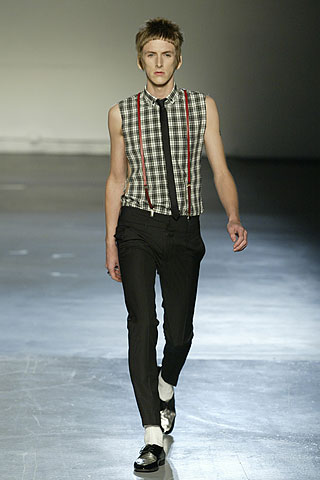
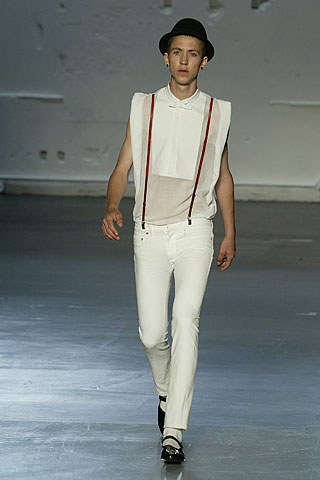
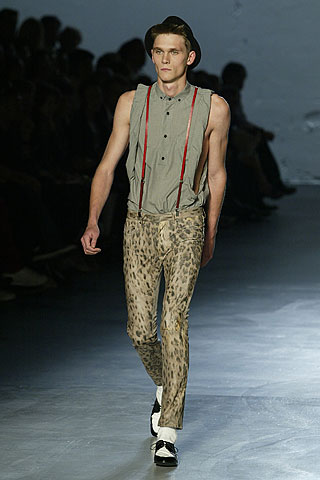
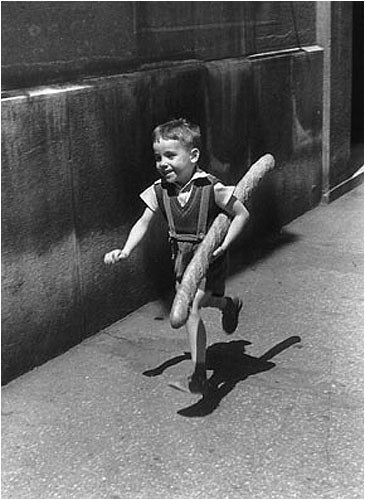
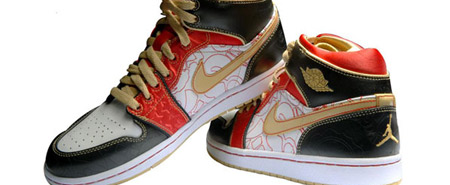
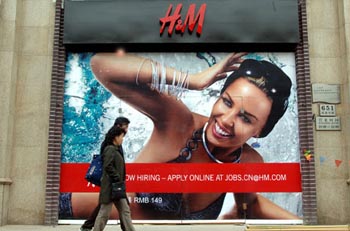
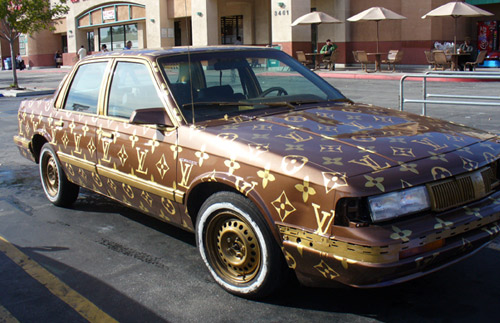
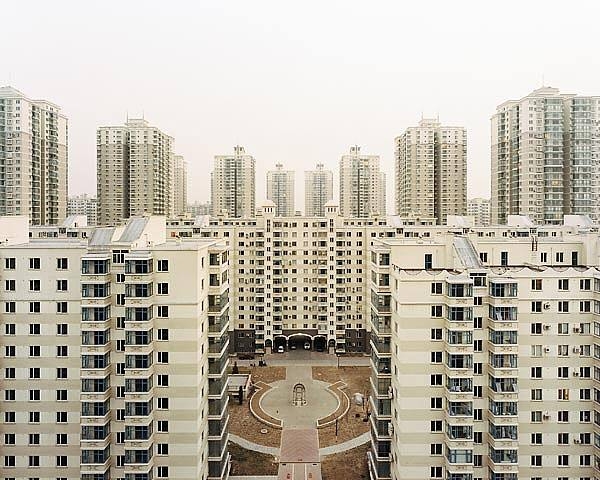
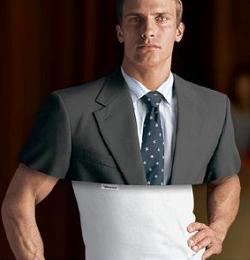
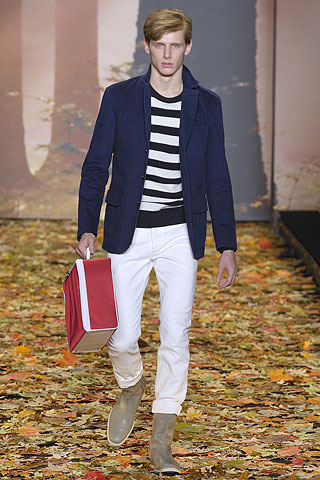
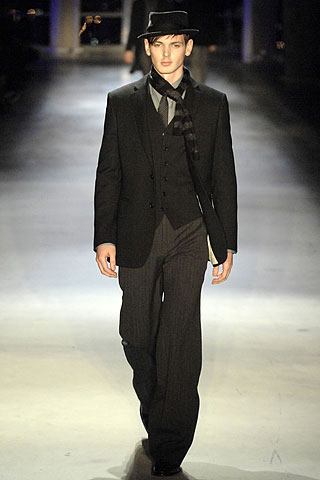
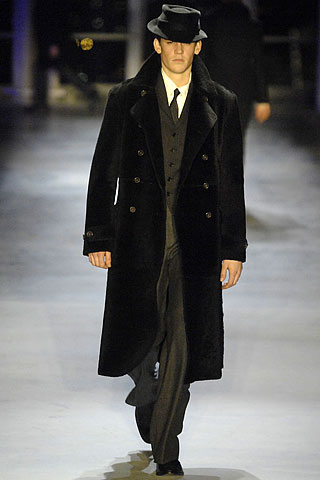
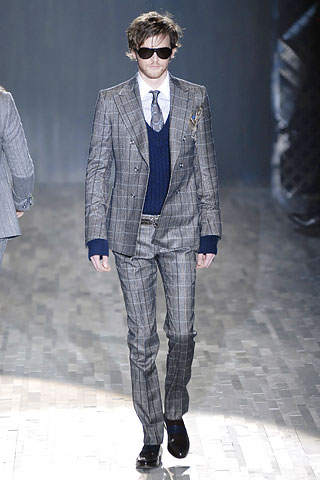
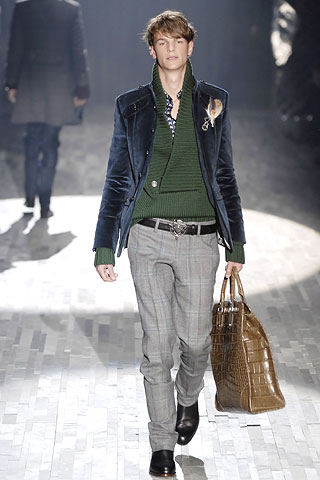
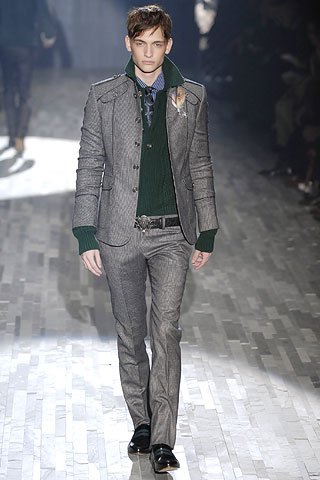
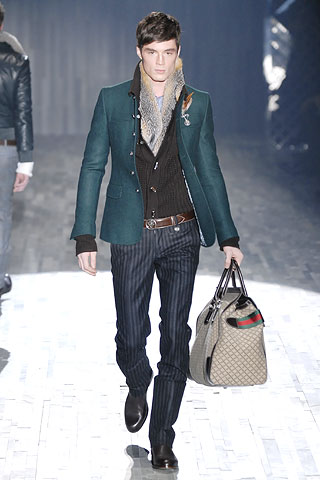
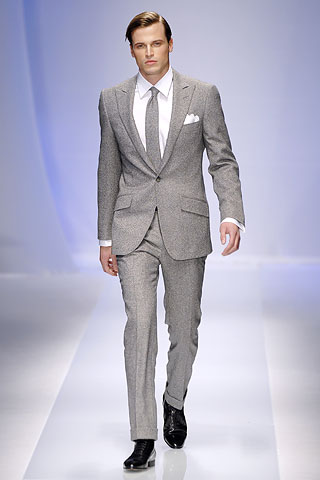
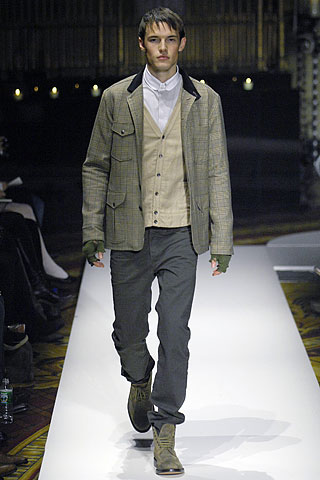
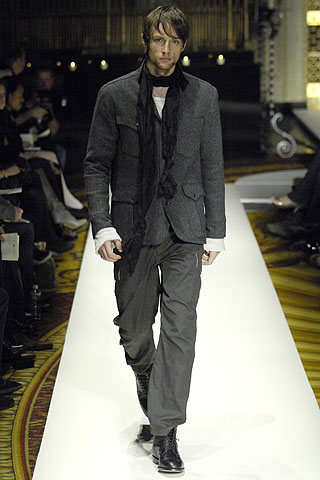

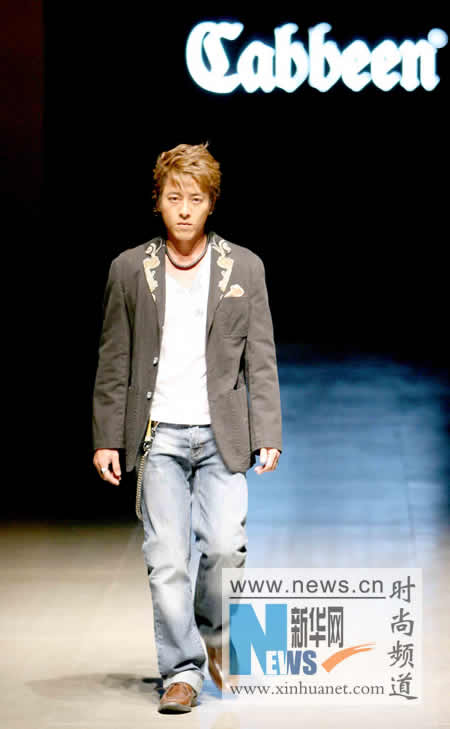
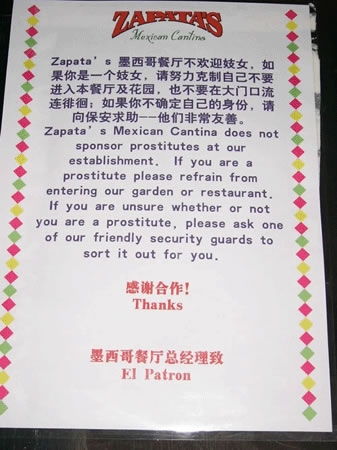


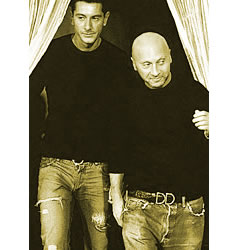



 It don’tunderstand why I am thinking of ways to produce more stuff. All I should really be considering is how to consume and produce less, and ways of convincing others to do the same.


 In addition to the first blue sky in nearly a month, please find above the disgusting fare I call lunch on most days. This meal can run as high as USD 1.80, depending on the size of the bananas. This isn’t cheap. A plate of tasty (but potentially bacteria-laden) Muslim noodles can be under one dollar. My goal is not to save money but to avoid becoming a fat guy in pleated pants when I’m forty. Since I’m too lazy to exercise, the only possible solution is what you see above. It’s easier to not do things than to do them. That’s my theory. It’s easier to not eat than exercise.


 Note the flip-flops and sunglasses.


