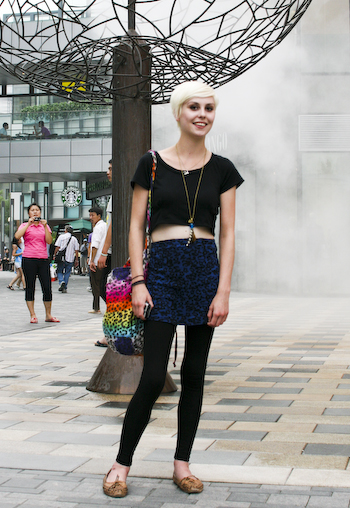
A London Girl on an internship here in Beijing.
A London Girl on an internship here in Beijing.
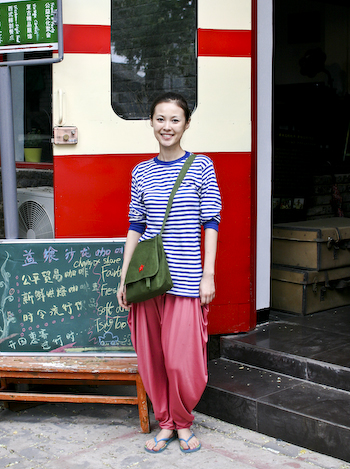
On my second trip to No. 46, I noticed a spacious new coffee shop just to the left of the main gate. Cola is proprieter of just opened Charity Share (益飨), which specializes in fair trade coffee and includes a fashion boutique in its loft.
She says Charity Share is the first bar or coffee shop in China to make promoting the public good its main theme. Her coffee shop is also the first in Beijing to receive a Certification Mark from the Fairtrade Labelling Organizations International. A portion of all profits will go to charities and the high-ceiled, roomy space will host numerous NGO fundraising events, auctions, etc.
Initially, she expects foreigners will be the main clients as they are both more picky about the quality of coffee and familiar with the concept of free trade products. Amusingly, she says the hard seats are another reason why foreigners will be more attracted to Charity Share than Chinese, who prefer softer seating.
Originally from Xinjiang, Cola came to Beijing in 1999 and studied Chinese at Beijing Normal University. In 2006, she received her Master’s in marketing from the Chinese University of Hong Kong. She quit her media job in May to focus all of her energy on the new coffee shop. Her recent interest in being more civic-minded has improved her mindset a great deal. She is now more able to be contented with her situation and less aggressive. Interestingly, one cup of coffee a day is her maximum. Any more and her heart beats too fast.
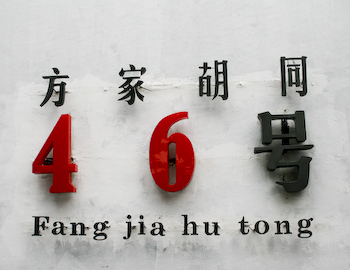
Many comment that Stylites seems focused on just a few areas of Beijing: Nanluoguxiang, Sanlitun, and occasionally Xidan. Beijing really does lack public spaces frequented by stylish people. The city is spread-out and, sadly, car-addicted; those with the leisure or funds usually a minimum requirement for style rarely walk anyway. So we are very happy to announce a new area in which we hope to find more and more fascinating individuals to photograph and profile.
The Hutong Art Zone centered around No. 46 Fangjia Hutong is Dongcheng District’s answer to 798. It houses art galleries, performance centers, fashion boutiques, and cafés. Xinhua gives the details. Massive Chaoyang District has 798, Caochangdi, and a growing number of other highly commercialized art districts. What Chaoyang lacks is the charm of Beijing’s old city. More compact than Chaoyang’s art districts, 46 Fangjia Hutong is set in a leafy, quiet and historic neighborhood right in the middle of the old city. The Dongcheng District government is committed to encouraging creative industries in a bid to compete against the overwhelming dominance enjoyed by Chaoyang District in this field.
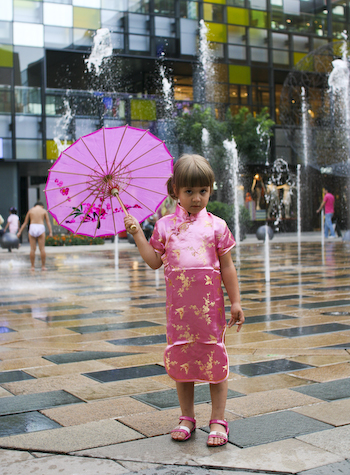
Getting into the local culture is a very cute girl visiting Beijing from Russia. Her parents should get her ballet flats and also iron her qipao.
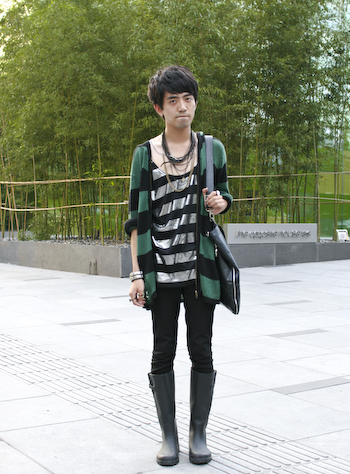
Here, outside our local empire of contrasts Opposite House, with stripes on his stripes, this young man was booted for the rain that had been sporadically falling all day. At this über hip Kengo Kuma-designed boutique hotel, and in its environs, anything might happen – even the complete opposite of what you expected.
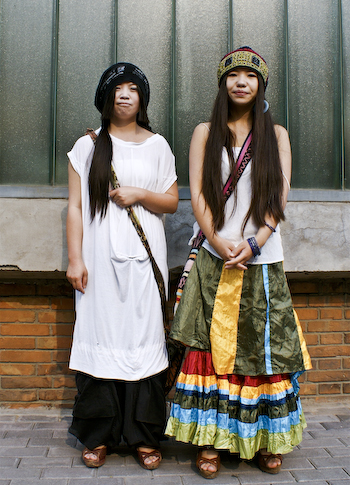
Marching to their own beat, these two stood out from the huge mass of style-mastering hipsters in 798. From a Cantonese speaking region they have been living and working in bj for some time.
Photo: Weina Zhao
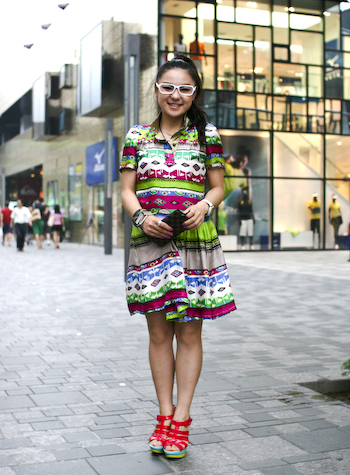
Just having finished university, this young lady from Sichuan is eager to make it big in the center of the empire.
I really should have figured out a way to host this site in China, because access has suddenly gotten tough again. Please accept my apologies for the more sporadic updates.
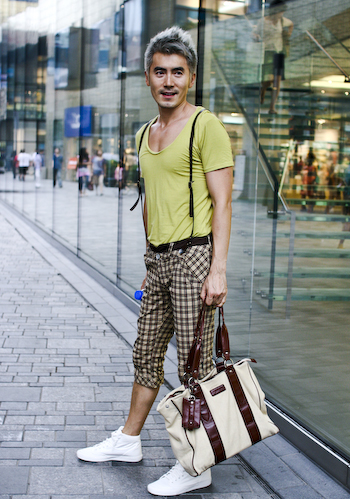
This is rather interesting given that this actor (of the stage, I believe) is actually form Beijing. I don’t know that I have ever glimsed someone as fashionable as with this particular color.
Here is a Guardian article on the growing number of Asian models hitting the mainstream. I’m not so hot on models of any type, but I do believe the world fashion stage will soon filled with tall Chinese girls from the Northeast.
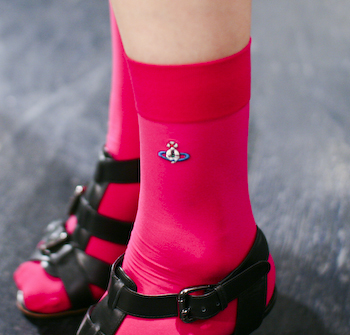
Love this, mainly because they seem like a chic version of the notorious nylon pop socks, favored by so many in this city – though the wearers seem to become older and older as the youth become generally hipper. The hated skin-colored pop socks are also often paired with strappy footwear, typically of the plastic variety.
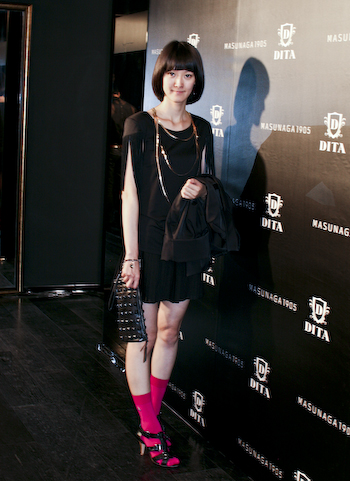
They were sighted on this editor (I am not allowed to mention the names and publications of others in the magazine business) at the opening party for Beijing’s first Dita shop at Huamao. Most of the glasses on sale are made in Japan as part of collaboration between Dita and the venerable brand Masunaga. Read more on Dita at High Snobiety.
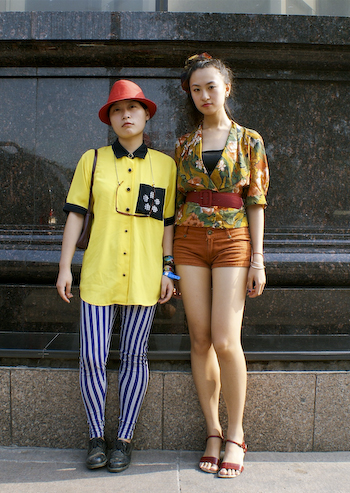
These two graphic/image design students stepped directly from the 80s, but in completely different styles.
Photo: Weina Zhao
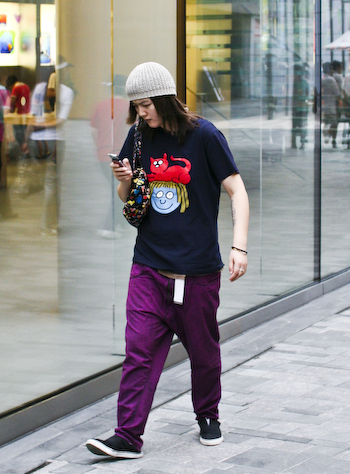
I’ve noticed a tendency among Beijingers to lament the passing of clear difference in appearance between the sexes. The refrain is that “these days everything is so confused”. A couple years ago, the youth did not yet have this predilection toward androgyny. Blame certain popstars. Of course, a few decades ago, there wasn’t much trace of the feminine along the gray, Mao-suited, streets of Beijing.
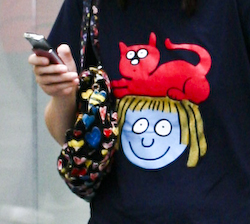
A “cat-head” would likely be a crafty or stealthy person.
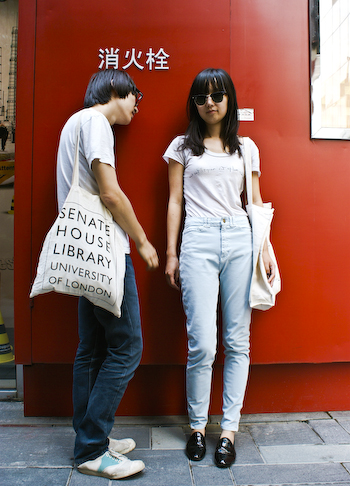
At first glance fairly uneventful though, definitely cool, hipsters, the shoes on both are nice. He didn’t want to show his face, let alone mention his name.
Photo: Weina Zhao
Cities:
1. Beijing
2. Hong Kong
3. Shanghai
4. New York
5. London
Countries:
1. China
2. USA
3. Germany
4. Canada
5. UK