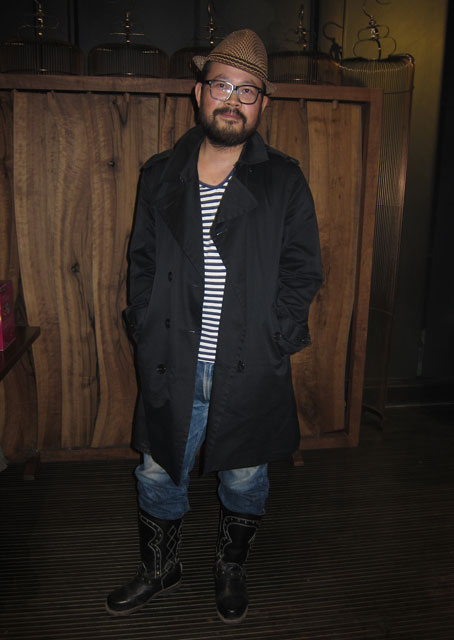
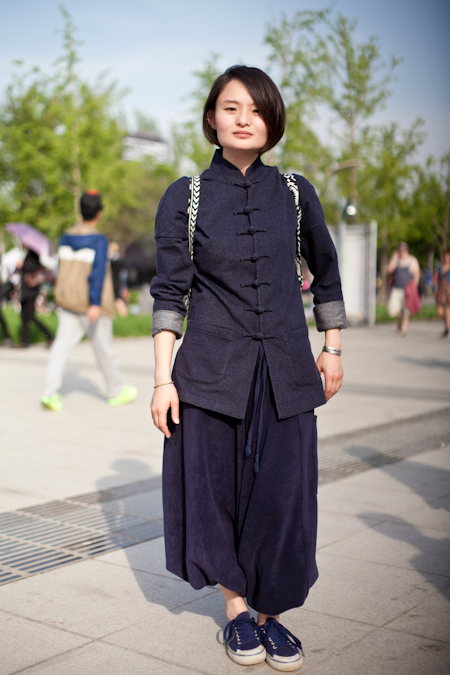
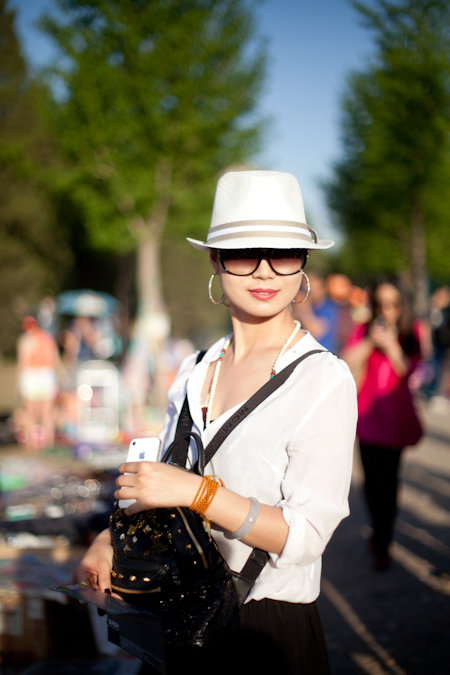
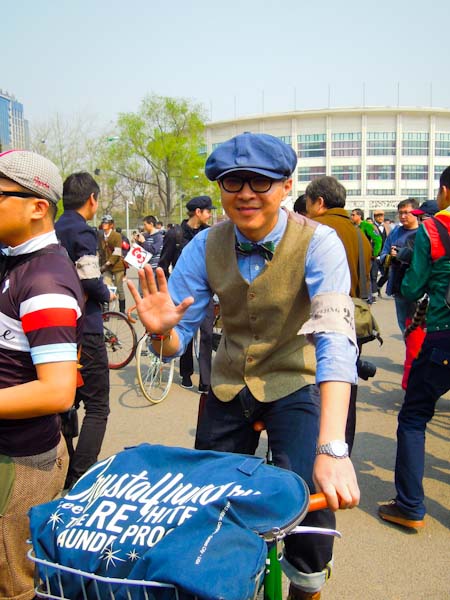
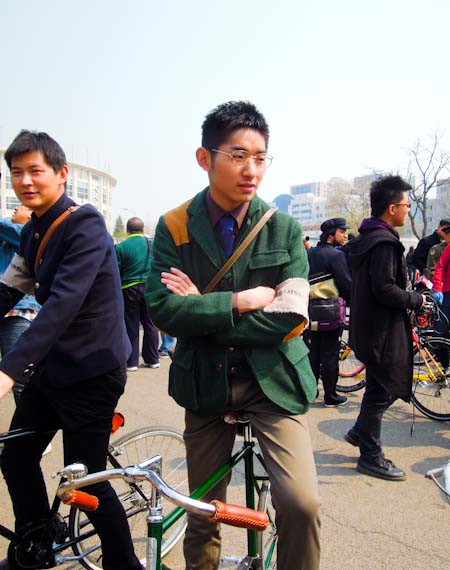
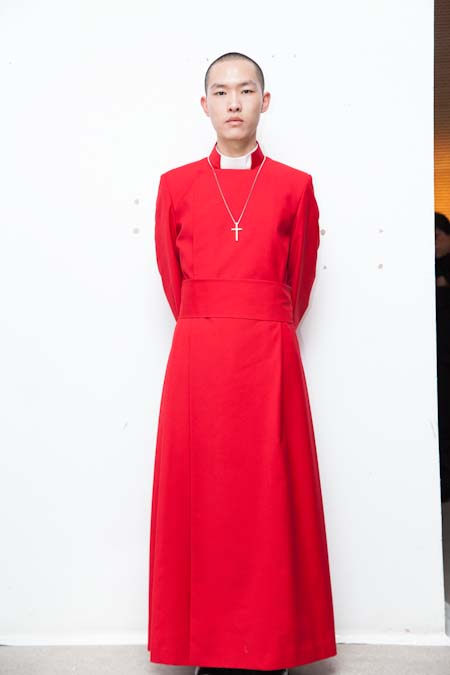
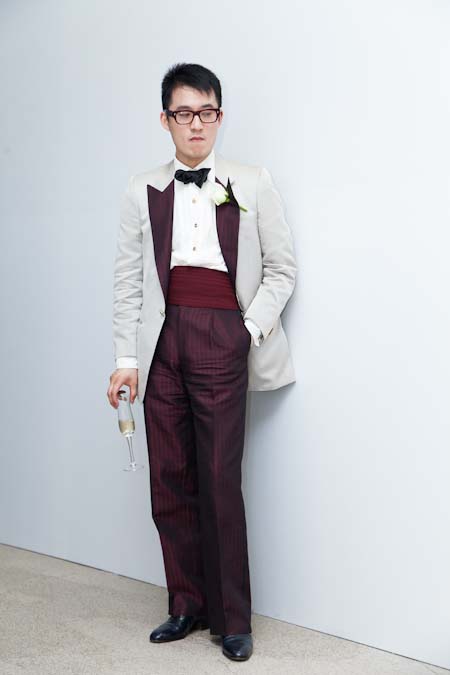
Vince Li is in the Offset Spectacles, a Hong Kong folk rock band. The three members came to Beijing because its rock scene is so far superior to the one in Hong Kong. They have performed in D-22 and other major venues around the city.
Favorite genres of music are Shoegaze and 80s and 90s NYC underground and, of the most well-known Chinese rock bands, he likes PK-14 most.

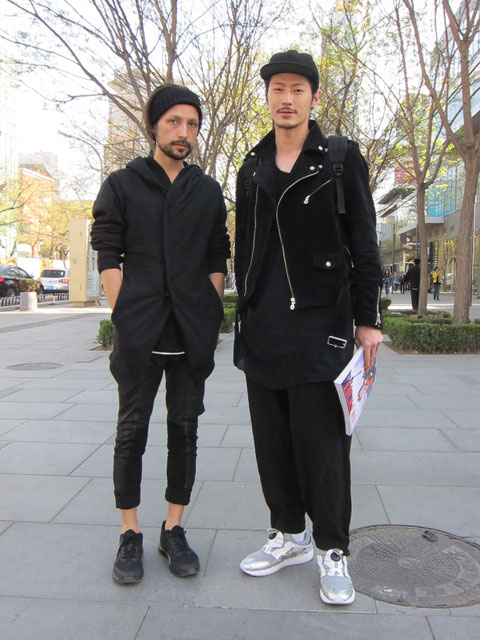
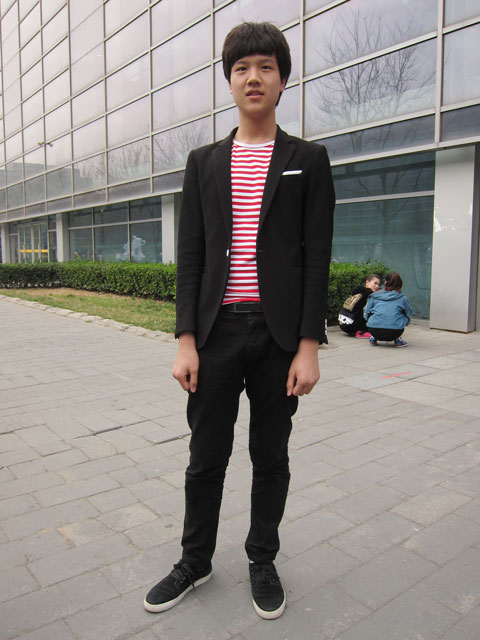
Liu Sha would not provide the name of his girlfriend, but he did mention that their clothes were mostly custom-made by a tailor near Dongsi. It was quite a hot day, but they didn’t seem to be sweating even in all that black.

The Beijing rock scene lures talent from other music hubs. Austin, Texas, guitarist and drummer Taylor arrived in Beijing four months ago to make music. In Texas he was part of Balmoreah, a band that blended classical, western and rock to produce a unique sound evoking the tranquil empty spaces of Western Texas. Taylor describes the region, his original home, as a perfect one for creative work. Distractions are minimal and entering a meditative, focused states is natural.
Beijing may not be terribly tranquil, but Taylor thinks it is also a good place for creatives, and they have been flocking here recently just as they do to Berlin, which he thinks has a similar vibe. He lives in the Nanshiliju area, one filled with bohemians, but also enjoys hanging out in the Nanluoguxiang area where there are several performance bars that he frequents. His favorite local bands are Lonely China Day and the Re-TROS.

Korean youngsters are fond of this type of ladylike style. I approve. In Beijing for six months so far, Korean Choi Ahrang attends international high school. Recently, we have seen more high schoolers: one from Austria and others from Beijing. Beijing boasts a wide selection of shops offering style from Korea, both of this more “youth elegance” type and of the more streetwear variety. Last year, I profiled a young lady who owns a boutique specializing in this type of Korean fashion as well as her employee. Prior to this, there has only been one actual Korean on Stylites.

Except on the weekend, it’s pretty hard to find Chinese high school students outside of those horrible nylon uniforms that look like something that might be favored by Jersey mafiosas. Still, they do find ways to be a bit rebellious, usually with shoes. Until very recently, if a Chinese student dressed and made-up like the Korean one above and had her hair permed, they would probably be told off by the teacher and grounded by their parents. It would be taken as indisputable proof that they were pursuing relations the opposite sex.

From Anhui, Rinko is a writer of pop music who is based here in Beijing. She is a lover of all things Japanese, from style to the language. She spent a half-year in Tokyo studying composition. Rinko is also the girlfriend of Ali Nosrati, founder and owner of the dowdy fourhundred. Next Thursday at Punk Bar in the basement of Opposite House, the dowdy fourhundred leather bags will be on display during a pretentious and decadent party that I am helping host.

Mylène Chen is an economist at Shell China Exploration and Production Co. Ltd. On the side, she sings for a rock band. Only 22, she speaks English and French, perhaps taking her name from France’s answer to Madonna. It’s funny because, in one of their constant comparisons of China with “developed” countries, several Beijingers have remarked to me that youngsters here have far fewer hobbies than their counterparts in the West. They do face far more constraints in the forms of huge loads of schoolwork and pressure from family, but I think that many people I meet in Beijing do a pretty good job in surmounting these.

There’s more to be scared of here than just the red trousers. I know there is an indie band here called Hedgehog, but this young rocker must be part of Porcupine.

I hope that bag is real. Clearly her boyfriend is investing all of his fashion renminbi in her. Aside from the tedious sack, I do rather like her look and it’s a nice shade of red.
Slim red jeans can be a good alternative to the usual blue. Anyway, this was a small fraction of the people wearing red pants on Nanluoguxiang this past weekend. It is a good color to wear. It symbolizes good luck and happiness and is thought to ward off evil.
This piece from Der Spiegel (in German) contains quite a few mentions of Stylites and comments of mine on street style in Beijing. Germany is now the third largest source of Stylites hits, behind China (#1) and the US (#2). The city ranking is now: 1. Beijing, 2. New York, 3. Shanghai, 4. Berlin, 5. London.
The print version is in Der Spiegel from the last week in February.

Yet another little girl wielding a huge camera on Nanluoguxiang…Not long ago, any type of digital camera was a status symbol, but I fear that soon, not taking photos will be elitist thing to do, though of course we have to pass through the lomography phase first. She wears a vintage leather jacket and works in Edelman, a PR firm founded in Chicago and one of the few that is not part of the massive WPP Group. Former PR account executives appearing on Stylites all worked in subsidiaries of that group. We’ve had a young punk from Weber-Shandwick, funky Sabrina (here again) of Ogilvy, a fellow in a long cardigan from tobacco-protecting Hill and Knowlton, cute Michelle from Burson Marsteller and crafty Yuanyuan, also at one time a BM employee.
Last October while walking out of Uniqlo on Broadway I happened to run into Wynn, grandson of BM founder Harold Burson. An aspiring fashion designer in NYC, he was wearing a jacket with shoulders that stretched about a foot beyond his natural ones in both directions. A year and a half earlier, I had the honor of hosting this young man on my couch here in Beijing.
The international firms in Beijing attract fashionable and worldly young people, women mostly. Excellent written and spoken English is a must for communicating effectively with the mostly foreign clients as is an ability to function effectively in the corporate world. A fine-tuned mastery of the corporate jargon is essential. The leveraging and picking of low-hanging fruit never ends in these offices. If you want to learn more about PR in Beijing, I suggest checking out Imagethief.

John Charles is one of the creatives at Thompson Advertising, Inc here in Beijing. This look is really quite punk in a way. I always find it interesting when people can wear a single color and still make it interesting. The Thompson website says that they are “business people, helping business people take care of business…Yes, we are creative, but you couldn’t tell by looking. “ I must say that I can tell from looking at John Charles is creative.
Could one say the same of the characters from Mad Men, my current favorite TV series? Perhaps in their own day, this would be the case, though my sense is that the intention was to make their costumes seem stylishly conservative – even for their own day – rather than edgy. As it turns out, this past weekend, Yan Zhang, a successful and very interesting young entrepreneur here in Beijing, hosted a Mad Men Party. Here are some of the photos. Compare the contemporary Beijing ad man with modern interpretations of 1950s/60s Ad Men.

Investment banker Mark is wearing a Senli and Frye suit. Julie is wearing a vintage 1960s dress and brooch.

Ben is hitting the look pretty accurately. Of course, they rarely wore suits this dark in the show, but medium grays are surprisingly rare these days.

Warren is manager of Punk, the club at Opposite House, currently Beijing’s hippest boutique hotel. Bill is working at the American Embassy and wearing a lovely suit from Saville Row that is in a shade quite like what one would have seen in Mad Men. I love the green knit tie.

Yan Zhang is the man who made it all happen. Nice tie, great apartment.

Nicholas had not seen the series, but he captured the spirit very well. The hair and glasses are perfect. The vintage suit made it seem a bit like a cross between Sterling and Pete Campbell while hunting in the English countryside.

Several of my posts and articles rail against the shapeless puffy coats that too many women resort to during Beijing’s winters, which are really neither cold nor long these years. Though they may not provide as much warmth, my preference is always for wool coats. This is not to say that a puffy coat cannot look good, as this young lady proves.

You may not believe it after seeing this chic fellow, but various schools of thought assert that no two of these colors work together. This fellow is looking quite good with all three. Some believe black trousers cannot be worn with brown shoes and others say black can never be combined with navy except for navy trousers with black shoes. The contrast between these neutral colors is seen as too minimal. This finance student, back in Beijing from attending university in Australia, makes it work very well though. Perhaps those rules only apply to more formal attire. The navy trench coat is real Burberry and the suede monkstraps are apparently made in Italy. Most of his items are purchased abroad, where the price of quality is lower.

People everywhere tend to dress in ways similar to their peers. In downtown Chicago, suburban soccer moms having a night out all wear high-waist baggy jeans and manly black leather jackets. Williamsburg hipsters
all wear tight but low-riding jeans and Converses (their counterparts in Beijing wear that too). In first-tier cities, white collar girls all have brand name handbags and an air of sophistication. Chengdu girls on internships
in Beijing go for colorful puffer vests, blues and greens, and plastic bows. All the bright colors and they still look quite harmonious.


People who like to pose are lovely. They are like interviewees who enjoy telling their own story. The dress may not be a perfect fit or material, but the slouchiness and that of the hat give this young student a perfect vibe for summer. As you’ve probably noticed, the truth is that I haven’t been in Beijing since it was basically still that season. This is all going to change in a week.

Converses – international symbol of free-thinking and youth – have always been best when red, at least in Beijing. I have read articles that praise a range of rockstars being the first to don the red Converses. This summer there were even more. It must have been the patriotic fervor surrounding the Olympics. Skinny jeans also became black, and girls studying finance adopted the Brit-rocker style of many of the young blokes, complete with the narrow, red, white and blue braces.
This type of braces have been around for a while, but I have been noticing this red, white, and blue stripe theme showing up everywhere. It is a signature detail for Thom Browne’s suits and coats, as in the following:

Pretty neat. Thom Browne’s quirky designs reference American classics and sports popular in Fairfield County. This leads one to believe that this highlight on the coat is not-quite-concealed patriotism. Still, the order of the colors is the same as the tricolour, of France. Chinese youngsters are most partial to referencing England, its rock and punk culture and its flag, in their attire. Let us try hard to interpret of these colors together as a sign of support for all three Western members of the security council. It is no surprise that US, France, and England have a strong grip on young people’s worldview.

This perfect pair would fit in on any trendy street in Asia. They capture the current fascination with hats on boys. This kind of hat actually looks better on Asia guys, so I think this style will remain. These two photographers have a certain louche aura, but the one on the right is a practicing Muslim from the Hui community. This is not to accuse Muslims of not being louche enough; Hui are simply less common than others. There are a mere 10 million of them, one-tenth the number of Chinese with the surname Li.
Calling this trend “tedious” is far too glib, considering the long history of the skull in art, jewelery and fashion. As this fun Esquire piece contends, the current omnipresence of skulls matches our global society’s unabashed embrace of wealth and materialism with its ephemeralness. The skull is probably even more fitting for this moment in China’s history and quite an appropriate symbol to mention on a website that celebrates a new blossoming of individualism and vanity. The skull has, often, represented the meaninglessness of these eternal human pursuits. There is not enough time to consider whether the skull might have any relation to this day, on which the Chinese people celebrate standing up for fifty-nine years, ever since the Great Helmsman declared the birth of the People’s Republic. I did want to wish everyone a happy October first.
Anyway, here are just a few pics, of hundreds I could have chosen, to show that skulls in all forms are just as common in China.

This one is a little bit pirate-like. This was right next to the bird’s nest.

Here we have a creative skull that seems to have an almost Central American influence. The wearer works in the new Mac store.

Here is a skull on the leg of a skater.

And a skull with paper clips.

This one looks as if illnesses have haunted it well into the grave.
This post reveals my ignorance more than anything else. More research clearly needs to be done on the subject of skulls in Chinese culture. When young people in China wear shirts with skulls is it rebellious (like it was previously in the West) or is more fashionable (like it is now)? Clearly it has to be associated with death. Some might respond that they are just wearing shirts that they find amusing, but it cannot be that simple. There have been decorative skulls made from jade dug up at sites in China, suggesting ritual importance for the symbol.

The Beijingers appearing on Stylites usually hail from the self-described “creative elite” or the white collar world of foreign multinationals, but it was clear from Daphne’s rough accent and manner that she claims neither of these two backgrounds. Unlike most girls from the provinces or others without foreign exposure, she has some natural grace. Maybe she also knows that adding a tincture of raspiness to a sweet appearance can have a special appeal. All items are from the zoo market. The flats are a kind of plastic webbing material perfect for rainy days – they seem a good alternative to crocs, though I guess rain isn’t the only justifications for crocs.
From Anqing, she has been in Beijing for two years, working in events organizing. Anhui is quite the trendy place these days since it is offers a great location, in the Yangzi River Delta, but without the high costs of Shanghai, Jiangsu, or Zhejiang. Suddenly, it seems like everyone is from Anhui – whether it is young tailors, cleaning ladies, owners of refrigerator factories or Hu Jintao. According to some, Anhuiers are still willing to work up from the bottom rung, whereas young people from more affluent provinces have a new sense of entitlement and expect to start out as managers or owners. All this is to say that Daphne can definitely make it in Beijing. And let’s face it, all Anhui girls like this can probably make it anywhere.

Beijinger Li Yuan could be from many nations. A professional model who has appeared in a host of trendy fashion magazines like Milk, 1626, Kaila and 0086, she describes her main appeal as her gender neutral looks – friends call her as “handsome” – but she can’t stand men who dress androgynously. When not modeling she likes to wear relaxed clothing and doesn’t particularly care about brands. She wears athletic style underwear.

From Hokkaido, Hitomi Oyama has been staying in China for over five years and has worked for radio, as a translator, and as a freelance journalist, writing for both Chinese and Japanese publications. Her main focuses are art and culture and a major hobby is handicrafts. She makes clothes and the white bag in the picture. I’m quite a fan of this look – she is so unmistakably Japanese and still so eclectic.
« Older Entries